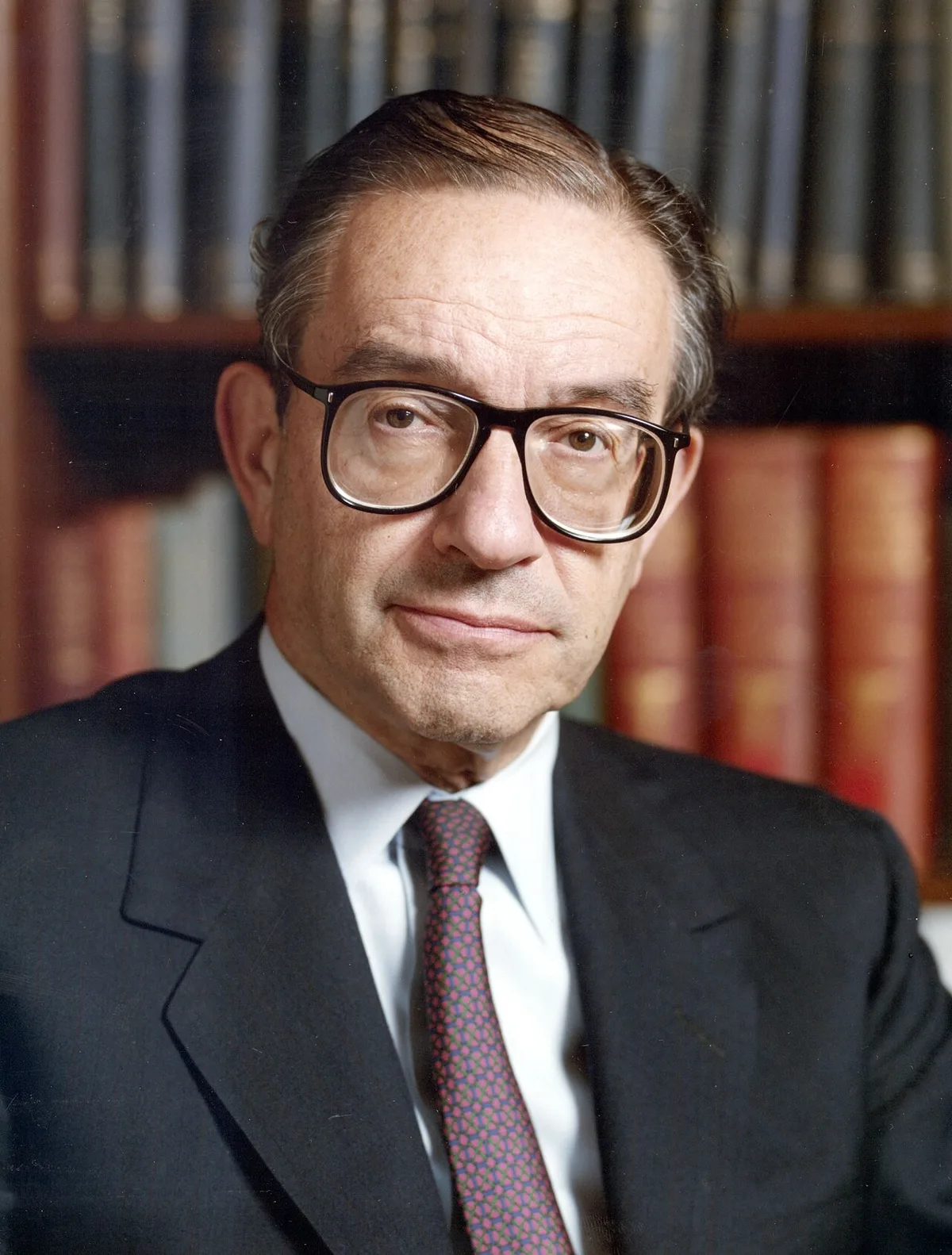
Alan Greenspan, the Federal Reserve chairman who ran the US economy like a god operating in secret for nearly two decades, died Sunday at age 100 from complications of Parkinson's Disease. His wife, NBC News correspondent Andrea Mitchell, announced his death in a statement calling him 'a giant of a man who helped shape the US economy for decades.' He was also, depending on who you ask, the man who handed subprime lenders a firehose of cheap credit and then acted surprised when the house burned down.
The Oracle in the Dark Suit
According to BBC News, Greenspan served as chairman of the Federal Reserve from 1987 to 2006, a post described as the second most important job in America after the presidency. He presided over the longest sustained period of US economic growth in a generation. The media and the money markets hung on his every word, and a sign in his office read simply: 'the buck starts here.'
He declined all interviews during his tenure, which is frankly a power move so absolute that most sitting presidents could learn something from it. You don't have to answer for anything if you never say anything. A quality Greenspan took seriously until, of course, he eventually had quite a lot to answer for.
From Juilliard to JP Morgan, With a Stop at Ayn Rand's House
Before he was the 'God in the machine' of American finance, Greenspan was a clarinet player. BBC News reports he studied at New York's Juilliard School of Music and played in a band with jazz legend Stan Getz before touring the country with the Henry Jerome Band. He spent his nights on the road doing the band's accounts while his bandmates smoked weed. A man who chose spreadsheets over saxophone solos tells you something about who Alan Greenspan was.
In 1952, he met Ayn Rand. This is the part of the biography where things get complicated. Rand, the novelist who built an entire philosophy around the idea that selfishness is actually a virtue and that helping other people is for suckers, called Greenspan 'the undertaker' because of his dark suits. He embraced her worldview. He wrote in 1966 that the welfare state was 'nothing more than a mechanism by which governments confiscate the wealth of the productive members of a society.' This is the intellectual DNA of the man who would go on to control American monetary policy for nineteen years.
He also advised Richard Nixon during the 1968 presidential campaign, later describing Nixon as 'sadly paranoid, misanthropic and cynical.' Which, sure, but also: you still worked for him. Every subsequent president from Ford through George W. Bush kept Greenspan in orbit, because he was genuinely brilliant and because no one wanted to be the guy who fired the Oracle.
The Golden Era and the Loaded Gun
When the stock market crashed in October 1987, losing over 30% of its value within weeks of Greenspan taking the Fed chair, he responded by flooding the system with cheap credit and issuing a calm public statement of confidence in the underlying economy. It worked. The markets steadied. A playbook was born.
He used the same approach repeatedly, according to BBC News, through the savings and loan crisis, the first Gulf War, the Mexican peso crisis, and the aftermath of the 1997 Asian financial crash. He became synonymous with a particular brand of crisis management: when in doubt, cut rates and let cheap money solve the problem. Bill Clinton, a Democrat, kept this arch-monetarist in place and was rewarded with a golden stretch of growth in the late 1990s. Greenspan later praised Clinton's 'consistent, disciplined focus on long-term economic growth' while taking quiet shots at Republican administrations that lost control of spending. He contained multitudes.
The Bubble He Watched Grow
Here is where the legacy gets messy. Critics have long argued, and not without evidence, that Greenspan's easy credit culture inflated the dot-com bubble of the late 1990s and laid the groundwork for the subprime mortgage catastrophe of 2008. Nobel laureate Paul Krugman put it plainly, as reported by BBC News: 'He didn't raise interest rates to curb the market's enthusiasm. He waited until the bubble burst, then tried to clean up the mess afterwards.'
Greenspan himself famously admitted in congressional testimony after the 2008 crash that there was a 'flaw' in his ideology. That ideology being, roughly, that unregulated markets would self-correct and that financial institutions acting in their own self-interest would never blow up the global economy out of sheer greed and recklessness. The man who spent the 1950s doing jazz band accounting while his friends got high had spent decades doing something arguably more dangerous: trusting Wall Street to behave itself.
What a Hundred Years Buys You
Alan Greenspan was born in New York City on March 6, 1926. His mother, who worked in a furniture store, raised him alone. He enrolled at NYU at 19, joined JP Morgan's board, advised four presidents, and married NBC News reporter Andrea Mitchell in 1997, after an early brief marriage and a long-running relationship with Barbara Walters that history has already processed as a fun fact and moved on from.
He reached 100 years old. He outlived the dot-com companies, outlived the banks that collapsed in 2008, outlived the reputations of most of the people who praised him without reservation. His wife's statement called him 'always honest in acknowledging his mistakes,' which is more than most people who help break things get credit for. He did, eventually, say he was wrong. Whether that was enough is a question reasonable people still disagree about over very expensive cocktails in Lower Manhattan.
The Dingo Take
Look, here is the honest version of this obituary: Alan Greenspan was genuinely brilliant, almost certainly one of the most consequential economic minds of the twentieth century, and by many measures an effective steward of American prosperity during an extraordinary run of growth. He also spent decades operating from a philosophical framework cooked up by a woman who thought charity was a character flaw, and that framework helped him rationalize keeping his foot off the brake while the financial system turned into a casino.
The 2008 crash did not have a single cause, and it would be too simple to pin it all on Greenspan. But the culture of cheap credit, the deference to Wall Street's judgment, the fundamental belief that markets are self-correcting and therefore require minimal oversight? That was him. That was his religion. And tens of millions of ordinary Americans who lost their homes, their savings, and their jobs in 2008 were not abstract data points in someone's monetary theory. They were people.
He lived to one hundred. He had time to reflect. He said he found a flaw in his worldview. Good. That matters. But we should be clear-eyed about what the 'God in the machine' of American finance actually built, alongside everything he managed well. Legacies this complicated deserve more than a headline that just says 'giant of a man.' They deserve the full accounting. This is what that looks like.


Comments