
Keir Starmer is out as British Prime Minister, JD Vance is sitting across a table from senior Iranian officials in Switzerland, and the United States Congress has just returned from recess with a fistful of questions about a ceasefire deal that nobody fully understands yet. It's a Monday. Of course it is.
Starmer Is Gone. That Was Fast.
Keir Starmer has resigned as Prime Minister of the United Kingdom, according to NPR's Morning Edition. The man who swept into Downing Street on a wave of exhaustion with the Tories has now become the latest casualty of a political moment that seems to be eating leaders whole, left and right, on both sides of the Atlantic.
Starmer came in promising to be the boring, competent antidote to years of Conservative chaos. Turns out 'boring and competent' is harder to sell than it sounds when your economy is still a mess, your party is fractious, and the global order has been flipped upside down by forces largely outside your control. His departure leaves British politics in yet another period of uncertainty it absolutely did not need.
The timing is brutal. Britain is not in a great position to be leaderless right now, with trade relationships still unsettled, a hot war on the European continent that hasn't gone anywhere, and a United States government that has spent the last year and a half making 'reliable ally' feel like a punchline. Good luck to whoever picks up the wreckage.
Vance in Switzerland, Trying to Do Diplomacy
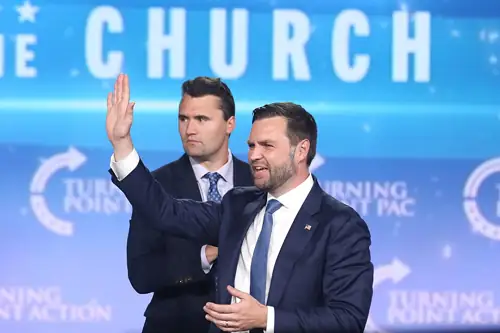
Vice President JD Vance has met with senior Iranian officials in Switzerland for what NPR is describing as high-stakes nuclear talks. Let that sentence sit with you for a second. JD Vance. Nuclear talks. Iran. Switzerland, at least, tracks.
This follows what the Trump administration has been calling a ceasefire arrangement with Iran, the details of which remain genuinely murky to most outside observers and, apparently, to several people inside the United States government as well. The fact that Vance himself is heading this up tells you something about how seriously the administration wants to be seen taking this, whether or not the substance backs that up.
Switzerland has historically served as the neutral ground for exactly this kind of delicate back-channel diplomacy, so the venue is not surprising. What is worth watching is whether the 'high-stakes' framing reflects actual progress or is doing the heavy lifting for a negotiation that is much more fragile than anyone wants to admit publicly.
Congress Comes Back, Full of Questions Nobody Wants to Answer
Congress has returned from recess, NPR reports, and members are coming back with pointed questions about Trump's Iran ceasefire and exactly what the United States has agreed to, with whom, and under what terms. This is, to be clear, a completely reasonable set of questions that should have been answered before any deal was announced.
The legislative branch has a constitutional role in war and foreign policy that the executive branch has spent decades cheerfully ignoring, and the Trump administration has shown no particular interest in reversing that trend. When the president announces a ceasefire with a country the United States has been in various states of conflict with for over four decades, it seems like the bare minimum to loop in the people's elected representatives at some point.
Whether Congress actually gets answers, or whether they get a two-hour briefing that raises more questions than it resolves before everyone goes home and posts about it, remains to be seen. The pattern here is not encouraging.
Three Crises, One Morning, Zero Margin for Error
What makes this particular Monday remarkable is the convergence. A major Western democratic ally just lost its head of government. Active nuclear diplomacy is happening at the vice presidential level with one of the most geopolitically complicated countries on earth. And the domestic political machinery in Washington is grinding back to life after recess, cranky and suspicious.
Any one of these stories on its own would be a full news day. All three landing at once is the kind of thing that tests whether governments actually have the bandwidth and competence to walk and chew gum, or whether something important gets dropped because everyone is looking somewhere else. The Trump administration's track record on sustained, multi-front diplomatic attention is, to put it charitably, mixed.
Britain will eventually settle on a new leader. The Iran talks will either produce something real or they will collapse messily. Congress will ask its questions and either get answers or be ignored. The question is whether all three of these things resolve in the direction of stability or in the direction of the other thing.
The Dingo Take
Here is what is actually happening underneath all of this. The post-World War Two framework of Western alliances, stable democratic governments, and carefully managed multilateral diplomacy is under sustained pressure from multiple directions at once, and we are watching it strain in real time. Starmer's resignation is one data point. Vance doing nuclear talks is another. A Congress that has to fight for basic information about a ceasefire is a third.
None of this means catastrophe is inevitable. Diplomacy has worked in ugly circumstances before. New leaders have stabilized shaky situations before. But the margin for error when everything is happening simultaneously, when institutions are weakened, and when the most powerful country on earth is run by an administration that treats expertise as a liability is not comfortable. Not even a little.
So watch the Iran talks closely. Watch who replaces Starmer and how fast Britain can get its footing. Watch whether Congress gets actual answers or a runaround. And try, if you can, to follow more than one story at a time. That appears to be more than the people in charge are managing.




Comments