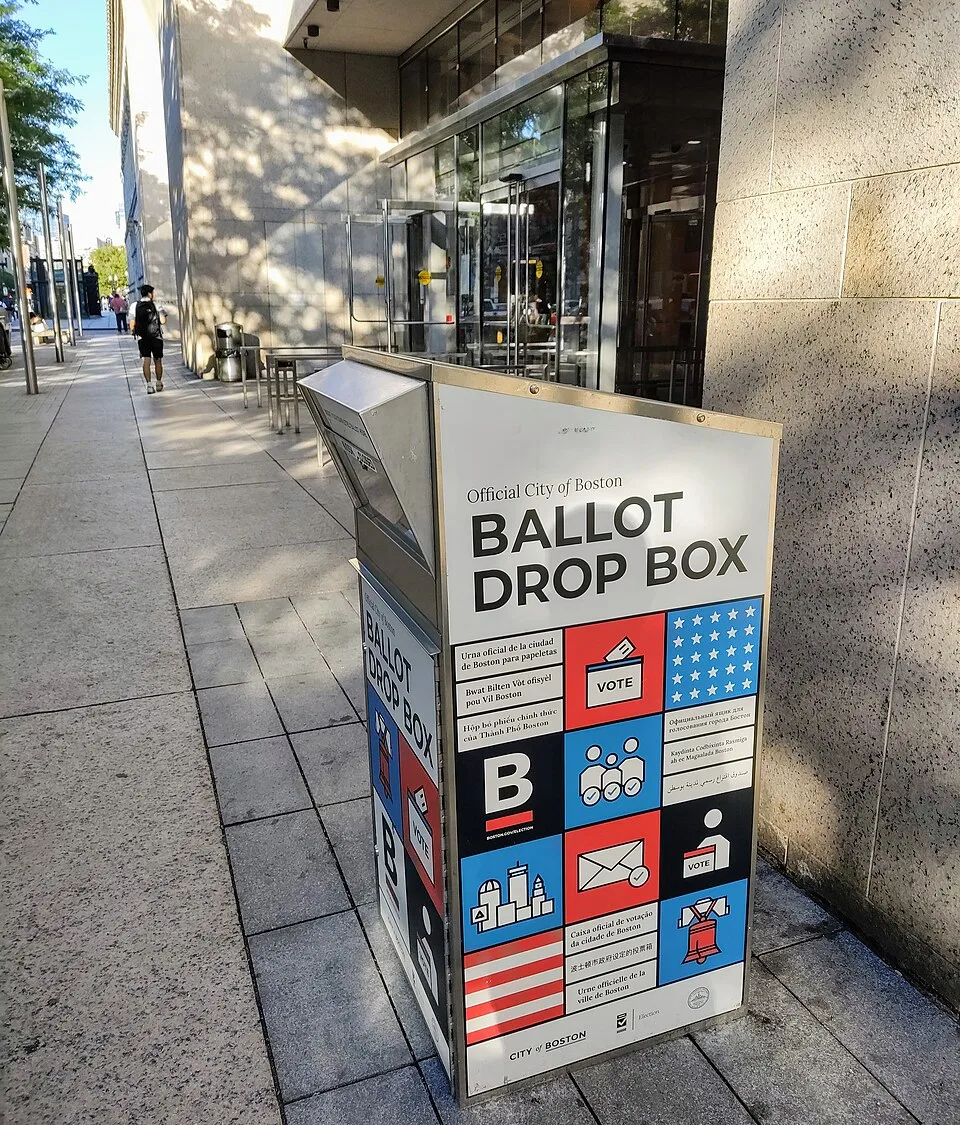
A federal judge in Boston just threw a wrench into one of Trump's more constitutionally adventurous projects: using an executive order to rewrite who gets to vote by mail in America. U.S. District Judge Indira Talwani blocked parts of the order on Thursday, and the administration is almost certainly going to appeal, because of course they are. The underlying fight here is about something pretty simple: the Constitution says presidents don't get to set the rules for federal elections, and Trump is testing whether anyone is going to stop him.
What the Order Actually Does
Trump signed the executive order back in March, waving it around in the Oval Office with Commerce Secretary Howard Lutnick standing by like a very expensive prop. The order does several things, none of which are particularly subtle about what they're going for.
According to NPR, the order instructs the Department of Homeland Security and the U.S. Postal Service to build lists of adult U.S. citizens or eligible voters in each state. Then, it tells USPS to only deliver mail-in ballots to people who appear on those lists. If your state doesn't play ball and hand over its absentee voter data to the federal government, the Postal Service simply won't deliver your ballots. That's the plan.
The problem, as every constitutional law professor and their graduate students will happily tell you, is that the Constitution gives state legislatures and Congress the power to set federal election rules. Not the executive branch. Not the president. This is not a gray area. Trump is asking the courts to let him do something the founding document pretty clearly says he can't do.
The Postmaster General's Role in All This
Here's where it gets even more interesting. The U.S. Postal Service is technically independent of the president's administration. Has been for decades. That independence is supposed to mean a president can't just call up the Postmaster General and tell him to start screening who gets their ballots delivered.
And yet. NPR reports that Postmaster General David Steiner told lawmakers on Wednesday that USPS has proposed using state election data to build the voter lists the order requires. More than that, Steiner confirmed that under this proposal, the Postal Service would refuse to deliver mail ballots in any state that won't hand over its absentee voter rolls to the federal government. So USPS is not exactly fighting this one. They're drafting the implementation playbook.
Let that sink in. The independent agency responsible for delivering your mail is now threatening to hold your ballot hostage unless your state surrenders its voter data to the Trump administration. The Postal Service. The people who bring you Amazon packages and birthday cards from your grandmother.
Two Courts, Two Fights
This is not just one lawsuit. There are parallel legal battles happening simultaneously in Boston and Washington, D.C., and they are moving at different speeds with different results.
The Boston ruling Thursday blocked parts of the order outright. Judge Talwani, an Obama appointee, found enough legal problems with specific directives to put a stop to them, at least for now. The Trump administration is expected to appeal that ruling.
Down in the D.C.-based cases, NPR reports that a different judge found in late May that it was too early to issue an emergency block because the administration hadn't actually carried out the directives yet. Democrats appealed that ruling to the U.S. Court of Appeals for the D.C. Circuit. So you've got one court saying stop, another saying not yet, and two sets of appeals heading upward. This thing is going to be in litigation for a while.
The Midterms Are Coming
One thing worth keeping track of here: NPR notes that so far, the order has not directly affected mail-in voting for this year's midterm primary elections. That's the good news, if you want to call it that.
The less good news is that the midterms themselves are coming, and the legal fight is very much not resolved. The Trump administration is appealing, multiple cases are working their way through multiple courts, and the policy machinery around voter list-sharing is already being built. The fact that primaries haven't been disrupted yet doesn't mean general election ballots are safe.
Mail-in voting is not some exotic loophole. Tens of millions of Americans vote by mail. Elderly voters, disabled voters, rural voters, military families stationed overseas. The executive order, if it ultimately survives the courts, doesn't just inconvenience a handful of people. It potentially cuts off ballot delivery for anyone whose state refuses to comply with the data-sharing demand.
The Dingo Take
Let's be direct about what this executive order is. It is not a good-faith effort to secure elections. It is an attempt by a president who lost the popular vote twice to make voting harder for the kinds of people who tend not to vote for him. Mail-in voting surged during the pandemic and has stayed elevated because it's convenient and accessible. Those are not bugs in the system. Those are features. The people who want to eliminate them know exactly what they're doing.
The constitutional argument against this order is not complicated. The Founders were extremely specific about who gets to run federal elections. They wrote it down. They gave that power to state legislatures and Congress, not to whoever happens to be sitting in the Oval Office in any given year. Trump's team knows this. They're not making a legal argument in good faith; they're running out the clock, tangling things up in courts, and hoping to create enough uncertainty that states panic and comply before anyone can stop them.
A Boston judge said no. Good. But one ruling in one city is not a solution to an administration that treats the Constitution like a suggestion box. Watch the appeals. Watch what USPS does with those voter lists. Watch what happens to states that refuse to comply. The ballots haven't been held hostage yet. The infrastructure to hold them hostage is being built right now.




Comments