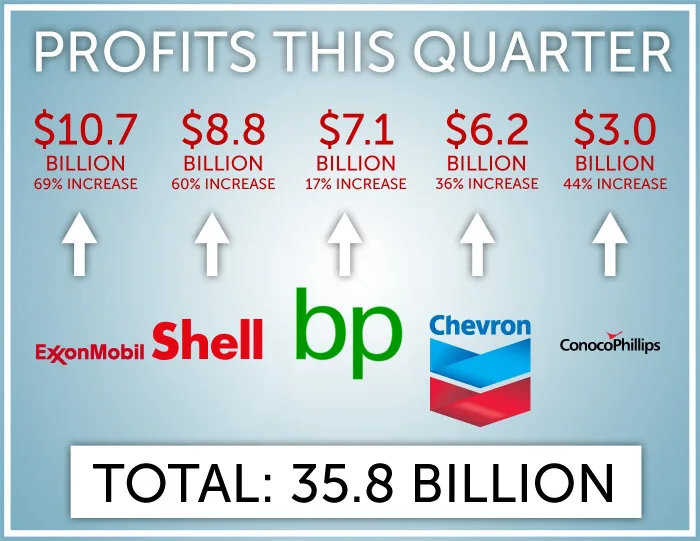
Donald Trump looked at the oil companies that have made billions off a war his administration is running, a war that has cost American families $78 billion extra at the pump, and said they had made "too much money." He said this. Out loud. The man who personally invests in major oil companies, who has spent eighteen months tearing up every regulation standing between fossil fuel producers and maximum profit, would like you to know he thinks this has gotten a little out of hand.
The Numbers Are Not Subtle
Since the start of the Iran war, American families have paid more than $78 billion more at the pump, according to a Brown University tracker. That is not rounding error. That is not an economic ripple. That is a deliberate wealth transfer from working people to an industry that was already doing fine.
An analysis from Climate Power and the Center for American Progress Action Fund put the personal cost at $285 more per family just for filling up the car. Per family. While oil company profits soared. While Trump signed executive order after executive order making sure those companies faced as little friction as possible on their way to the bank.
And now Trump, having constructed this entire apparatus, is performing surprise. He is standing in front of the machine he built and shaking his head at what it's producing. The audacity would be impressive if it weren't so exhausting.
What Trump Actually Did for the Oil Industry
Let's be precise about this, because precision matters when someone is trying to gaslight you at scale. Since returning to the White House, Trump has eased dozens of restrictions and regulations on fossil fuel expansion. He has exempted fossil fuel producers from environmental rules. He signed an executive order directing the attorney general to prioritize blocking climate lawsuits targeting oil majors, according to the Guardian.
He also, and this is the part that in a functioning democracy would be a front-page scandal every single day, personally invested in major oil companies. The president of the United States has a direct financial stake in the industry he is actively deregulating while overseeing a war that is spiking that industry's profits. What exactly is the word for that? Because "conflict of interest" seems too gentle. It sounds like something that happens at a city zoning board.
This is the policy record. This is what "drill baby drill" looks like when it hits contact with a regional military conflict. The families paying $285 more at the pump are not an unfortunate side effect. They are the mechanism.
Some Lawmakers Are Trying to Do Something About It
Rhode Island Senator Sheldon Whitehouse and California Congressman Ro Khanna have proposed a windfall profits tax on big oil, with proceeds going directly to American families absorbing the fuel cost increases. It is a straightforward idea. You made extraordinary profits from an extraordinary crisis you did not create. You give some of it back to the people the crisis hurt. This is not radical economics. Several countries did exactly this during the 2022 energy crisis.
Environmentalists and climate advocates are furious, and not just at the profits. They are furious at the framing that lets Trump play concerned observer of a situation he architected. As the Guardian reports, activists have been clear: his policies were designed to benefit these corporations. The windfall was not an accident. It was the plan.
Meanwhile, the Rest of the Week Also Happened
If you were hoping the oil story was the ceiling on this particular news cycle, the week had thoughts. Trump signed two new executive orders Thursday trying again to restrict birthright citizenship, just weeks after the Supreme Court told him his first attempt violated the 14th Amendment. Chief Justice John Roberts was pretty direct about it in June, writing that the 14th Amendment extended citizenship to "every free-born person in this land." Trump's response to a Supreme Court ruling that he was violating the Constitution was to go back and try again with slightly different paperwork.
Separately, law enforcement officials provided false information to federal judges while building a criminal case against independent journalist Georgia Fort, who was charged in connection with a protest at a Minnesota church where an ICE official serves as pastor, according to court filings her lawyers submitted Thursday. Nearly 40 people were charged after demonstrators disrupted the service. The Trump administration had vowed to arrest everyone involved. What they apparently also did, per those court filings, was lie to judges to make the charges stick.
And ICE is now tracking nearly 54,000 immigrants through GPS ankle monitors, up from 17,000 early last year, according to figures from the Geo Group, a private prison corporation. To hit a goal of 2,000 daily arrests, ICE has started detaining people at airport ticket counters and near gates, disrupting domestic travel in ways authorities had historically avoided. The machine is running fast and it is not particularly concerned with accuracy.
The New Mexico Court Did Something Real
In news that does not involve the executive branch making everything worse, a New Mexico court ordered Meta to pay $567 million into a fund aimed at addressing mental health harms caused by the company's platforms. The ruling is part of the second phase of a trial Meta lost in March, when a jury found the company had knowingly harmed children's mental health and concealed what it knew about child sexual exploitation on its platforms.
Five hundred and sixty-seven million dollars is a large number. It is also considerably less than Meta makes in a slow week. But a court finding that a company knowingly harmed children and then lied about it, and ordering them to actually pay something, is not nothing. In a week full of institutions failing to function, it registers.
The Dingo Take
Trump personally profits from oil companies. Trump dismantled every regulatory check on those companies. Trump ran a war that sent oil prices spiking. American families paid $78 billion more at the pump. And Trump went on the record saying oil companies made "too much money." You are supposed to read that sequence and feel reassured that he is on your side. That is what is being asked of you.
The windfall tax proposal from Whitehouse and Khanna is the correct policy response and will almost certainly go nowhere in a Congress that has spent two years rubber-stamping whatever the administration wants. That is not pessimism. That is the vote count. The $285 per family will not be coming back. The regulations will not be reinstated. The executive order protecting oil companies from climate lawsuits will stay on the books. What will change is that Trump will continue saying he is mad about it, because saying you are mad about a thing you caused is now apparently an acceptable substitute for governance.
The oil industry got exactly what it paid for. The only people who didn't are the ones filling up their tanks.




Comments