
They watched federal agents flood their neighborhoods, kill two of their neighbors, and deport hundreds more. They documented it, fed each other, got each other's kids to school. Now the same Minnesotans who built a block-by-block resistance to Operation Metro Surge have a new question keeping them up at night: what happens when Trump tries to steal the midterms?
Lightning Doesn't Strike Twice — Until It Does
Here's the thing about living through something that was supposed to be impossible. You stop laughing when people warn you about the next impossible thing.
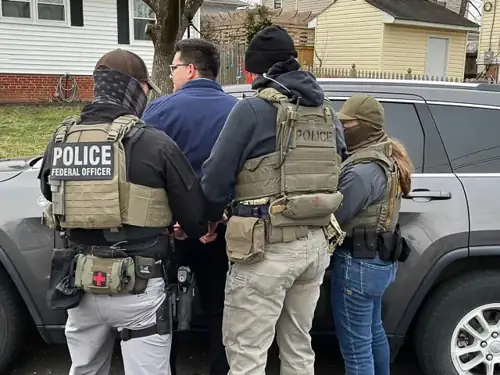
Minnesotans learned that lesson the hard way earlier this year. A loose network of neighbors had spent months thinking the mass federal deployment was an abstraction, a fever dream from political Twitter, something that happened in authoritarian countries and not in the upper Midwest. Then Operation Metro Surge happened. Then people died. Then hundreds were deported. Then the neighbors who had built that informal mutual aid network started asking each other: okay, what's next?
According to The Guardian, one of the core groups behind the immigration observation trainings has now launched what they're calling democracy defense sessions, teaching residents to knock on every neighbor's door to help them vote and, if it comes to it, to respond to attacks on the election itself. The person who ran constitutional observation trainings for roughly 2,500 Minnesotans during the ICE crackdown, a former federal worker who goes by Jess and who was fired during Elon Musk's DOGE purge, is now helping lead the charge.
Church Basements and Civilizational Stakes
On a steamy Tuesday evening in June, dozens of people crowded into a suburban church basement, finding seats at tables organized by the neighborhoods where they live. The Guardian was there. These weren't political operatives or professional activists. They were people who had already lived through one assault on their state and knew, viscerally, not to wait for the next one to get organized.
"We've got to make sure that everybody who wants to vote can vote, and everybody's vote is counted, and those votes and the will of the majority is respected," said David Brauer, who helped lead the training for Monarca, a project of the social justice group Unidos MN. He then added, with the exhausted clarity of someone who has thought about this too much: "Basic stuff, but so crucial right now. But that's just the first step. Once they're cast, we know we'll have to defend them."
The trainings are theoretical for now, but they're built on a foundation of things that have already happened. The president has already moved to undermine California's election results and publicly promised federal investigation of them. The midterms are months away. Nobody in that church basement thinks this is abstract.
The DOJ Is Already Playing Its Hand
If you want to understand why these organizers are scared, look at what the federal government has already done to people who pushed back on ICE in Minnesota. The Guardian reports that the Department of Justice has charged nearly 40 people over a protest at a church, and another 15 with sweeping conspiracy charges for their responses to ICE enforcement in the state. That's on top of the hundreds detained and deported.
Protect Democracy, a nonprofit focused on anti-authoritarianism, told The Guardian that the conspiracy charges against the 15 Minnesotans are a preview of a deliberate "disrupt" strategy: use federal power to scare opponents into silence before November. "The Department of Justice is attempting to intimidate critics and punish those who organize to expose the administration's abuses," said Jess Marsden, Protect Democracy's counsel and director of impact programs. "They know how much easier it is to tilt the electoral playing field if people stay home and stay quiet."
This is not paranoia. This is pattern recognition. The charges are the message.
2020 Guardrails Held. Nobody Is Counting on That Again.
When Trump and his allies tried to overturn the 2020 election, the institutional machinery mostly held. Mike Pence didn't stop the certification. State officials resisted pressure. Courts threw out the lawsuits. People looked at that outcome and told themselves the system worked.
The system worked because people inside it did the right thing under enormous pressure. Trump spent the following four years replacing most of those people. His government is now staffed with loyalists up and down the line. The guardrails that held in 2020 exist because individuals chose to hold them. Those individuals are largely gone.
Jess, the trainer who asked The Guardian to use only her first name out of fear of retaliation, put it as plainly as anyone has: there is a "very visceral concern that this administration is planning to ensure that the elections go their way by any means necessary." These are not the words of someone who has been radicalized by MSNBC. These are the words of a former federal worker who watched her colleagues get fired by a billionaire running a fake government agency, then watched immigration agents tear through her community, and drew the obvious conclusion.
Block by Block, Because That's How You Vote
The strategy here is granular by design. You vote by precinct. You vote where you live. So the people who watch what happens to your vote are most effective when they live near you, know your neighbors, and have already built the trust required to mobilize quickly. That's what the immigration monitoring networks built. That's the infrastructure being repurposed now.
Luis Argueta Jr, communications director of Unidos MN, told The Guardian that hundreds have already signed up for the democracy defense trainings since they launched in late April. He said he's not aware of similar ground-level efforts anywhere else in the country, though groups in other states have been calling, asking how it's going. Minnesota is, for the moment, the experiment.
The people doing this are exhausted. The Guardian is careful to note that. Months of day-to-day activism burns people out. The threat of federal prosecution hangs over anyone who gets too visible. But they're showing up to church basements on Tuesday nights in June anyway, because they made the mistake of assuming it couldn't get worse once, and they're not making that mistake again.
The Dingo Take
Let's be honest about what's happening here. A group of ordinary people in Minnesota watched their federal government conduct a military-style immigration operation that killed two of their neighbors, then watched the DOJ charge dozens of their fellow citizens for protesting it, and their response was to get more organized. Not less. More. That's not radicalism. That's rational behavior in the face of a government that has made its intentions extremely clear.
The cynical read on democracy defense trainings is that they're feel-good activism, church basements full of anxious liberals running tabletop exercises about election integrity while the real levers of power are held by people who don't care. That cynicism is understandable. It is also, at this particular moment in American history, a luxury. In 2020, the guardrails held because people inside the system chose to hold them. Those people are gone. The new strategy is to build the guardrails from the outside, neighbor by neighbor, precinct by precinct. Is it enough? Nobody knows. Is it better than doing nothing and hoping the institutions hold? The Minnesotans in that church basement have already seen what hoping gets you.
The most damning detail in The Guardian's reporting isn't the conspiracy charges, or the deportations, or even the president openly telegraphing plans to investigate elections that don't go his way. It's this: Jess, the woman training thousands of people to protect their elections, won't give her last name. She's afraid of her own government. In the United States. In 2026. Everything else in this story flows from that single fact.


Comments