
The President of the United States hid inside an airport catering truck to sneak off Air Force One during a NATO summit in Turkey last month, while journalists and White House staff flew on a decoy plane with their window shades closed, convinced the leader of the free world was somewhere behind them. This actually happened. The Washington Post and New York Times both confirmed it, with officials on the record.
How You Smuggle a President in a Meal Cart
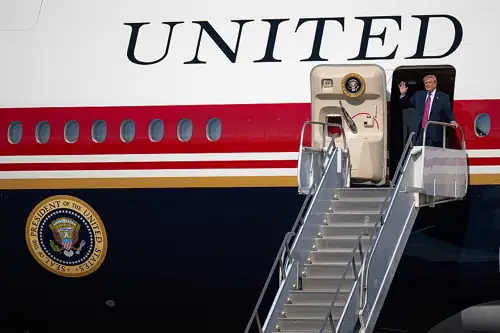
Here is the sequence of events, because you need to hear it laid out plainly. Trump walked up the stairs of the older, baby-blue Boeing 747 at Ankara airport on July 8, waved at the cameras like everything was normal, and stepped inside. Then, minutes later, he and a small team of aides slipped out an exit door on the far side of the plane and climbed into an airport catering truck, the kind that lifts up to aircraft doors to load meals and supplies before a flight.
The truck lowered to the tarmac. It drove across the airport. Trump got out and boarded an Air Force C-32A, a modified Boeing 757 that had been quietly positioned nearby. Meanwhile, the press pool and a chunk of White House staff settled into the decoy 747, pulled down their shades as instructed, and took off into the night, not knowing the man they were supposedly traveling with was already in the air on a completely different plane.
According to the Washington Post, which broke the story alongside the New York Times, the older 747 even appeared briefly on radar without a call sign before picking up the "AF1" designation mid-flight, despite the president not being aboard. The whole operation was triggered by a credible Iranian assassination threat against Trump, confirmed to both outlets by U.S. officials.
Iran, the NATO Summit, and Why This Happened
To understand the threat, you need a little context. Trump had arrived in Ankara on the new Boeing 747-8, the one Qatar gifted to the United States, which had already generated its own separate controversy about foreign governments handing the president a luxury aircraft. The NATO summit was his first major international trip on the new plane. And it was happening against a backdrop of active U.S. military strikes against Iranian targets earlier in the summer.
Following those strikes, Fox News reports that intelligence officials identified a specific Iranian threat targeting the president's movements. Trump himself, at a NATO press conference, said he was "No. 1 on the kill list for Iran." Whether that particular phrase was a strategic disclosure or just Trump being Trump is a question only his therapist could answer, but the underlying threat assessment was real enough that U.S. security officials designed an elaborate tarmac deception to move him off the announced flight.
A precedent exists for this kind of thing. The Washington Post noted a similar operation in 2000, when Bill Clinton flew into Pakistan on an unmarked executive jet while sending the official Air Force One as a decoy. That comparison is doing a lot of work in terms of making this feel normal. It is not entirely normal.
The Reporters Had No Idea
This is the part that deserves more attention. The journalists covering the president of the United States, the people whose entire job is to know where he is and what he is doing, were on the wrong plane. They sat in a pressurized aluminum tube heading to Britain, shades down, filing notes, presumably assuming the man they were covering was in a different section of the same aircraft.
When reporters later asked Trump why they had been told to keep the window shades closed during the flight, he told them, according to the Post's account, that they were "probably on a dangerous flight" and then added: "But if I go, you go. Right?" Which is either a reassuring expression of solidarity or a deeply unsettling thing to say to people who, it turns out, were not going anywhere near where he went. Fox News reported a slightly different version of the quote, with Trump telling them they were on a dangerous flight "because of the sleaze bags that we have to deal with." Either way, charming stuff.
It was not just reporters in the dark. The Post confirmed that some White House staff also believed Trump was on the older 747. This was a genuine operational secret, compartmentalized enough that people who work in the White House did not know the president had slipped out the back of a plane in a food service truck.
The Arrival, the Peace Sign, and the Qatar Plane
Trump's C-32A landed at RAF Mildenhall in England at around 10:20 p.m. local time, according to the Washington Post. The decoy 747 with the press pool arrived minutes later. It is still not entirely clear how Trump got from the C-32A back onto the older Air Force One for his public arrival, but at 10:56 p.m., he descended the stairs of the 747 in front of cameras, gave reporters a peace sign, and went to greet service members stationed at the base.
At 11:01 p.m., he boarded the Qatari-donated 747-8 for the return flight to Washington. Staff and reporters transferred from the legacy aircraft and made the trip home on the new plane. The whole choreography of planes, trucks, and tarmacs resolved itself into a clean public image: the president, safely in Britain, waving at cameras.
When Fox News reached the White House for comment, Communications Director Steven Cheung issued a statement saying the new Air Force One has been "fitted with high-level security protocols that ensure the safety of the President and his staff." He added that "many enemies of America" have their sights on Trump and that the administration uses "every tool at our disposal" to address those threats. The same statement went to the Washington Post. One statement, two outlets, zero acknowledgment of a president hiding in a catering cart.
The Qatar Plane Subplot Nobody Should Forget
Buried inside this story is a detail that was already a scandal before anyone knew about the catering truck: the plane Trump flew to the NATO summit on in the first place was a gift from Qatar. A Boeing 747-8 luxury jet, donated by a foreign government to the United States, fast-tracked through security upgrades at a cost and timeline that had already drawn congressional scrutiny.
The trip to Ankara was the new plane's debut international flight. Trump had even posted on Truth Social before the summit that he planned to take the "former Air Force One" back home instead of the Qatar plane, framing it as nostalgia. "For old time's sake," he wrote. The whole elaborate catering cart operation partly traced back to the confusion and coverage that choice generated, which created a window of public misdirection the security team apparently decided to exploit.
So to recap: the president is flying around in a plane a foreign government gave him, took a secret military jet to avoid an Iranian assassination plot, and the White House's response to all of this is to talk about the new plane's safety features. The Qatar plane. Which Iran apparently wants to shoot him out of.
The Dingo Take
You are supposed to read this story and think: good, the Secret Service protected the president from a genuine threat, the operation worked, everyone came home safe. And fine. Sure. That is one way to process it.
But zoom out for exactly one second. The United States is in active military confrontation with Iran. The president is publicly declaring himself "No. 1" on their kill list at NATO press conferences. His security team is executing Cold War-era decoy operations involving airport food trucks on Turkish tarmacs. Journalists covering the White House were flying on a plane the president had already secretly left. Some of his own staff didn't know. And the official White House response to questions about all of this is a boilerplate statement about the Qatar jet's security features. The Qatar jet. The one a foreign government gave him.
This is the state of things. Not a movie. Not a Tom Clancy novel somebody left open on a plane. This is the actual, documented operational reality of the American presidency in August 2026. The catering cart is funny until you sit with the fact that it was necessary.



Comments