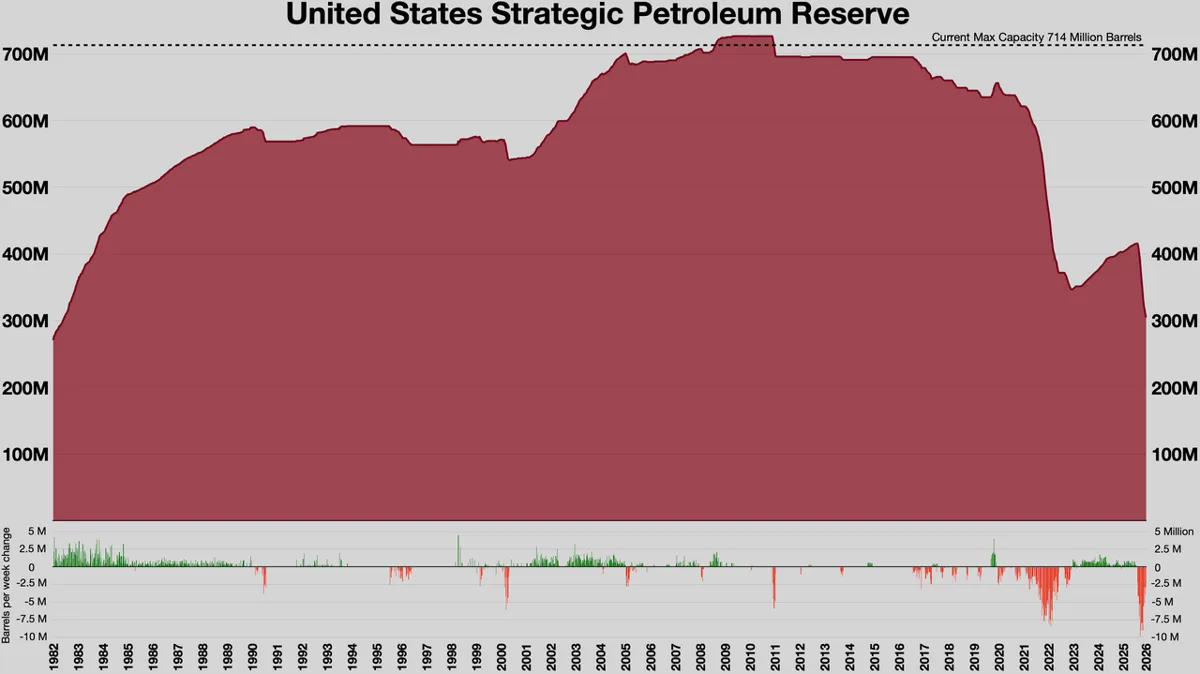
The United States government's emergency oil reserve, the thing we're supposed to crack open when the world goes sideways, is sitting at less than half its capacity and its storage wells are so old that the newest one was built during the Reagan administration. A bombshell report from the Government Accountability Office dropped Friday, and it reads less like a policy document and more like an inspection report on a condemned building. The kicker: nobody has a plan to fix any of it.
Half the Oil, All of the False Confidence
Here's the situation. The Strategic Petroleum Reserve can hold up to 680 million barrels of oil. As of early June, according to the GAO report, it held less than 350 million barrels. That's not a minor drawdown. That's not some routine adjustment. That is the United States running its emergency energy stockpile at below half capacity while simultaneously being in the middle of a war that disrupted global oil markets.
The New York Post reports that at least 180 million barrels were released in response to the war in Ukraine and mandatory congressional sales to fund maintenance. Then, in March 2026, with global oil flow interrupted by the closure of the Strait of Hormuz, the Department of Energy announced it would release an additional 172 million barrels to stabilize domestic gas prices. The GAO's response to that announcement, rendered in the dry language of government watchdogs, was essentially: we have no idea how bad this is going to get. "The full timing and implications of this large-scale emergency release are not yet realized," the report warned.
Some of that oil has been flowing to countries in Asia. The Philippines was among the first recipients of US reserves. So while Americans are watching gas prices, their emergency stockpile is being shipped overseas to fill supply gaps created by a conflict that isn't over.
The Wells Are Older Than the Internet
The volume problem is bad. The infrastructure problem might be worse. The GAO found that the vast majority of the SPR's storage wells are past their average design life of 20 to 30 years. The newest one is 38 years old. Let that sink in: the youngest well in America's strategic oil reserve was built before the Berlin Wall came down.
The Energy Department is currently running a $1.4 billion life extension project on the facilities, which are located in Louisiana and Texas. But according to the report, those repairs "are not keeping pace with the aging reserve's needs, resulting in a growing backlog and looming operational limitations." The GAO put it plainly: if these repairs don't happen, they could "undermine the reserve's ability to safely and reliably release and receive oil." The current maintenance backlog alone would cost approximately $230 million to clear, per the Energy Department's own December 2025 projections.
In other words, the storage tanks holding America's emergency oil supply are crumbling faster than anyone is fixing them, and the bill to just catch up on deferred maintenance is a quarter of a billion dollars that nobody has appropriated.
No Plan to Refill It. No Target. Nothing.
You might be wondering what the plan is to replenish the reserve after draining hundreds of millions of barrels during back-to-back international crises. The GAO was wondering the same thing. There isn't one. Not really.
The report found there is no established "target size" for the reserve, no method to identify where replacement oil would come from, and no unified long-term strategy for managing the stockpile against changing US energy needs. The GAO recommended that Congress and the Department of Energy get together and actually build one of those plans. The fact that that recommendation had to be made in 2026 is its own kind of story.
The Energy Department, for its part, pushed back in a statement quoted by the Post, saying the Trump administration had arranged barrel exchanges that "will more than replace the 172-million-barrel release." They also blamed the Biden administration for draining the reserve to fund what they called the "Green New Scam agenda." The GAO report, for the record, did not let any previous administration off the hook. It noted the reserve has been tapped repeatedly across administrations for years, for reasons ranging from genuine emergencies to Congress raiding it to pay for other things.
Drill Baby Drill Doesn't Automatically Fill the Tank
The Trump administration has been loudly aggressive on domestic energy production, approving drilling projects in the Gulf of America, off the California coast, and in Alaska's Arctic National Wildlife Refuge. The Post's reporting makes clear that this commercial expansion is real. It's also, at least for now, largely beside the point when it comes to the SPR.
The reserve is owned and operated by the federal government. Commercial drilling projects don't automatically pipe oil into government storage. The GAO report noted it was unclear how much of the new production would actually flow back into the reserve, because there's no framework requiring it to. You can drill as much oil as you want out of the Alaskan wilderness. Without a plan to route any of it into emergency storage, the SPR stays depleted.
Clay Seigle, a non-resident scholar with the CSIS Energy Security and Climate Change Program, told the Post that the US has been "drastically ramping up oil exports" to help bridge supply chain disruptions caused by the Hormuz closure. So domestic production is going up, emergency reserves are going down, and exports are going out. That's a lot of moving pieces for a situation with no long-term management plan.
The Dingo Take
The Strategic Petroleum Reserve exists for one reason: so that when the world blows up and oil stops flowing, the United States doesn't grind to a halt in a week. That's the entire job. And right now, that one job is being done by a half-empty stockpile sitting in wells that are old enough to collect Social Security, managed under a framework that the government's own watchdog says doesn't actually have a plan for the future. A national security asset designed for worst-case scenarios is being stress-tested by the worst case, and the answer to "what happens next" is apparently "we'll figure it out."
The Energy Department's statement blaming the previous administration while insisting everything is fine is exactly the kind of response that should make you more worried, not less. "Unlike the previous administration" is not a maintenance schedule. "President Trump's leadership" is not a geological survey of where the replacement barrels are coming from. The GAO didn't write this report to score political points. They wrote it because the numbers are alarming and nobody in charge seems to be alarmed enough to have drawn up a real plan.
At some point, the United States is going to need that reserve to actually work. The wells need to be able to pump. The tanks need to hold oil. There needs to be oil in the tanks. All three of those things are currently in question simultaneously, during a period of active global conflict, and the bipartisan response has been to drain the thing a little more every few years and worry about refilling it later. Later has been arriving for decades. It's starting to look a lot like now.





Comments