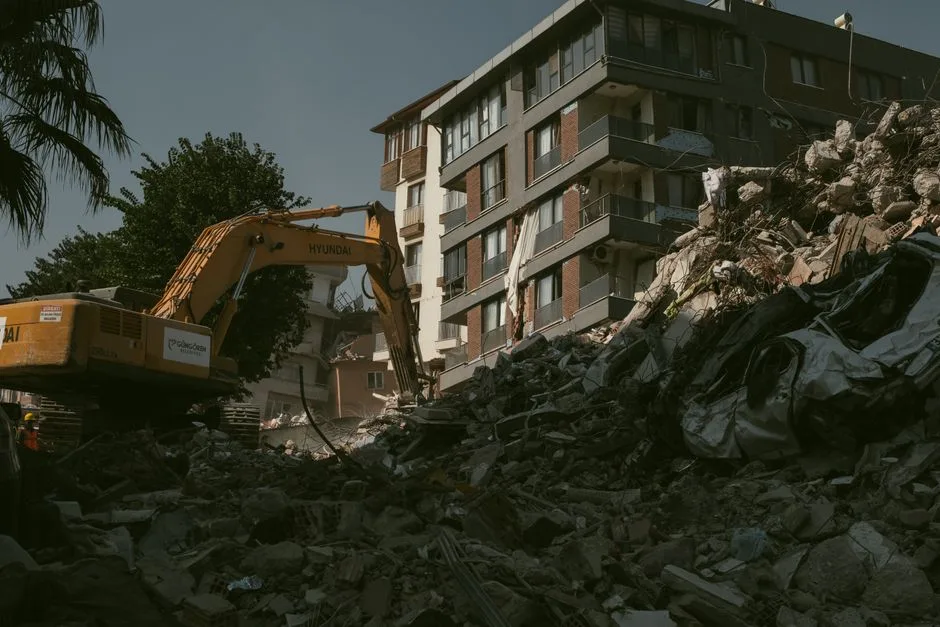
At least 1,719 people are dead after back-to-back earthquakes devastated Venezuela's Caribbean coast, and the government's response has been so catastrophically useless that local residents had to pass a hat around to pay for a backhoe because the official one never showed up. Survivors called out from the rubble of a collapsed 12-story building in Los Corales. They are no longer calling out. The bodies are now being wrapped in garbage bags because nobody sent body bags.
People Were Still Alive in That Rubble
Rosalia Bustamante lost several friends in the collapse of a 12-story building in Los Corales, a town in the La Guaira state that the Venezuelan government says was hit hardest by the disaster. She told NPR exactly what the delay cost. "There were people in the ruins responding when we called out to them," she said. "But now, they are dead."
Neighborhood volunteers, not soldiers, not emergency crews, pulled more than a dozen corpses from that building. Because nobody sent body bags, they used garbage bags and plastic sheets. Because nobody sent refrigerated containers, the bodies sit in tropical heat. NPR reports the stench is overpowering. This is not a developing-world problem or an infrastructure problem. This is a government that simply did not show up.
The Army Did Show Up, Actually, to Set Up Roadblocks
Venezuela has thousands of police and army troops, according to NPR. They have been deployed. They just haven't been deployed to, say, rescue anyone. Instead, security forces set up roadblocks and started demanding government permits from doctors and rescue workers trying to reach the disaster zone.
Julio Meléndez, a Caracas construction company owner, tried to bring a jackhammer to help break up debris. It took two days to get through because police wanted to see not just his permit, but the sales receipt for the jackhammer. A jackhammer. While people were dying in rubble. "The only thing the authorities do is get in the way," he told NPR. Some soldiers have also been accused of looting. So, to recap: the government's armed forces contribution to this disaster has been theft and bureaucratic obstruction.
Retired Venezuelan Army Gen. Antonio Rivero told NPR that President Delcy Rodriguez could have immediately deployed the military with trucks, generators, portable lights, and water systems. That didn't happen. Former civil defense chief Angel Rangel put it plainly to local journalists: "They are prepared for riots but not natural disasters."
Who Is Running This Country, Exactly
Here is the condensed version of Venezuela's current political situation, which is genuinely insane even before the earthquakes. After U.S. troops seized President Nicolas Maduro in January, his vice president Delcy Rodriguez took over. She held high-ranking posts in Maduro's authoritarian regime and has kept his hardliners in government. She is now the person in charge of the earthquake response. She is widely blamed for how that is going.
Phil Gunson, who covers Venezuela for the International Crisis Group and is based in Caracas, told NPR that authoritarian regimes can sometimes respond faster than democracies during crises because of top-down command structures. Venezuela, he said, has none of those benefits. The country failed to maintain its civil defense capabilities and lacks ambulances, firefighting gear, and basic emergency equipment. "So, you have the worst of both worlds: an authoritarian system without any of the benefits," Gunson said. That sentence should be carved somewhere.
A Country Already Hollowed Out
Venezuela was not exactly thriving before the ground started shaking. NPR describes an economic meltdown compounded by years of democratic crackdown, which together have driven more than a quarter of the population out of the country. That exodus included large numbers of health workers and engineers. The people you would most want around during a mass casualty disaster.
The Los Angeles County Fire Department's urban search and rescue team is working in affected neighborhoods, according to NPR, part of an international aid effort now pouring in. The irony here is historically loaded. Back in 1999, when mudslides killed at least 10,000 people, Hugo Chavez rejected help from the U.S. Army Corps of Engineers because they were American, and relied on Cuba instead. Now American rescue teams are on the ground and the government that replaced Maduro, the one the U.S. backed into power, is the one fumbling the response.
Democracy Is Now Even Further Away
The political opposition, led by Nobel Peace Prize recipient Maria Corina Machado, had been pushing hard for new elections after evidence indicated Maduro stole the 2024 vote. That fight is now on hold. The earthquake and recovery dominate everything.
"No one is seriously talking about elections anymore. That is all postponed indefinitely now," Orlando Perez, a Latin America specialist at the University of North Texas at Dallas, told NPR. Perez also issued a warning worth paying attention to: earthquakes can bring down governments. Nicaragua's dictator Anastasio Somoza was so brazen about stealing international relief aid after a 1972 earthquake that it helped fuel the Sandinista revolution that eventually removed him. Rodriguez should maybe think about that. Or keep demanding jackhammer receipts. Either way.
The Dingo Take
Let's be very clear about what happened here. People were alive in the rubble. They were making noise. Rescue equipment did not arrive in time. The government's armed forces, rather than digging, were running ID checks on doctors. Those people are now dead. This is not a tragedy of circumstances. This is a tragedy of choices made by a government more practiced at suppressing its own population than helping it.
The International Crisis Group's formulation, "the worst of both worlds," is the most damning four-word summary of authoritarian failure you will read this year. Venezuela got the repression and the incompetence simultaneously. The security apparatus exists to crush dissent, not to respond to disasters, and decades of that institutional priority meant that when the earth moved, there was nothing left that could actually help people. A quarter of the country already fled. The ones who stayed are wrapping their neighbors in trash bags.
Rodriguez is now using the earthquake to delay the democratic transition her predecessor stole his way into preventing in the first place. It is a grim kind of genius, ruling through catastrophe. The question is whether Venezuelans, who have endured more than most populations on earth, will eventually reach the same breaking point that Somoza's earthquake indifference triggered in Nicaragua. History says they might. Governments that let people die in garbage bags tend not to last forever.


Comments