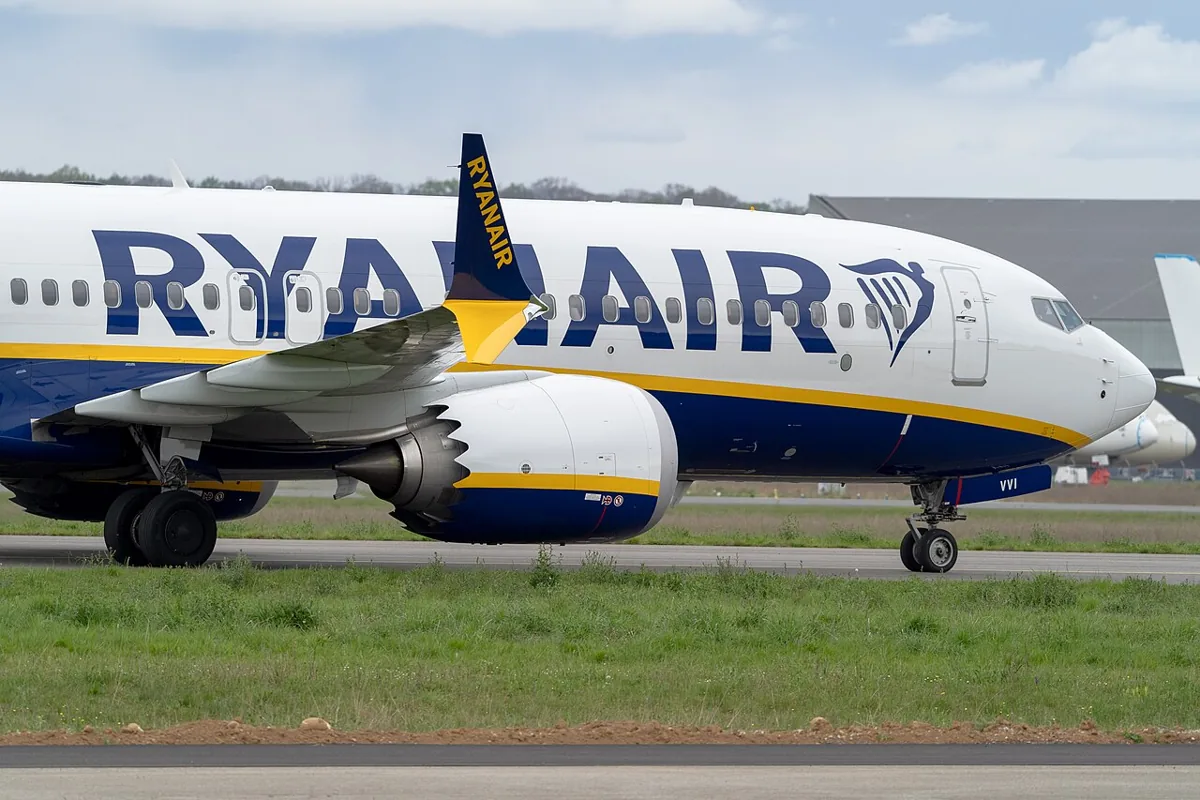
A 61-year-old man was partially sucked through a shattered airplane window at 16,000 feet while other passengers grabbed his body and physically held him inside the plane. This happened on July 10. We are only now getting the NTSB's preliminary report on how, exactly, a bird may have almost killed everyone aboard Ryanair Flight 1879.
What Actually Happened Up There
According to the NTSB's preliminary report, issued Thursday, Malta Air Flight 1879 — a Boeing 737-8AS operating for Ryanair — had been in the air for only a few minutes after departing Thessaloniki, Greece, bound for Memmingen, Germany. The plane was climbing through 16,000 feet when the No. 2 engine's fan blade fractured and separated from the engine entirely.
That blade, now a high-speed projectile, punched through the engine casing and into the fuselage at multiple points. One of those points was the cabin window directly at seat 11F. The window didn't crack. It didn't develop a small hole. It blew out completely. Engine fragments breached the fuselage, the cabin depressurized instantly, and oxygen masks dropped throughout the cabin.
CBS News reports that pieces of the shattered window were found scattered across several rows of the plane. Three loose fan blade fragments were also recovered from inside the engine. The pilots had received an engine warning just before hearing the loud bang, though by that point the situation had already moved well beyond warning territory.
The Man in Seat 11F
Ljubisa Karović, a Serbian entrepreneur and father of two, was sitting in seat 11F when his window ceased to exist. A flight attendant later told NTSB investigators that after the depressurization, they found Karović "partially lodged in a damaged cabin window, and that the entire window was missing." His face was briefly exposed to the full force of outside air at altitude.
Karović told The Guardian that he fainted twice during the ordeal and that the pressure rush left his face "swollen and deformed." He suffered serious burns and bruising on his right arm from his armpit to his chest. He remembers the noise before everything went wrong more than anything else. "The explosion is what I remember," he said. "It's the noise before the chaos, the noise that is always there when I close my eyes to sleep."
He credits his survival partly to his seatbelt still being fastened. Other passengers grabbed him and pulled him back into the cabin. He was moved to row 12, where a fellow passenger who happened to be a doctor treated him. Someone else went to the galley and found a metal box to jam into the open window hole. The plane immediately turned around and landed back at Thessaloniki. All 149 other passengers and six crew members walked away without injury.
A History of Birds and a Fan Blade That Was Already Tired
The NTSB found bird remains, including feathers, inside the damaged engine. The investigation is ongoing, but here is the part that will make your skin crawl: this aircraft had been involved in four reported bird strikes in the twelve months leading up to July 10. Bird remains were confirmed in two of those prior incidents. Whether the feathers found during this investigation came from a July 10 bird strike or from a previous one that never fully cleared the engine is, as of now, unknown. Those samples have been sent to the Smithsonian Institution Feather Identification Lab in Washington for analysis.
The fan blade itself showed signs of high-amplitude fatigue at its base, the NTSB found, and organic material was transferred across several adjacent blades. Data from the flight recorders showed that the No. 2 engine's vibrations were running higher than the No. 1 engine's even during the tail end of takeoff, which is not a particularly comforting data point. Investigators are still working to determine whether the bird strike was the sole cause of the failure or whether pre-existing metal fatigue played an independent role.
The Safety Update That Wasn't There Yet
The NTSB report also noted that the aircraft's engine covers had not been upgraded with stronger safety bolts required by recent FAA regulations. Here is where the aviation safety world gets its familiar flavor of frustrating: Ryanair is an Irish airline, which means it is not subject to FAA rules. The deadline for U.S. carriers to implement those particular mandates is 2028. So technically, legally, nobody did anything wrong.
Boeing issued a statement to CBS News saying the company "continues to support the investigation" and is working with Ryanair and Malta Air. The final NTSB report, per standard protocol, will likely arrive somewhere in the next 12 to 24 months. Greek authorities delegated the NTSB as the lead investigating agency. Ryanair had not responded to CBS News's request for comment as of the time of reporting.
The Dingo Take
Four bird strikes in twelve months on the same engine, organic material deep inside the machinery, a fan blade already showing metal fatigue, and a passenger half out of a window at 16,000 feet. The question investigators are still working through is which of those ingredients was the actual trigger. The more uncomfortable question is why it took all of them being present at the same time before we were even asking.
The safety bolt upgrade is the part that sticks. It is not illegal for a European carrier to be behind on FAA mandates. That is a straightforward jurisdictional reality, not a scandal in itself. But the existence of a known fix, a deadline two years out, and an incident that may or may not have been made worse by the lack of that fix is the kind of sequence that tends to make people look very carefully at how aviation safety timelines get set. Deadlines that trail incidents by years are not deadlines. They're suggestions with good PR.
Karović says he considers himself lucky. He is right. The passengers who grabbed him are the reason he is alive to say it. A metal box jammed into a window hole at altitude by a stranger in coach is not a backup system anyone designed. It is improvised human survival, and it worked. The NTSB will spend the next two years producing a report. The Smithsonian will identify the feathers. Boeing will continue to support the investigation. And Ljubisa Karović will keep hearing that noise every time he closes his eyes.



Comments