
On the steps of the Supreme Court this week, a crowd of young women cheered a ruling that strips transgender students from girls' sports teams, holding signs about 'biological reality' and celebrating what one activist called a victory for feminism. Yes, feminism. The movement that Phyllis Schlafly spent her career trying to destroy has now been picked up, gutted, and turned into the ideological engine of the anti-trans crusade. Welcome to 2026.
The Ruling That Started the Party
The Supreme Court this week upheld state restrictions on transgender students' sports participation, a ruling that effectively green-lights the more than two dozen state laws banning trans girls from school athletics. The two cases decided, Little v Hecox out of Idaho and West Virginia v BPJ, had been working through the courts for years. Idaho was the first state to pass this kind of ban, back in 2020, and the ACLU challenged it immediately on Title IX grounds.
Title IX, for those who skipped civics, is the federal civil rights law that has guaranteed women's equal participation in school sports since 1972. The ACLU argued that excluding transgender students violated it. The Supreme Court, in its current form, disagreed. Penny Young Nance, CEO of Concerned Women for America, told the crowd gathered outside the court that 'a man cannot be a woman.' She promised the decision would give conservatives 'a better opportunity to protect young women.'
The Red-Pilled Young Man Is Not the Whole Story
Every cable news segment about the radicalization of Gen Z men features the same cast: Joe Rogan, Andrew Tate, some guy in a podcast studio with too many microphones. And look, that story is real. But according to research published in The Guardian by sociologists Kelsy Burke and Katie Gaddini, who have spent the better part of a decade studying conservative women's activism, that framing misses something crucial.
Gen Z conservative women are, according to their research, 'at the heart of the MAGA movement.' Organizing at state and national legislatures. Building social media followings. Staffing rightwing advocacy groups. Running actual political operations. They are fewer in number than their male counterparts, Burke and Gaddini write, but they are not less consequential. They are also considerably harder to dismiss as angry basement-dwellers, which is exactly the point.
The media, the researchers note, tends to cover these women through the lens of their fashion choices or slot them into the tradwife narrative. That framing is doing a lot of work to obscure how politically organized and effective this cohort actually is.
How Phyllis Schlafly's Worst Nightmare Became a Recruitment Tool
Here is the genuinely wild historical whiplash at the center of this story. In the 1970s, Phyllis Schlafly, the patron saint of American antifeminism, actively opposed Title IX. Her argument, stated plainly, was that 'men like to play sports far more than women do.' She thought the whole thing was ridiculous. She spent decades fighting the feminist movement on every front.
Now, half a century later, the conservative women's movement is using Title IX as its primary weapon, claiming to be the law's true defenders against the supposed threat of trans athletes. The argument has flipped completely. The language of women's liberation, the slogans, the framing around protecting hard-won gains, all of it has been absorbed and redirected. Burke and Gaddini document how young conservative activists in their research invoked the feminist movement repeatedly, insisting that protecting women's sports from transgender competitors was itself a feminist act.
One activist they interviewed, a college student named Caitlyn from South Carolina, told them: 'If identifying as feminist is you believe that men and women are different but still should be equal in law, to that I say of course.' Another, a 24-year-old California woman named Olivia who works for a rightwing lobby group, got involved initially to oppose abortion, then pivoted to trans athletes after Roe fell. Allowing trans women in sports, she said, violated 'everything women fought for.'
The TERF Pipeline Has Corporate Sponsors
The ideological framework these young women are operating in has a name: TERF, short for trans-exclusionary radical feminist. It has roots in second-wave feminism, where certain feminist thinkers made it a mission to exclude trans women from feminist organizing. The conservative movement, Burke and Gaddini write, has been 'more than happy' to cite feminist voices who share their views on trans people, because it makes the position look popular and non-partisan.
The problem, as the researchers point out, is that this creates a deeply misleading picture. There is no broad feminist movement in the United States opposing transgender people. National survey data suggests the vast majority of self-identified feminists strongly support transgender rights. The conservative movement has found a handful of liberal feminist voices to amplify, and is using them to launder what is, at its core, a Republican legislative agenda targeting a vulnerable minority.
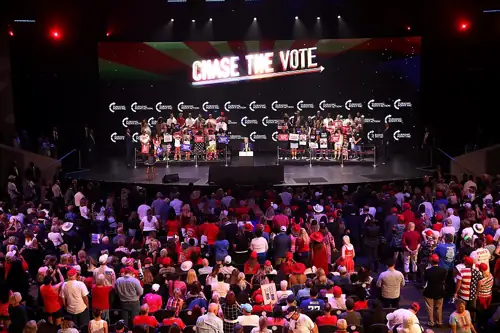
And the infrastructure behind it is not grassroots. Burke and Gaddini report that young conservative women receive training and support from a network of well-funded rightwing political organizations, including Turning Point USA and Young Women for America. These national groups routinely fly college female athletes to testify before state legislatures considering anti-trans sports bans. This is an organized, financed political campaign with a very effective human face.
Why the Branding Is Working
Here is the strategic genius of it, as much as it pains anyone with a conscience to acknowledge. The MAGA movement has a serious image problem. It is, statistically and visually, dominated by older white men. When young women show up waving feminist-adjacent slogans and talking about protecting women's rights, it scrambles the narrative in ways that are very useful to the broader movement.
As Burke and Gaddini put it, these young women make the MAGA movement 'seem trendy, modern and even, well, feminist.' They grew up in a world saturated with women's empowerment messaging, they take it for granted, and they have decided it is compatible with their politics. Whether that self-assessment is sincere or a deliberate rhetorical strategy probably varies by individual. The political effect is the same either way.
The Dingo Take
Let's be honest about what just happened. The Supreme Court handed down a ruling that will be used to remove transgender children from school sports teams across the country, and the celebration outside featured young women holding feminist slogans. The movement that brought you the Dobbs decision, that has spent decades trying to dismantle Title IX along with every other lever of gender equality, is now running on the language of women's liberation. The audacity would be impressive if the consequences were not so real for actual kids.
The researchers who wrote this up are right to push back on the red-pilled-young-man-in-a-podcast narrative. That story is real, but it is incomplete, and the incompleteness is doing political work. If the only face of radicalization is the guy shouting into a microphone about alpha males, then the organized, well-funded, legislatively effective network of young conservative women building careers around anti-trans activism gets to operate largely unexamined. That is a mistake worth correcting.
The most clarifying detail in all of this is Phyllis Schlafly's ghost hovering over the whole thing. She dedicated her life to fighting feminism, and now the movement she built is using feminist rhetoric as its primary vehicle for stripping rights from one of the most vulnerable groups in the country. The cynicism is bottomless. The political effectiveness, at least for now, is real. And the kids on the receiving end of these laws did not get a vote.




Comments