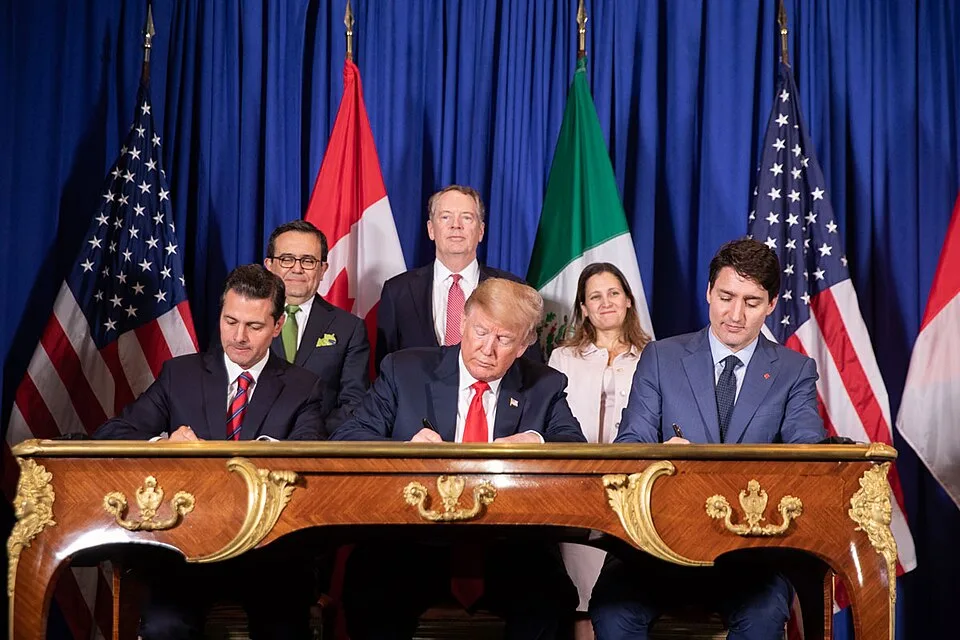
The United States has officially refused to renew the USMCA, the trade agreement that underpins roughly $2 trillion in annual commerce across North America, and has instead set a ten-year clock ticking toward the whole thing falling apart. A senior US official confirmed the decision this week, framing the chaos as intentional. Apparently blowing up your own continent's trade framework is now a negotiating strategy.
What Just Happened, and Why It Matters
Under the USMCA's own rules, all three countries, the US, Mexico, and Canada, had to unanimously agree to extend the deal for another 16 years. That unanimous agreement would have kept the agreement in place until 2042. The US just said no.
According to the BBC, a senior US official confirmed the administration "chose not to rubber stamp a USMCA renewal without addressing existing issues" and that "the United States did not agree to renew the USMCA in its current form." That's the diplomatic way of saying they blew the deadline on purpose.
The practical result? The three countries now have to meet every single year to renegotiate the deal's terms. And if they can't get unanimous agreement on an extension down the road, the BBC reports the whole arrangement essentially enters a ten-year countdown to termination, with expiration possible as early as 2036.
The Deal Itself Is Worth Knowing About
The USMCA replaced NAFTA back in 2020, and it wasn't a trivial upgrade. The agreement updated rules around digital trade, workers' rights, and regional manufacturing. It specifically required more vehicle parts to be made within North America rather than outsourced to cheaper overseas suppliers. For a guy who campaigned on bringing manufacturing home, those provisions should have been a point of pride.
Instead, the administration is now treating the deal it negotiated and signed as a problem to be fixed. Trump's team has raised repeated concerns about automotive rules of origin, dairy market access, and whether the agreement allows third-party countries like China to route goods through Canada or Mexico and effectively access US markets under preferential terms. Those are legitimate trade policy concerns. Blowing up the renewal mechanism to address them is a different question entirely.
The US Chamber of Commerce had urged renewal, warning that manufacturing and agriculture sectors depend on the kind of cross-border certainty that a 16-year extension would have provided. When the Chamber of Commerce is begging you to be more stable, you have made some choices.
Who's Happy About This, and Who Isn't
Not everyone is panicking. Domestic steel groups, specifically the American Iron and Steel Institute and the Steel Manufacturers Association, both welcomed the move, according to BBC reporting. Their argument is that annual review cycles give American negotiators ongoing leverage to press for better terms rather than locking in a deal for a decade and a half.
That's a real argument. Annual reviews do create pressure points. The question is whether turning a $2 trillion trade relationship into a year-by-year negotiation hostage situation is worth the leverage, especially when your counterparts in Ottawa and Mexico City have their own political pressures, their own domestic industries to protect, and very little reason to just hand you concessions every twelve months because you asked nicely.
The Clock Is Now Running
Here is what this actually means in practice. The USMCA doesn't disappear tomorrow. The BBC makes clear that the free trade deal remains in place for now. Goods are still crossing the border under existing terms. Nobody should be panicking about the immediate future of North American trade this week.
But the long-term picture just got considerably murkier. Businesses that make multi-year investment decisions based on trade policy certainty, auto manufacturers, agricultural exporters, electronics assemblers, now have to weigh the real possibility that the North American trade framework as they know it expires in a decade. That uncertainty has a cost even when it never becomes a crisis. It shows up in delayed investment decisions, factory location choices, supply chain restructuring. The economic damage from chaos doesn't always arrive as a single dramatic event.
The Dingo Take
Let's be clear about what this administration just did. They inherited a trade deal they themselves negotiated, a deal that already addressed many of the concerns Trump spent years screaming about under NAFTA, and declined to renew it because it wasn't perfect enough. The result is that North America's $2 trillion trade relationship now runs year-to-year on a clock that could run out in ten years, with every annual negotiation serving as a fresh opportunity for manufactured drama, political leverage, and economic disruption.
The steel industry is happy. Great. The steel industry employs about 140,000 people in the United States. The industries that depend on stable cross-border supply chains employ considerably more. The US Chamber of Commerce doesn't beg politicians for things very often. When it does, and gets ignored, it tends to mean that someone is prioritizing a political signal over an economic reality.
Trump has now spent a decade treating trade relationships as zero-sum combat rather than mutual arrangements that create value for everyone involved. Sometimes that posture produces results. More often it produces uncertainty, and uncertainty has a cost that never shows up cleanly on a ledger but always shows up somewhere. Usually in the places that can least afford it.





Comments