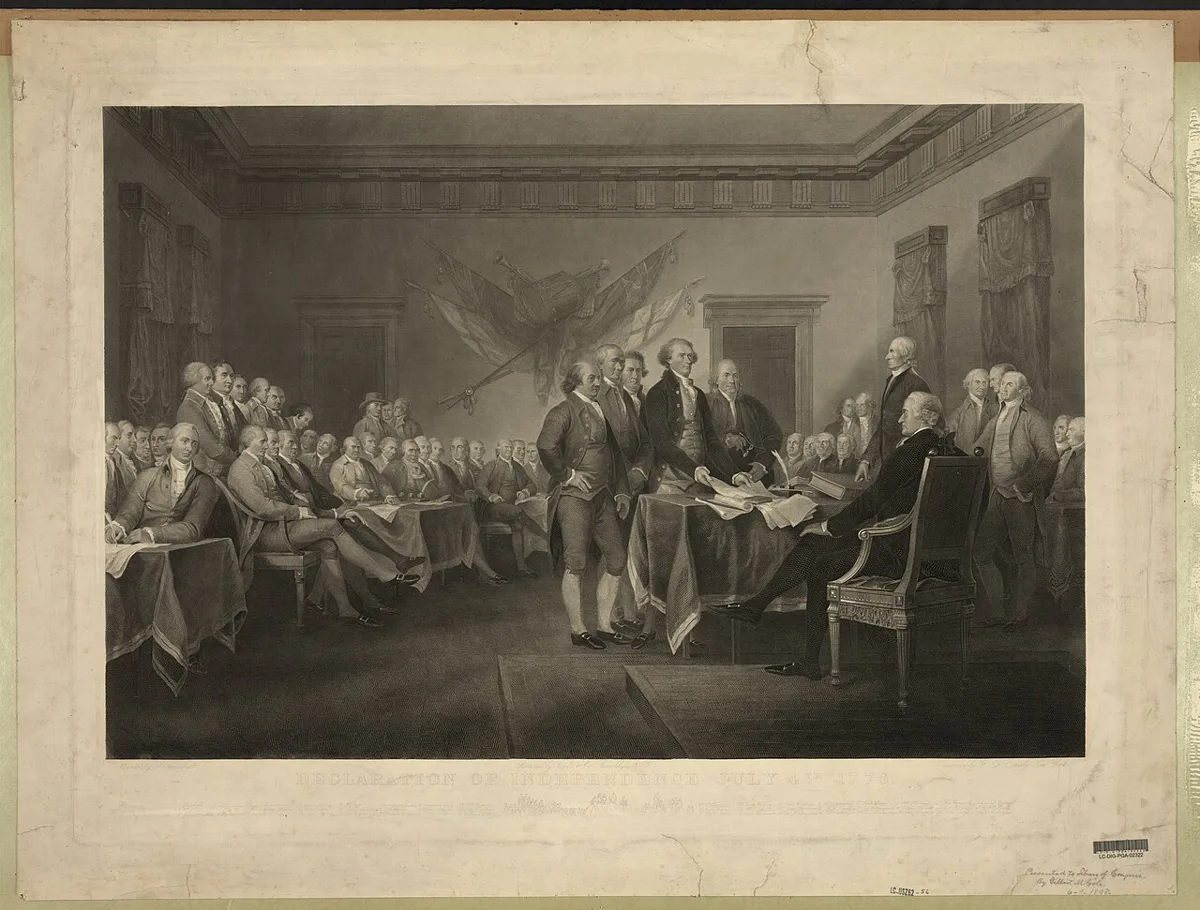
A volunteer at the UK National Archives sat down on an ordinary Thursday morning in May, opened a dusty folder of 18th-century Royal Navy correspondence, and accidentally became the most interesting person in any room for the rest of his life. He had found a 'vanishingly rare' copy of the US Declaration of Independence, crammed inside British naval files, completely forgotten for nearly 250 years. Happy Fourth of July, we guess.
A Boring Thursday That Wasn't
Michael Scurr is a volunteer at the National Archives in Kew, west London. In late May, he was doing the unglamorous work of cataloguing a collection of documents that had never been recorded in detail. Routine stuff. Reading old paper. The kind of job that attracts a specific type of person and generally produces zero surprises.
Then he unfolded a document and read the opening line. "In Congress, July 4, 1776. A declaration by the representatives of the United States of America..." According to The Guardian, Scurr looked up at his supervisor and said, simply: "I think you should come and have a look at this."
What he had found was one of 11 surviving copies of the so-called Exeter printing of the Declaration of Independence, and the only one known to exist outside the United States. It had been sitting in the British national archives, mis-catalogued as "another document," since the 18th century. No big deal. Just America's founding text, misfiled under British naval paperwork.
How It Got There: A Very American Story
The document was printed in Exeter, New Hampshire, somewhere between July 16 and 19, 1776. That's how long it took for news of the July 4th signing in Philadelphia to travel north. These so-called broadsides were mass-produced, fast and cheap, designed to get the word out. Graham Moore, a records specialist at the National Archives, told The Guardian they were "designed to be printed quickly, distributed fast, and read and consumed by as many people as possible in as short a time as possible."
From the print shop, the copy likely ended up in the hands of Eleazer Johnson, captain of an American privateer ship called the Dalton. Johnson stopped briefly in Portsmouth, New Hampshire, near Exeter, to pick up more crew. Moore believes he probably bought a copy of the declaration there. A man heading out to sea to raid British ships on behalf of a brand new nation probably felt the document was relevant reading.
The Dalton was commissioned by Congress, like all American privateers, to attack British vessels. In a detail that The Guardian flags as historically significant, it was the first American privateer ship captured in European waters. A British warship nabbed it off the coast of Spain in December 1776, seized all the papers on board, and that was that. The declaration got bundled into the naval archives and promptly forgotten.
The Captain Was Not Subtle About His Allegiances
When Eleazer Johnson was hauled before a court in Plymouth, UK, after his capture, he declared himself a citizen of the United States of America. In 1776, the British Crown still considered that a treasonous statement. The man was not hedging his bets.
Amanda Bevan, the head of legal records at the National Archives, told The Guardian she imagines Johnson reading the declaration aloud to his crew on deck before they set sail. "I have this nice image of Eleazar Johnson on the ship," she said, "potentially reading out the declaration of independence to his 120-man crew of diverse nations to say: 'This is why we're doing it, this is why we're putting our lives at risk, this is why we're heading out into the ocean to take our chances again.'" That is, frankly, a great image.
120 Men, One Document, and a Story That Deserves Finishing
The crew of the Dalton was a genuinely multinational group: English, Irish, Scottish, French, and Danish sailors alongside those claiming American citizenship. Among them was a man named Daniel Cottle, listed in the muster book as a black man. Moore told The Guardian this was not unusual in North America at the time, and that Cottle's role on the ship suggests he was likely a free Black man. "We do see free black people fighting on both sides of the revolution," Moore said.
After the Dalton's capture, the crew was transferred to a guard ship and eventually imprisoned at Old Mill prison in Plymouth, England. That's where Cottle's documented story ends. Moore said he believes more research could uncover what happened next, noting that most of the Dalton's crew came from Newburyport, Massachusetts. "There's definitely more to his story there, and I'd love to uncover more of it if we can," he said. A man who crossed the Atlantic on a privateer ship carrying the Declaration of Independence while the revolution was still being fought deserves better than a footnote.
Saul Nassé, the chief executive of the National Archives, told The Guardian the document is "a powerful reminder that the history of the American Revolution is fundamentally transatlantic." Which is a very polished way of saying: Britain was there too, and they still have the receipts.
Why This Copy Is Different From the Others
There are surviving copies of the Exeter printing, but most of them are just copies. Paper. This one has what archivists call provenance, a complete documented chain of custody that tells you exactly where it's been and why.
As Nassé put it to The Guardian: "Not only is it one of 11 in the world, it also has provenance. From a print shop in Exeter, New Hampshire, to a privateer at sea, to its capture, and eventually to being part of our state's archives. And that kind of provenance is exceptionally rare." In the world of historical documents, provenance is often worth as much as the document itself. This one has a full story attached, complete with a named captain, a named ship, a specific sea battle, and a specific date of capture.
The timing is absurd in the best possible way. Scurr made his discovery in late May 2026, just weeks before the 250th anniversary of the declaration's signing. The document spent two and a half centuries in a filing cabinet waiting for the right moment.
The Dingo Take
Let's just sit with this for a second. The United States has spent 250 years treating the Declaration of Independence as the sacred founding artifact of American exceptionalism. There are replicas in every middle school classroom. Nicholas Cage made a movie about stealing one. And the whole time, Britain has had a surviving original copy, captured from a privateer ship, misfiled under "another document," sitting in a box in Kew. They weren't even hiding it. They just... forgot.
There is something deeply, perfectly fitting about this. The American Revolution was a chaotic, improvised, multinational scramble, fought by a crew of English, Irish, Scottish, French, Danish, and American sailors alongside at least one free Black man, led by a captain who thought it was a good idea to carry the founding document of a new nation while sailing around raiding British ships. That's not a historical event. That's a heist movie with better speeches.
And now, right on schedule for the 250th birthday party, the document shows up again. Found by a volunteer on a boring Thursday morning. The story of Daniel Cottle, who crossed an ocean on that ship and then vanished from the record in a Plymouth prison, is still out there waiting to be found. Moore wants to find it. He should. Because the real history of what that declaration meant, and who actually risked their lives for it, is a lot more complicated and a lot more interesting than anything you'll see at a fireworks show this weekend.



Comments