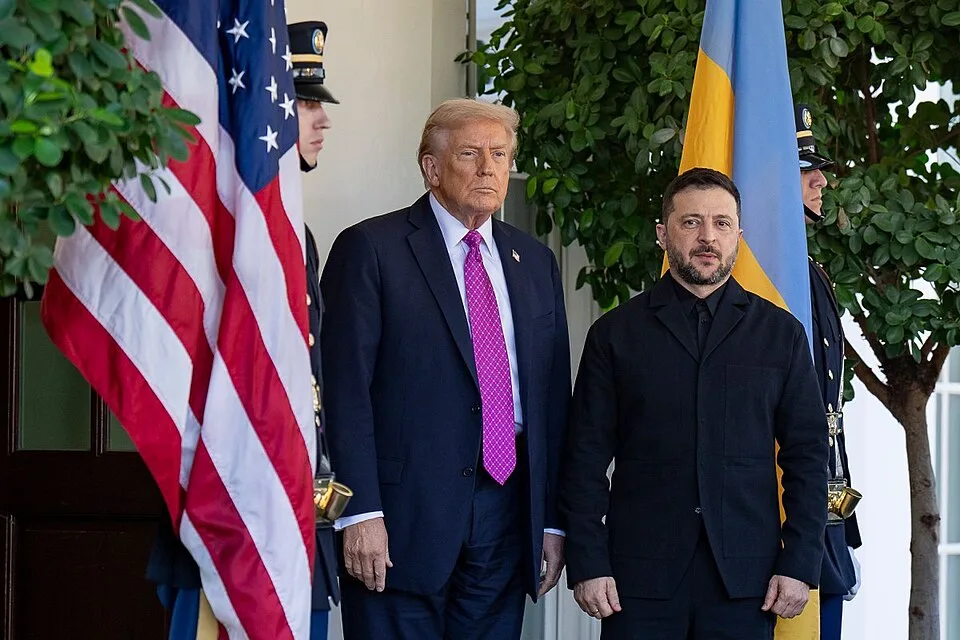
Donald Trump stood next to Volodymyr Zelenskyy at the NATO summit in Ankara on Wednesday and announced that the United States will license Ukraine to build its own Patriot missile interceptors. Great news. One small problem: the companies that actually make the Patriot system had no idea this was coming. Trump said so himself.
A Little Birdie Told Him to Announce a Major Defense Deal
CBS News was in the room when Trump made the announcement, and the quote is something you have to read twice. "A little birdie told me this, about the fact that we'll give them the right to make Patriots," Trump said. "We'll show them how to do it, it's very complex actually. But it's — you'll figure out the complexity quickly."
The Patriot missile system is one of the most sophisticated air defense platforms ever built. It involves radar arrays, fire control software, interceptor missiles traveling at hypersonic speeds, and decades of classified engineering. The president's explanation for how Ukraine will master it was essentially: you'll figure it out. Good enough.
The companies responsible for actually building this technology, Lockheed Martin and RTX Corporation (formerly Raytheon), had not been informed of the deal before Trump made it public at a multinational summit. CBS News had to reach out to Lockheed Martin for comment after the fact. The U.S. government apparently did not.
What Zelenskyy Actually Asked For, and Why It Matters
To be fair to the underlying policy, this is something Ukraine has been pushing for a long time. Zelenskyy made a direct public pitch for Patriot production licenses back in May, appearing on CBS News' "Face the Nation with Margaret Brennan." "I asked previous administration, I am asking today's administration — give Ukraine licenses," he said. "We will increase the production of Patriot missiles. It will be very helpful for us, it will be very helpful for Middle East, for everybody whom United States will decide to help."
The logic is sound. Ukraine has proven it can absorb and adapt advanced military technology faster than almost anyone expected. The Patriot system has been central to blocking Russian air attacks throughout the war. More Patriot interceptors, built locally, would mean Ukraine could sustain its air defense without depending entirely on U.S. shipments that have been inconsistent at best under this administration.
If the license deal actually materializes, it is a genuine win for Ukraine. The question, as with everything in Trump's foreign policy, is whether an announcement made via presidential stream-of-consciousness in front of cameras actually turns into a signed, legal, executable agreement.
Trump Also Found a Moment to Feel Bad for Putin
Because it would not be a Trump-Zelenskyy meeting without at least one remarkable moment of diplomatic whiplash, Trump took time to express sympathy for Russia. "It's been tough on Russia," he said, of the country that invaded its neighbor in 2022 and has been bombing Ukrainian civilians ever since.
Vladimir Putin launched the war. Putin could end the war by withdrawing. Putin has instead spent three years grinding through Ukrainian territory at catastrophic human cost to both sides. But yes, it's been tough on Russia.
Trump then told reporters he planned to speak with Putin later and actually invited them to suggest questions he should ask the Russian president. A Ukrainian reporter asked when Putin would end the war. Trump responded, "I don't think I've ever asked him that question. I'm going to ask him that question." Three and a half years into a full-scale land war in Europe, the American president has not thought to ask the man who started it when he plans to stop.
The Drone Deal That May or May Not Happen
Trump also signaled at the Ankara summit that the U.S. is looking at a deal to buy Ukrainian drones, though he stopped well short of committing to anything. As CBS News notes, Ukraine has dramatically exceeded expectations in drone development throughout the war, building a domestic industry that has genuinely rattled Russian military planners.
A U.S.-Ukraine drone procurement arrangement would be strategically significant and, unlike the Patriot license announcement, would flow money toward Ukraine rather than just transferring American technology. But Trump said he "thinks" a deal will happen, which in this administration is roughly equivalent to a shrug.
After the press conference, Trump posted on Truth Social that the meeting "went very well" and that everyone is "looking for a solution. Very positive!" The precise content of that solution remains, as of this writing, unclear.
The History in That Room Was Heavy
It is impossible to watch Trump and Zelenskyy share a stage without thinking about what these two men have put each other through. Trump's 2019 phone call pressuring Zelenskyy to investigate Joe Biden's family triggered the first impeachment trial of Trump's presidency. Then last year, their Oval Office meeting collapsed into a televised blow-up that left relations between the two governments visibly damaged for months.
The fact that they are now standing together at NATO, announcing weapons deals and taking press questions, is genuinely strange. Not bad, necessarily. Strange. The world has bent itself into unusual shapes since Russia went to war and Trump came back to power.
What is consistent is the pattern. Trump makes a big announcement. Details are thin or absent. The companies involved find out from the news. And then Trump posts that everything went very positively.
The Dingo Take
Here is what happened Wednesday in plain language: the President of the United States announced a major transfer of defense manufacturing rights to a wartime ally, in front of cameras, at a NATO summit, without telling the defense contractors whose intellectual property is involved. He learned about it from a little birdie. He explained the technology by saying Ukraine would figure out the complexity quickly. This is how American foreign policy works now.
The underlying move, if it holds, is actually the right call. Ukraine has earned the right to build its own air defenses. Zelenskyy has been asking for this for years, from two different administrations. The Patriot system is what's keeping Russian missiles out of Ukrainian cities. More of them, built locally, saves lives. Credit where it's due.
But the process is a shambles, and the shambles matter. Defense licenses involve legal frameworks, export control reviews, congressional notifications, and binding agreements between governments. They do not typically begin with a president ad-libbing at a press conference while Lockheed Martin reads about it on the internet. What gets announced is not always what gets delivered. Ukraine knows this better than anyone. So do the rest of America's allies, who are watching every single one of these performances and making their own calculations about how much any of it means.



Comments