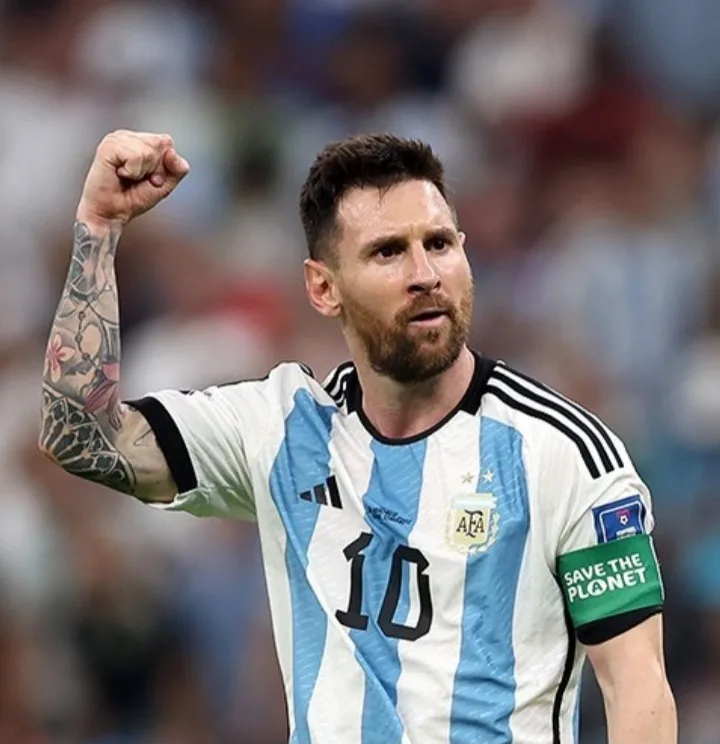
Egypt came back from the future to 2-0 up against Argentina in the World Cup round of 16, then watched Argentina score three goals in thirteen minutes, and have now decided the whole thing was a setup. The Egyptian Football Association released a formal statement accusing the officials of biased, unfair refereeing. FIFA's refereeing chief, Pierluigi Collina, essentially told them to sit down.
What Actually Happened in Atlanta
Let's set the scene. Tuesday night, Atlanta, one of the more genuinely insane football matches in recent World Cup memory. Egypt built a 2-0 lead against the reigning world champions. The crowd had questions. Argentina had a Messi.
Then, as NPR reports, Argentina scored three unanswered goals in thirteen minutes to complete one of the biggest comebacks in World Cup history. Cristian Romero got Argentina on the board in the 79th minute, assisted by Messi. Then two more followed. Egypt's goalkeeper coach got red-carded in the chaos. Several Egyptian players collected yellow cards. The final whistle blew at 3-2 Argentina, and Egyptian coach Hossam Hassan immediately started crossing his arms in an X shape, a gesture signaling racial abuse.
The Goal That Started the War
Here's the specific incident that lit the fuse. In the 58th minute, Egypt appeared to score what would have been their second goal. VAR reviewed it and ruled the goal out, determining that Egyptian player Marwan Attia had fouled Argentina's Lisandro Martinez earlier in the buildup.
FIFA's chief of refereeing Collina later defended the call explicitly, saying Attia "clearly treads on the foot of Argentina No. 6 Lisandro Martinez." He also explained that there is no defined limit on how far back in time or how far away from goal a foul can be identified and used to disallow a goal. According to NPR, Collina said: "We believe that a foul is a foul. Regardless of whether the foul appears 'obvious,' if the referee did not see it on the field of play, the VAR can intervene."
Egypt's camp was not satisfied with this explanation. In fact, Egypt's camp was not satisfied with essentially anything that happened after halftime.
Egypt Goes Official With It
The Egyptian Football Association did not just complain on social media like normal people. They released a full formal statement. "Defending the rights and interests of the Egyptian national team is not a matter that can be ignored, minimized, or treated as secondary," the statement read, according to NPR. "It is a responsibility that we carry with full conviction and determination."
Coach Hassan, for his part, told reporters that his team was the victim of a soccer establishment that favored Messi and Argentina specifically. Several players backed him up. The EFA statement noted that unspecified "experts and analysts" agreed with Egypt's read of the situation, which is doing a lot of work for an official grievance from a national football governing body.
The EFA also said it "cannot remain silent" about the VAR usage, arguing the system was applied unfairly and inconsistently throughout the match. The statement called for "integrity, fairness and transparency" in officiating at the sport's highest level, which, fair enough in theory, but also: they lost to Argentina, who just scored three goals in thirteen minutes. The referee did not do that.
FIFA Slams the Door
Collina's response was diplomatic in structure and blunt in content. He said constructive discussion about decisions is always welcome in football. He then said "unfounded allegations have no place in our sport" and added: "Nobody can question the integrity of the FIFA World Cup match officials."
He also said something that actually matters, and that the EFA should probably take seriously. "When this happens," Collina said, referring to public accusations of bias against specific referees, "it may provoke reactions that lead to threats against them and their families. This is not right." That is not a FIFA bureaucrat being prissy. Match officials at major international tournaments do receive threats after controversial calls. That part is real, and worth stating plainly regardless of how you feel about the goal that got disallowed.
The Messi Variable
Look, here is a thing that is true about international football and has been true for years: there is a persistent belief among fans and some coaches that referees at the highest level subconsciously, or consciously, protect the game's biggest stars and biggest brands. Whether you think that belief is earned or paranoid probably depends heavily on which team you support.
What is also true: Argentina came back from 2-0 down in thirteen minutes. Three goals. Thirteen minutes. Messi assisted the first one. That is not refereeing. That is football, and sometimes football is horrible and unfair in ways that have nothing to do with the officials. Egypt played an excellent game for 78 minutes and then Argentina turned into Argentina. Those two things can both be real simultaneously.
The Dingo Take
Here is what Egypt's complaint is actually doing: it is making a specific, formal accusation of biased officiating at the institutional level, against named individuals, on the world's biggest sporting stage. That is a serious thing to do. It is the kind of thing that, if you are going to do it, you had better be able to back up with something more concrete than "several experts and analysts" and "profound questions." The EFA has not pointed to a specific rule that was broken. They have pointed to decisions they disagree with, which is a different thing entirely.
The VAR call on the disallowed goal is genuinely debatable, in the way that most VAR calls are genuinely debatable, because VAR has introduced a whole new category of calls that look wrong at full speed, look maybe-right in slow motion, and feel deeply unsatisfying regardless of outcome. That is a legitimate criticism of how VAR works as a system. It is not the same thing as accusing the referee of being in Lionel Messi's pocket.
Egypt had Argentina dead to rights. Two goals up, sixty minutes played, against the defending world champions. Then Argentina scored three times in thirteen minutes. That is the story. It is a gutting, brutal, spectacular story of a comeback that will be replayed for decades. Blaming the referees does not change what happened. It just means Egypt gets remembered for the press conference instead of the performance.



Comments