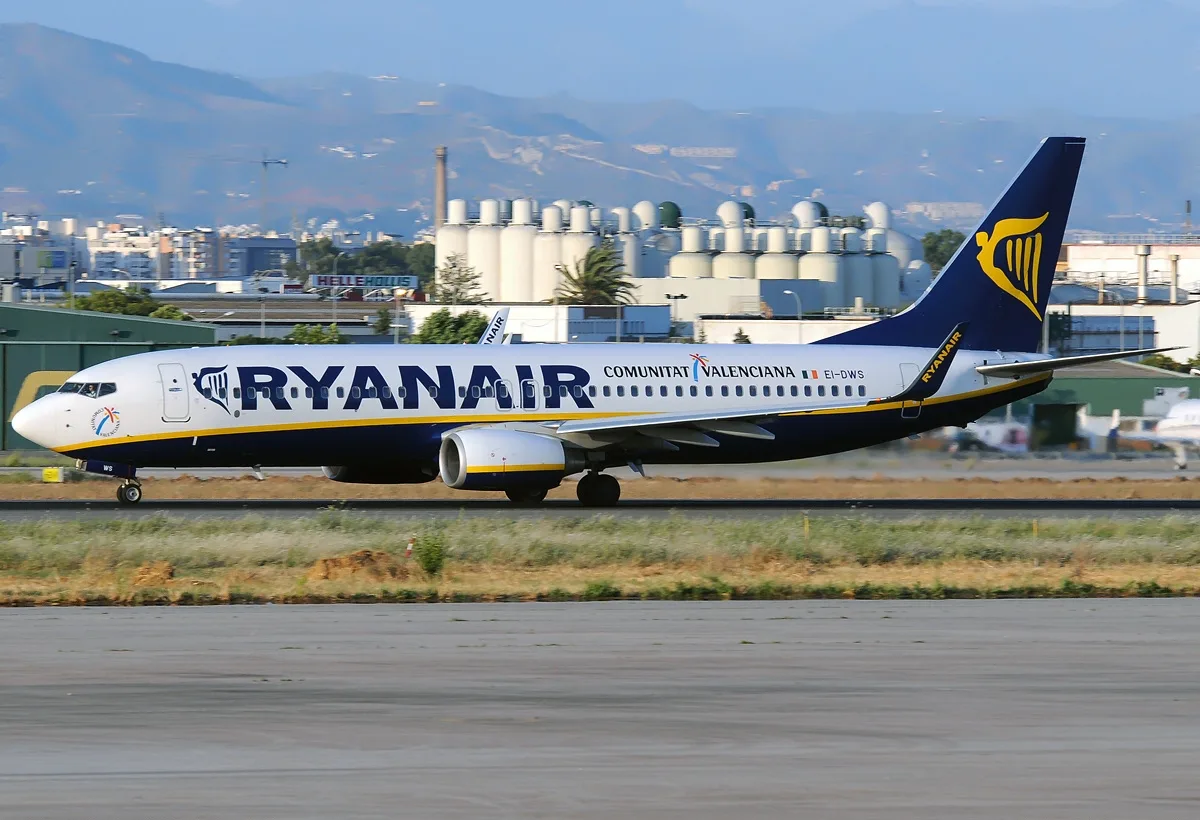
A 61-year-old man's head and shoulders were outside a Ryanair airplane window somewhere over North Macedonia on Friday morning before fellow passengers physically pulled him back into the cabin. He was wearing his seatbelt, which is the only reason this story has a living protagonist. The window, per Ryanair's own statement, simply 'detached during the flight,' as if that is a normal sentence that normal airlines say.
What Actually Happened Up There
The flight was a Ryanair Boeing 737-800 running from Thessaloniki, Greece to Memmingen, Germany. According to CBS News, Greek media reported that a piece of debris broke off one of the plane's engines and struck the window, causing it to fail mid-air. The plane was over North Macedonia when this happened.
A fellow passenger described the moment to Radio Thessaloniki: a loud noise, like a tire bursting, then immediate decompression, then screaming, then oxygen masks dropping from the ceiling. 'For a moment I thought someone had accidentally opened the emergency door,' she said. Then she looked over and saw a man's head and shoulders outside the aircraft.
The man, described as a Serbian tourist, had not unbuckled his seatbelt. That seatbelt is the reason he is currently recovering in a Greek hospital with friction burns and neck and shoulder injuries rather than being recovered from a field in the Balkans. Other passengers near him grabbed him and pulled him back inside the plane. The aircraft returned to Thessaloniki and landed safely at approximately 7:10 a.m. local time.
Ryanair's Statement Is Doing a Lot of Heavy Lifting
Ryanair released a statement confirming the flight 'returned to Thessaloniki shortly after takeoff when a passenger window detached during the flight.' The aircraft, they added, 'landed normally.' A replacement plane was provided to take the remaining passengers on to Germany, because apparently they still wanted to go.
Let's sit with 'the passenger window detached during the flight' for a second. That is the airline's chosen framing for 'a window came off our plane while it was in the sky and a man was partially ejected from the aircraft.' You have to admire the economy of language, if nothing else. Ryanair has turned an extraordinary act of structural failure into something that sounds like a minor inconvenience, like a tray table that won't stay up.
The airline did not immediately respond to questions about the engine debris that reportedly caused the failure, which is the part of this story that should be keeping aviation engineers awake at night.
Boeing. Again. Still.
The FAA confirmed to CBS News that the aircraft involved was a U.S.-made Boeing product, specifically a Boeing 737-800. The FAA said it 'stands ready' to support local authorities and the NTSB in the investigation. The European Union Aviation Safety Agency told CBS News they were also aware and in contact with the FAA and the engine manufacturer.
The 737-800 is a different variant from the 737 MAX that has dominated Boeing's recent headlines, but the brand association is not doing the company any favors at this point. Boeing is a company that has spent several years watching pieces of its planes fall off in ways that were not supposed to be physically possible, and yet here we are again with another window situation on another Boeing jet.
For context, CBS News noted a similar incident in the U.S. in 2018, when a woman died after being partially sucked out of a Southwest Airlines 737 window following an engine failure. An aviation expert told CBS News at the time that the pressure differential during decompression creates an 'incredible amount of pressure trying to rush out of that small opening.' The Serbian tourist on Friday survived that force because he was buckled in and because strangers grabbed him. Two variables that should not be this load-bearing.
The Part Where Everyone Promises to Look Into It
The EASA said in a statement to CBS News that it would 'follow the situation closely as more information emerges and take any continued airworthiness action needed to ensure safety.' Which is the regulatory equivalent of saying 'we are aware that something happened and we will continue to be aware of it going forward.'
The FAA echoed the sentiment with its offer to 'stand ready' to assist, a phrase that communicates vigilance without committing to anything specific. Both agencies are doing exactly what agencies do after aviation incidents: expressing concern in passive, non-committal language while the actual investigation grinds forward at investigation speed.
Greek authorities are presumably leading the inquiry given the aircraft returned to Thessaloniki. What investigators will want to understand is how a piece of engine debris was able to detach, travel far enough to strike a fuselage window with sufficient force to blow it out, and whether there were any signs of pre-existing structural issues with either the engine or the window assembly.
The Dingo Take
Here is the thing about flying in 2026 that nobody in the aviation industry seems to want to say out loud: the margin between 'everyone lands safely' and 'man is partially ejected from aircraft' has gotten uncomfortably thin, and 'the seatbelt held' is not a safety system, it is luck wearing a lap belt.
This passenger survived because he fell asleep with his seatbelt on, because strangers reacted quickly in a moment of pure chaos, and because the pressure differential didn't finish the job before they could pull him back. None of those are engineering solutions. None of those are things Ryanair or Boeing or the EASA designed into this outcome. This man is alive because of a combination of personal habit and stranger heroism, and that should embarrass every party that certified this aircraft and every party that operates it.
Ryanair helpfully provided a replacement plane so passengers could continue their trip to Germany, which tells you everything you need to know about the airline's read on the situation. A man's shoulders were outside the aircraft. The airline's response was essentially: we've sourced another plane, who's still in? The audacity is genuinely staggering. Fly safe, everyone. Keep your seatbelt on. And maybe consider trains.



Comments