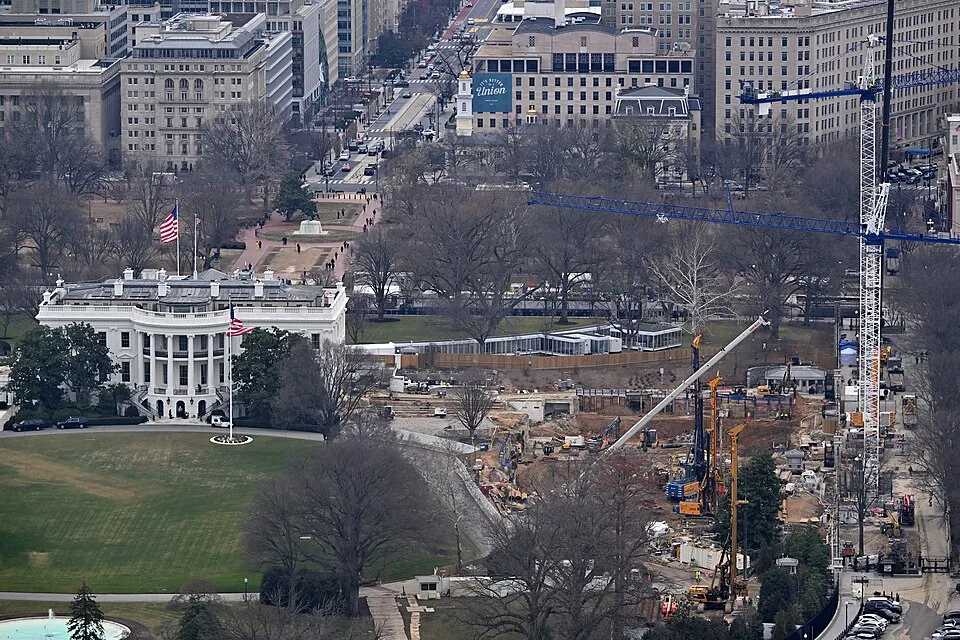
The White House is getting a new front door. And new fences. And fortified walls. And scaffolding that will be up for months. Call it what you want, but when the most powerful building in the world starts looking like a medieval siege fortress, it's worth asking out loud how we got here.
What They're Actually Building
CNN is reporting, citing a White House official, that the administration is undertaking security upgrades to the North Portico, the grand front entrance of the White House that you've seen in roughly ten thousand establishing shots of every political drama ever made. The work is expected to take several months, with completion targeted for around mid-September.
The North Portico is currently obscured by scaffolding and a tarp, which the White House has explained is for exterior column repairs that Trump personally requested. So yes, the president is simultaneously redecorating and fortifying his house. A renovation and a panic room, all in one.
The Washington Post reported separately that the administration also plans to erect new permanent fencing outside the White House itself, on top of previously reported plans to build permanent fencing around Lafayette Square, the public park directly across the street. Lafayette Square, for those keeping score at home, used to be a place where ordinary citizens could stand and wave at the building where democracy theoretically lives. Those days appear to be numbered.
Why the Secret Service Suddenly Has Trump's Full Attention
The Guardian notes that the Secret Service has long advocated for exactly these kinds of fortifications at the North Portico entrance. "Long advocated" is doing a lot of work in that sentence. It implies the agency has been asking for this for some time and wasn't getting it, until recently.
What changed? Two things, and they are not small things. In April, a gunman opened fire at the White House Correspondents' Dinner, one of Washington's most high-profile annual events, in what became one of the most shocking security failures in recent American political history. Then, last month, federal authorities allegedly uncovered a plot to attack a UFC fight being held on the White House South Lawn.
A UFC event. On the South Lawn. That sentence alone could anchor a satirical novel about the Trump era, and yet here we are, reporting it as a straight news fact in the summer of 2026.
Two Attempts in One Year
Let's be direct about what this means. The President of the United States has now been the target of multiple serious, credible assassination attempts within a single year. The Correspondents' Dinner shooting in April. The alleged South Lawn plot in June. That is not a pattern any functional democracy should be comfortable with, regardless of where you stand politically.
And the response, at least the physical, architectural response, is to turn the White House into something that would give a medieval castle architect a sense of professional pride. Fortified doors. Permanent perimeter fencing. A sealed-off public park. What used to be a symbol of American openness is becoming, incrementally but unmistakably, a compound.
The security logic is not hard to follow. If someone shoots at the president at a ballroom dinner and someone else allegedly plans to attack a sporting event on his front lawn, you harden the target. That's rational. The part that should make everyone uncomfortable is the context that produced these threats in the first place.
Lafayette Square Is the Tell
The fencing around Lafayette Square is the detail that deserves more scrutiny than it's getting. That park has been a site of public protest and demonstration for generations. In 2020, it became a flashpoint when law enforcement cleared it with force ahead of Trump's infamous church photo-op. Temporary fencing went up then too, and eventually came down.
This time, according to the Washington Post, the fencing will be permanent. A public park in the heart of Washington, directly in front of the White House, physically walled off from the citizenry on a permanent basis. The administration will frame this as a security necessity. Critics will frame it as something else entirely: the slow physical expression of a government that doesn't particularly want its citizens standing in front of it anymore.
Both things can contain some truth. Security concerns are real. And the pattern of this administration using security as justification for actions that have obvious political benefits is also real.
The Dingo Take
Here is the honest, uncomfortable version of this story: the White House is being fortified because the president has survived multiple serious attempts on his life, and that is a genuinely alarming fact that transcends politics. Nobody should want their head of state getting shot at, even a head of state they vigorously oppose. The threat environment around Trump is real, and the Secret Service's long-standing requests for better physical security at the North Portico are not unreasonable.
But the Lafayette Square piece is where this stops being purely a security story. Permanently fencing off a public park in front of the seat of American government is a symbolic act as much as a practical one. It says something about the relationship between this administration and the public it governs. It says: stay over there. The optics of a White House wrapped in scaffolding, tarps, and new perimeter fencing, looking less like a democratic institution and more like a protected compound, should prompt at least a moment of national reflection about what we've normalized.
The scaffolding comes down in September, supposedly. The fences, per the Washington Post, are permanent. Some things, once built, don't get taken down easily. That goes for fences and for the political conditions that made them feel necessary.





Comments