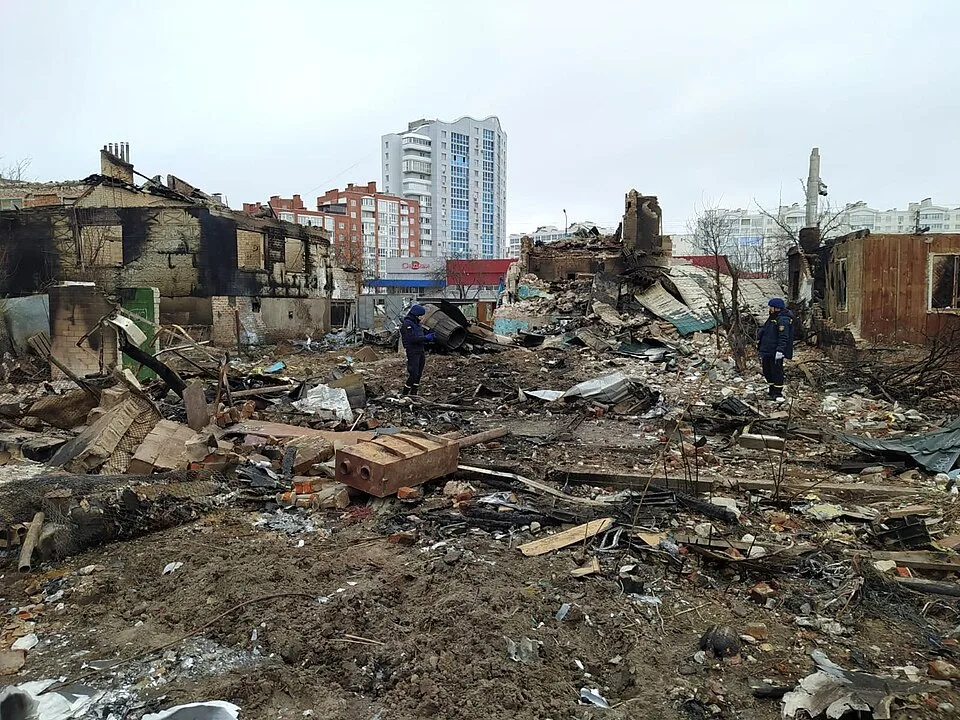
Russia sent 131 missiles and drones screaming into Ukrainian airspace overnight Friday, hitting Kyiv hard enough to injure at least 10 people, including a child, and light multiple buildings on fire. Ukraine's air defenses knocked most of it down. Most. The rest landed exactly where Russia aimed them.
What Hit Kyiv and Where
CBS News reports that explosions and fires broke out across three of Kyiv's districts: Solomianskyi, Darnytskyi, and Dniprovskyi. In Solomianskyi, a strike set a three-story office and warehouse building ablaze. Over in Dniprovskyi, another warehouse caught fire after taking a direct hit. Ukraine's State Emergency Service confirmed the damage and injuries via Telegram.
The at least 10 injured include a child. That detail sits there in the official statement, matter-of-fact, which is somehow worse than if someone had editorialized around it. A child. In Kyiv. In 2026. Because Russia decided to launch an overnight barrage on a Saturday.
The Scale of the Attack
Ukraine's Air Force broke down the assault in stark terms: 10 missiles of various types, including six ballistic missiles, plus 121 drones. Ukrainian air defenses shot down or electronically suppressed two missiles and 111 drones, which sounds impressive right up until you do the math and realize that still left a significant chunk of the attack getting through.
Direct hits were recorded at 11 separate locations from ballistic missiles, two guided air-to-surface missiles, and seven attack drones, according to the Air Force. Debris from intercepted weapons caused additional damage at three more locations. So even the stuff Ukraine successfully stopped still managed to hurt people and property on the way down. There is truly no clean version of this.
What Russia Says It Was Targeting
Russia's Defense Ministry, never shy about framing war crimes as precision operations, said its forces targeted drone production facilities in Kyiv. It also claimed strikes against the ports of Izmail and Chornomorsk in Ukraine's southern Odesa region. Take that framing for whatever you think it's worth, which should be approximately nothing, given that warehouses and office buildings in residential districts are not traditionally classified as military drone factories.
Moscow also claimed its own air defenses destroyed 178 Ukrainian drones overnight across eight Russian regions, plus over occupied Crimea and the Black and Azov seas. Ukraine has been striking back hard at Russian territory for months now. That part of the story tends to get less airtime in Western coverage, but it's very much happening.
This Is Not a One-Off
Here's the thing about framing an overnight barrage of 131 weapons as breaking news in July 2026: it has become, in the most horrifying sense possible, routine. Russia has been hammering Ukrainian cities with drone and missile salvos for years. The specific mix of weapons shifts. The target districts rotate. The injury counts fluctuate. The fundamental reality does not change.
What has changed is the scale and sophistication of the drone component. Russia is launching larger swarms more frequently, and Ukraine is getting better at intercepting them, but better is a relative term when the attacker just keeps scaling up the volume. You can improve your interception rate and still have more actual weapons getting through than before, simply because the raw numbers keep climbing.
Where the War Stands Right Now
The front lines in eastern Ukraine remain brutally contested. Russia has ground forward in some areas while taking significant losses in both personnel and equipment. Diplomatic noise about ceasefires and negotiations has, so far, produced exactly zero ceasefires and zero negotiations of substance. What it has produced is a lot of Western officials talking about peace while Ukraine burns.
The United States, under the current administration, has sent mixed signals about continued military support that would be alarming if you had not already spent the last year watching the White House treat Ukrainian sovereignty as a bargaining chip in its weird ongoing psychodrama with Vladimir Putin. Europe has stepped up its own support commitments, but the gap left by any reduction in American hardware is not a small one.
The Dingo Take
Ten people injured, including a child. Buildings burning in three separate districts. One hundred and thirty-one weapons launched at a civilian capital in a single overnight attack. And somewhere in Moscow, officials typed out a press release describing it as a precision strike on drone facilities, and nobody in the Russian government had to answer for any of it.
This is what impunity looks like when it has been fully institutionalized. Russia has been doing this, in various configurations, for years. The world watches, condemns, sometimes sanctions, occasionally sends weapons, and the barrage continues the next Saturday and the one after that. The child injured in Kyiv last night is not a data point. That is an actual kid who got hurt because the international community has collectively decided that the cost of stopping this is higher than the cost of watching it continue.
We are not going to tell you there is an easy answer here, because there isn't one. But we are going to tell you that normalizing this, filing it under 'ongoing conflict' and clicking to the next story, is exactly what Russia is counting on. The boredom of atrocity is a weapon too. Don't let them have it.



Comments