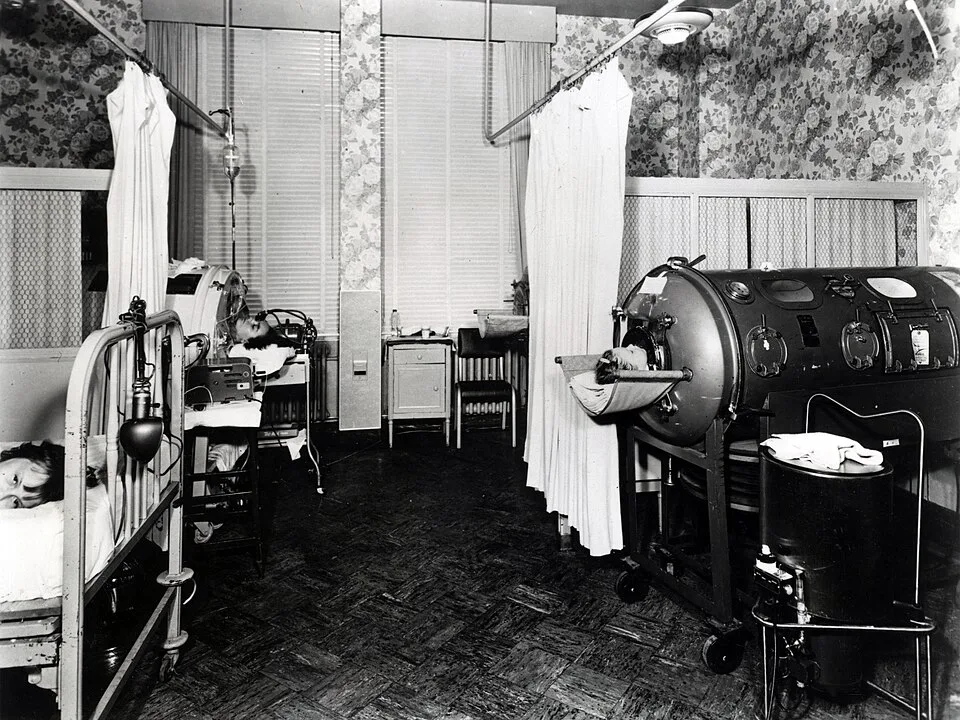
Martha Lillard was told she wouldn't survive past 20. She made it to 78, outliving that prediction by nearly six decades, outliving the disease that paralyzed her, and outliving an era when iron lungs filled hospital wards from coast to coast. She died on June 26 in Oklahoma, and with her goes the last living connection to one of the most terrifying chapters in American medical history.
A Machine, a Life, and 73 Years Inside a Metal Cylinder
Lillard contracted polio at age five. The disease attacked her lungs. The iron lung became her survival mechanism, a cylindrical metal chamber that enclosed her body and used changing air pressure to force air in and out of her lungs since her own respiratory muscles could no longer do the job. She slept inside it every night for the rest of her life.
And yet. According to The Guardian, she attended grade school for two hours daily. She completed the rest of her education through tutoring. Her family built a custom trailer so she could take road trips to Missouri, her father personally calling ahead to hotels to make sure the doors were wide enough to wheel in the machine. She drove a car for a period of time. She drove a car.
In a 2013 interview with NBC News, Lillard described the first moment she was placed inside the iron lung not as horror but as relief. 'It feels wonderful, actually, if you're not breathing well,' she said. 'It makes all the difference when you're not breathing.' That quote deserves a moment. The machine that most people would find nightmarish was, for her, the thing that made everything else possible.
What Actually Killed Her
Her death certificate lists chronic pulmonary failure and post-polio syndrome as causes of death, according to The Guardian. But her younger sister, Cindy McVey, told the Associated Press that she believes the effects of a long-term Covid-19 infection contributed to Lillard's death.
Post-polio syndrome is a real and cruel twist of the disease. Decades after the initial infection, survivors can experience a return of muscle weakness, fatigue, and breathing problems. For someone already dependent on a machine to breathe, there is no margin for error. Covid attacking the lungs of a woman whose lungs had already been fighting for 73 years is not a minor complication. It is the final straw on a structure that had been holding itself together through sheer human will.
The End of an Era That Should Never Come Back
Lillard's death comes roughly two years after Paul Alexander, a Texas man who spent most of his life in an iron lung after contracting polio at age six. Alexander was paralyzed from the neck down, earned a law degree, wrote a memoir, and created paintings by holding a brush in his mouth. He was recognized by Guinness World Records as the longest iron lung patient in history. He also died at 78.
Two people. Both in iron lungs. Both 78 years old. Both gone within two years of each other. There are no more like them. The disease that put them in those machines was eliminated in the United States in 1979, and the CDC reports that widespread vaccination had already pushed annual US polio cases below 100 by the 1960s and below 10 by the 1970s. The iron lung wards that once packed hospitals during summer epidemic season are a ghost story now, something parents used to whisper about to explain why their kids couldn't swim in public pools.
Before vaccines became available, polio was one of the most feared diseases in the country. Thousands of children paralyzed every year. Iron lungs were everywhere, and they were only ever meant to be a temporary measure. Vaccination campaigns made both the disease and the machines disappear. That is what vaccines actually did. That is the historical record.
She Was Not Supposed to Be Here This Long
'They told her she wasn't supposed to live past 20 years old,' McVey told the Associated Press. 'She had the enthusiasm and the drive to continue living and make the best of her life.'
That's the sentence that stays with you. The medical community looked at a five-year-old girl in a metal cylinder and gave her fifteen more years, maybe. She gave herself another fifty-eight on top of that. Road trips. Driving. Two hours of school every day as a kid, dragging herself into a classroom while a machine sat waiting at home. Every single day of her adult life was a statistic that shouldn't have existed according to the original prognosis.
The Guardian reports Lillard's obituary was posted online following her death on June 26. She leaves behind her sister and a country that has almost entirely forgotten what her disease could do.
The Dingo Take
Here is the unbearably dark irony of this moment. Martha Lillard survived polio. She survived it for 73 years inside a machine, doing things nobody thought she could do, living a life that defied every grim prediction handed to her family in the 1950s. And we are eulogizing her right now, in 2026, while a significant chunk of the American public has spent the last several years being actively recruited into skepticism about the vaccines that made sure nobody else ever had to be put in an iron lung in the first place. That's where we are.
Robert F. Kennedy Jr. runs the Department of Health and Human Services. The CDC's credibility has been systematically torched. Measles is back. Polio showed up in New York sewage samples not that long ago. And the two last people in America who could have told you from personal lived experience exactly what it felt like to have vaccine-preventable disease take your body apart are now both dead. The witnesses are gone. The institutional memory is being bulldozed. This is the part where history repeats itself and everyone acts surprised.
Martha Lillard deserved a better send-off than becoming a cautionary tale. She was a person, not a metaphor, and she was apparently a hell of one who refused to let a metal box define the boundaries of her existence. But she is also now a piece of evidence in an argument that should not still be happening. Remember what the machine looked like. Remember what put people in it. Remember that vaccines ended it. This is not complicated.



Comments