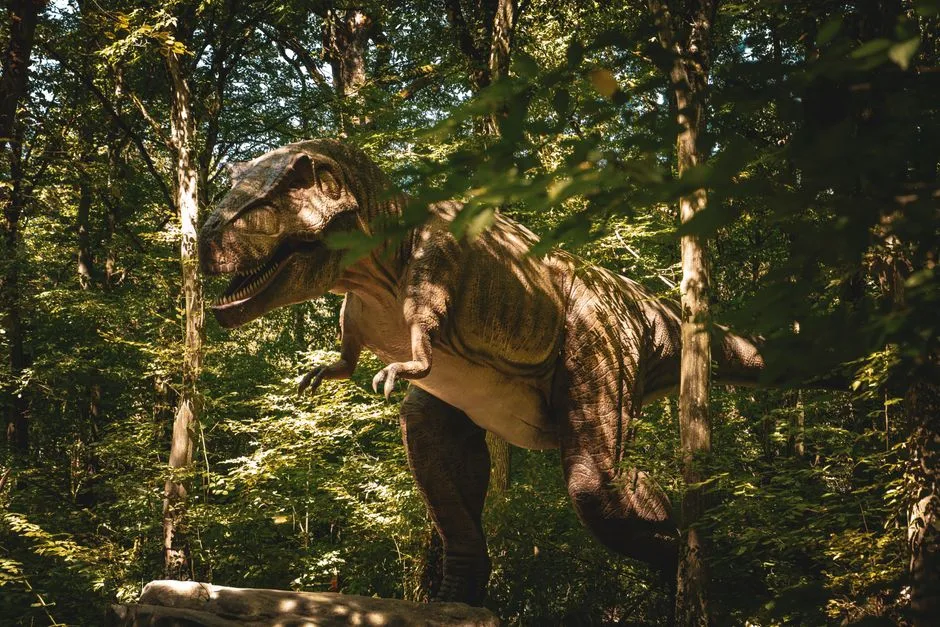
Somewhere right now, a very wealthy person is deciding whether a 67-million-year-old apex predator would look good in their foyer. 'Gus,' a 38-foot Tyrannosaurus rex skeleton pulled out of the South Dakota dirt just a few years ago, went up for auction at Sotheby's New York on Tuesday with a starting bid of $19 million and an estimated final price of $20 to $30 million. The scientists who actually study these things are, to put it gently, losing their minds.
Meet Gus, the Most Expensive Dead Thing on Earth
According to NPR, Gus was discovered in 2021 on private land in Harding County, South Dakota, and excavated through 2023 by Theropoda Expeditions. Nearly a thousand bone fragments were collected. The finished skeleton stands 12 and a half feet tall and stretches 38 feet long, making it one of the largest and most complete T. rex specimens ever found.
The dinosaur is named after Gary 'Gus' Licking, the rancher who owned the 6,500-acre property where Gus was buried. Licking had apparently spent years wandering his land, spotting T. rex teeth and fossil fragments and suspecting something big was underneath. He was right. He also, heartbreakingly, died during the excavation and never got to see the skeleton fully assembled. The dinosaur outlasted him by 67 million years and counting.
Sotheby's describes Gus as 'a very large, robust, adult individual' based on bone size and development. Which, honestly, same energy as a real estate listing calling a studio apartment 'cozy.' But in this case, it's accurate.
The Bidding War for Bones Has Been Going on for a While
This isn't some new fever dream of the ultra-rich. NPR points out that Sotheby's held its first dinosaur auction back in 1997, when a T. rex named Sue sold for $8.4 million, purchased by a consortium of companies for the Field Museum in Chicago. That felt like a lot of money then. It feels almost quaint now.
In 2024, a stegosaurus named Apex sold for $44.6 million, the highest price ever paid for a dinosaur fossil. The buyer was billionaire investor Ken Griffin, who then loaned it to the American Museum of Natural History in New York for four years. Ken Griffin, the man who famously bought a copy of the U.S. Constitution to outbid a crowdfunded effort, now also owns a stegosaurus. Sure. Fine. Everything is fine.
Gus, at an estimated $20 to $30 million, sits comfortably in what is apparently now the standard price range for prehistoric megafauna. The market for dead dinosaurs is, by any measure, booming.
What $30 Million Could Actually Do for Science
Here is where the story stops being funny for a second. Paleontologist Scott Persons, curator of natural history at the South Carolina State Museum, told NPR in an email that dinosaurs selling at these prices reflects an 'increase in market demand' and that 'more and more dinosaurs are being sold this way and at ridiculous prices.'
Persons didn't mince words about the opportunity cost. 'A sum like that could endow a research program at a public museum of your choosing,' he said. 'That would pay for a career's worth of fieldwork, the discovery of whole new species, and the public exhibition of the findings.' Let that sink in. Thirty million dollars could fund an entire scientific career, generate genuinely new knowledge about life on this planet, and make those discoveries available to the public. Or it could sit in a hedge fund manager's living room.
This is the part that makes paleontologists genuinely angry, not just aesthetically displeased. When a fossil ends up in a private collection, it is effectively removed from science. Researchers cannot study it. The public cannot see it. It becomes a very expensive, very old conversation piece.
The Private Fossil Market Is a Real Problem With No Easy Fix
The legal situation here is worth understanding. Gus was found on private land, which under U.S. law means the landowner, not the public, owns what's underneath. This is distinct from fossils found on federal land, which belong to the government and must go to public institutions. It's a patchwork legal framework that has created a thriving private fossil market with essentially no guardrails on where specimens end up.
Other countries handle this differently. In many places, significant fossil finds are considered national patrimony regardless of where they're located. The United States, predictably, has chosen the path where a billionaire can outbid a natural history museum for a one-of-a-kind scientific specimen because the free market is a sacred and eternal principle that must be applied even to extinct apex predators.
The result is a slow drain of irreplaceable specimens out of public access and into private hands. Gus might get loaned to a museum, like Apex the stegosaurus. Or it might not. That's entirely up to whoever writes the check.
The Dingo Take
Look, nobody is saying rich people can't spend their money on weird things. Buy a yacht. Commission an enormous painting of yourself on a horse. Knock yourself out. But there is something specifically maddening about funneling tens of millions of dollars into a private fossil collection when that same money could fund a decade of field research, the discovery of species nobody has ever seen, and the kind of science education that actually moves the needle on public understanding of, say, the natural world we are currently destroying at an impressive clip.
The Ken Griffin stegosaurus loan to the American Museum of Natural History is the best-case scenario here, and it still involves a billionaire deciding, on his own private timeline, what the public gets access to and for how long. That is not how science is supposed to work. That is how patronage works, which is a system we nominally moved away from several centuries ago.
Gus survived 67 million years under the South Dakota prairie. He made it through multiple mass extinction events, the rise and fall of entire ecosystems, and the whole embarrassing saga of human civilization. It would be a genuine tragedy if the last chapter of his story was 'and then he became a tax-deductible art object for someone who also owns three private jets.' The scientists are right to be furious. The rest of us should probably be paying more attention.



Comments