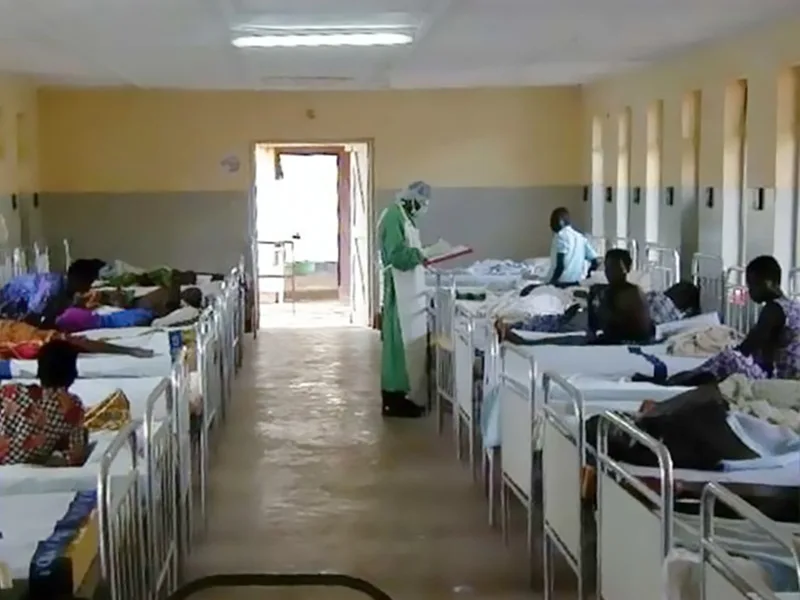
The people burying Ebola victims in the Democratic Republic of the Congo have not been paid in two months. So they stopped. The gravediggers walked off the job. The epidemiologists walked off the job. The drivers walked off the job. And now the worst Ebola outbreak in African history has a new problem: the hospital at the center of it is at a standstill.
What's Actually Happening on the Ground
Dozens of employees at Rwampara General Hospital in Ituri province walked off the job Monday, according to Al Jazeera. Ituri is the epicenter of an outbreak that has now recorded 1,926 cases and 702 deaths. The strikers include epidemiologists, case investigators, drivers and gravediggers. People who touch the sick. People who bury the dead. Gone.
"We don't know how it is possible to not have been paid for two months," health worker Bahati Claude told the Associated Press. That's a sentence that should stop you cold. In the middle of the deadliest Ebola outbreak Africa has ever seen, the people doing the most dangerous and essential work on the planet are asking why their paychecks haven't shown up since May.
DRC Health Minister Roger Kamba told reporters last week that the government is working on it, blaming "changes to the lists" for the payroll chaos. He promised the money exists and the situation can be sorted out. Great. Fantastic. Someone should tell the virus to pause while the paperwork gets fixed.
The Outbreak Is Spreading. Fast.
While the hospital sat empty on Monday, DRC's National Public Health Institute confirmed the virus has now reached two new northeastern provinces: Haut-Uele and Tshopo. That brings the total to five provinces with confirmed Ebola cases. The outbreak started in the north and it is moving.
The International Rescue Committee has warned that the risk of Ebola crossing into neighboring South Sudan is growing as the outbreak expands into new territory, according to Al Jazeera. South Sudan, for context, is a country with a healthcare system in no shape to absorb an Ebola outbreak. The IRC says transmission is accelerating in areas already hit. The WHO has called for an "urgently needed" accelerated response from local, national and international partners. That word, urgently, is doing a lot of work in that sentence.
The United Nations has already calculated that this outbreak has pushed nearly one million people into poverty and could cost the African continent $3.6 billion. That number will go up if the response workforce is on a picket line.
Why This Is So Hard to Fight
Even before the payroll collapse, this outbreak was a nightmare to contain. Al Jazeera reports that paramilitary rebels control parts of Ituri province, specifically because the region sits on valuable mineral deposits. Health workers trying to reach patients have to move through territory that armed groups treat as their personal revenue stream. That is not a metaphor. There are actual gunmen between doctors and patients.
Beyond the security situation, the response has been complicated by communities that believe Ebola is a form of witchcraft, leading to attacks on health workers. Bereaved families have held traditional burial ceremonies that involve physical contact with the dead, which is one of the most efficient ways the virus spreads. Misinformation is moving faster than the response. Trust in health officials, already thin, is not improving when the health officials haven't been paid and have stopped showing up.
This is what an outbreak looks like when the systems holding it back are made of wet paper. Every obstacle compounds the next one.
It's Already Crossing Borders
A second American citizen infected with Ebola was admitted to a special isolation unit at Frankfurt University Hospital in Germany on Monday, according to Al Jazeera. The patient, a man in his 60s, was confirmed to have contracted the virus while working for a Christian aid group in the DRC. His condition is currently stable, the head of the isolation unit said.
This is the second U.S. citizen to be medevaced out with the disease. That detail matters not because the lives of American aid workers matter more than Congolese patients, but because it is a reminder that this outbreak has a footprint that reaches Europe. Ebola does not respect borders. It never has. The response to it cannot be treated as someone else's regional problem.
The Dingo Take
Let's be honest about what this looks like from the outside. The worst Ebola outbreak in African history is burning through a region controlled in part by armed rebels, and the people tasked with stopping it just went on strike because their government couldn't figure out how to send them a paycheck. The health minister's explanation, that list changes created some confusion, is the kind of bureaucratic shrug that gets people killed. Seven hundred and two people are already dead. The number is going up.
The international community has been sounding alarms. The WHO is using the word "urgently." The IRC is warning about South Sudan. The UN is counting the billions this will cost. And yet here we are, watching the response mechanism break down over an accounts-payable problem. There is plenty of blame to go around, from a Congolese government that cannot pay its workers to an international aid architecture that consistently underinvests in outbreak preparedness until things are already catastrophic.
The gravediggers walked off the job. Read that again. The people burying Ebola victims stopped going to work because they have not been paid since May. If that image does not clarify exactly how badly this situation has deteriorated, nothing will.



Comments