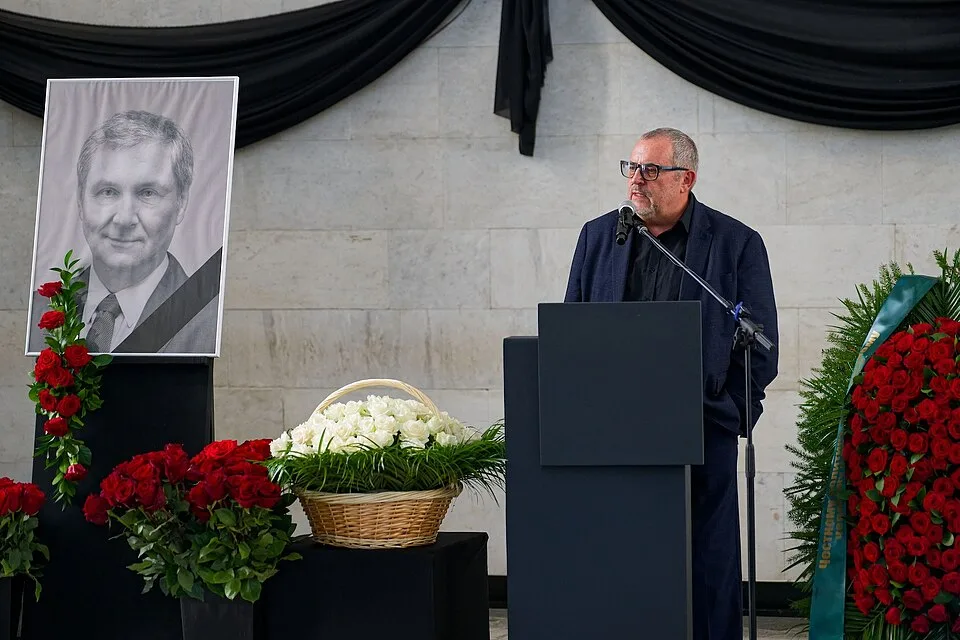
The Russian government, apparently threatened by a man whose face appeared in a video for ten seconds, has arrested Boris Nadezhdin, the anti-war politician who tried to challenge Vladimir Putin in last year's presidential election. Nadezhdin was taken to a police station west of Moscow on Monday morning and charged with 'displaying extremist symbols.' The extremist symbol in question was a brief image of the late Alexei Navalny, dead opposition leader and current regime boogeyman, which flickered across a reposted video on Nadezhdin's social media accounts back in November 2023.
A 10-Second Crime
Let's be precise about what Russia is calling a criminal act here, because precision is important. According to the BBC, the charge stems from a video that Nadezhdin's accounts reposted more than two years ago. Navalny's face appeared in it. For ten seconds. That's the whole case.
Navalny, for anyone who needs the reminder, was Putin's most prominent domestic critic. He was poisoned with a nerve agent in 2020, survived, returned to Russia, was immediately imprisoned, and then died in an Arctic penal colony in February 2024 under circumstances that no serious person believes were natural. Russia has since designated him an extremist, which means that posting a photo of his face is now, legally speaking, a crime. This is the country's justice system at work.
They Already Tried to Kneecap Him Last Week
Monday's arrest didn't come out of nowhere. Just last week, Russia's justice ministry designated Nadezhdin a 'foreign agent,' a label the Kremlin has used for years to sideline critics and civil society groups. The BBC reports the designation came with accusations that he spread false information about the Russian government and called people to attend unauthorized rallies.
The foreign agent label would have already disqualified him from running in September's parliamentary elections, the Duma vote he had recently announced he'd contest. So the regime had already legally blocked his path back into politics. The arrest on Monday, carrying a separate one-year ban on running for office, was purely redundant. Which tells you this isn't about legal process. It's about sending a message to anyone watching.
This Guy Was Already the Mild One
Here's the darkly funny part about Boris Nadezhdin: he was never even the radical. When he tried to run as a presidential candidate in early 2024 on an anti-war platform, his criticism of Putin was, as the BBC noted at the time, measured enough that some observers speculated the Kremlin might actually allow him to run, just to give the election a thin coating of legitimacy.
He told the BBC he wanted to stop the war in Ukraine and restore normal relations with the West. That's it. No calls to storm the Kremlin, no revolutionary manifesto. The man wanted a ceasefire and working relations with neighboring democracies. For this, Russia's electoral commission found that over 15% of his submitted signatures were somehow flawed and barred him from the ballot. For this, he is now under arrest.
Putin, meanwhile, won that March 2024 election with a landslide. He is now in his fifth term. A constitutional amendment quietly passed in 2020 reset his term limits entirely, meaning he can legally stay in power until 2036. He will be 78 at the next scheduled presidential election in 2030. The man has planned this very carefully.
The Options Are Jail, Exile, or Death
The BBC puts it plainly: the opposition figures who could have offered Russian voters a genuine alternative are now either in jail, in exile, or dead. That sentence should probably be read slowly and in full, because it describes the complete elimination of political competition in a country with over 140 million people.
Earlier this year, Nadezhdin told the BBC that Russians were starting to connect their daily economic misery, the healthcare failures, rising food prices, restricted internet, to Putin's political choices. That kind of message, linking kitchen-table problems to Kremlin policy, is precisely the thing an authoritarian government most fears. Not because it's radical. Because it's obvious, and it works.
What September's Elections Will Look Like
Russia is still holding elections in September. The Duma, the country's parliament, will go through the formal motions of a vote. Candidates will appear on ballots. Results will be announced.
What will not happen is competition. The BBC notes the Kremlin now holds near-total control over Russian political life, and that any credible challenge to Putin's rule is effectively impossible. What September produces will be a managed performance, not a democratic exercise. Nadezhdin was one of the last people willing to try to make it something else. Now he's at a police station answering for a decade-old repost.
The Dingo Take
The ten-second Navalny clip is almost a perfect symbol of where Russia is right now. The regime is so locked down, so completely intolerant of anything that even gestures toward dissent, that a fleeting image of a dead man's face constitutes a prosecutable offense. Not a speech. Not a rally. Not a leaked document. A repost with a two-second glimpse of someone the government murdered and then retroactively declared a criminal.
Nadezhdin wasn't a revolutionary. He was a moderate anti-war politician who wanted to run for parliament, the kind of person any functioning democracy would welcome into the process as proof that the system works. Instead, Russia hit him with a foreign agent designation, then an arrest, then a criminal charge, in the space of a single week. The message is not subtle: there is no legal path to challenging this government, and the government would like you to understand that clearly.
The rest of the world is deep in its own chaos right now, and stories like this one tend to get swallowed by the news cycle. Don't let it. What's happening to Nadezhdin is what the end of politics looks like. Not a dramatic coup, not tanks in the street. Just quiet, bureaucratic elimination. A man trying to run for office, charged with a ten-second video, banned from the ballot, and sitting in a police station. That's how it goes.


Comments