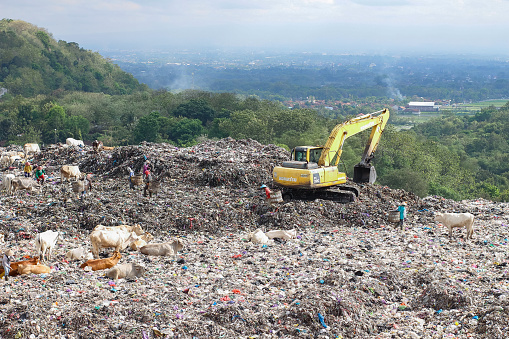
A landfill that Indonesian regulators had already ordered closed for illegal open dumping caught fire on June 30, burned for ten straight days, sent 200 residents fleeing into an emergency shelter, and took 300 firefighters, 19 engines, and three helicopters to finally put out. The site had been allowed to reopen in December after promising to clean up its act. It had not cleaned up its act. Shocking, we know.
Ten Days of Fire, a Week of Toxic Smoke
The Jatiwaringin landfill in Tangerang regency, about 30 kilometers west of Jakarta, receives roughly 1,200 tonnes of waste every single day. When it caught fire, about 15 of its 33 hectares went up, which CNA describes as the equivalent of 22 football fields burning simultaneously. For more than a week, over 200 displaced residents packed into the rundown hall of Tanjakan Mekar village office, sleeping on thin mats while toxic haze drifted in on shifting winds.
"It was so hard to breathe. My throat hurt and my eyes stung," Fitriah, a 34-year-old housewife who sheltered there with her two children, told CNA. Sleep was hard to come by. Families lay awake worrying about the homes they had left behind and whether the flames were getting closer. The fire was finally fully contained at 7:30 pm on July 9, Indonesia's National Disaster Mitigation Agency announced. Police are still investigating what started it and have not ruled out negligence or open burning.
The Part Where It Gets Embarrassing
Here is where the story goes from disaster to farce. Indonesia has technically banned open dumping since 2013. That is not a typo. Thirteen years ago, the practice was made illegal. According to the country's Environment Ministry, more than 340 of Indonesia's 550 landfills are still doing it anyway.
Jatiwaringin was not just one of those 340. It was one that regulators had specifically called out. In May 2025, inspectors ordered it to temporarily shut down after finding it was still operating as an open dumpsite, letting untreated leachate seep into groundwater, and failing to stop open burning on site. The site was allowed to reopen in December. Seven months later, it was on fire for ten days.
Environment Minister Jumhur Hidayat told RRI radio on July 5 that the fire was "not a natural disaster but a failure and negligence in its waste management system." He also said the government is looking to end open dumping nationwide by the end of this year. The government has been saying something like that since approximately 2013.
Why These Fires Keep Happening
Open dumps are not just ugly. They are chemical fires waiting for a spark. Mahawan Karuniasa, an environmental engineering expert at the University of Indonesia, explained to CNA exactly what makes them so dangerous: decomposing organic waste produces methane, a highly flammable greenhouse gas. Extreme heat dries everything out and lowers the ignition point. Then the smallest spark hits a pile containing dried organics, plastics, paper, textiles, rubber, and possibly electronic waste or batteries, and suddenly you have something no one can put out quickly.
"Which is why they can ignite, spread easily and keep smoldering beneath the surface, which makes detecting, let alone extinguishing, such fire difficult," Mahawan said. Wahyu Eka Styawan of environmental advocacy group Walhi put it even more plainly: "As long as methane continues to be produced in open dumps, with organic waste mixed together with other types of rubbish, fires like this are not merely a possibility, they are inevitable."
El Nino Is Coming Back, and That Is Bad News
Landfill fires are a recurring problem in Indonesia during prolonged dry spells, and forecasters have warned that El Nino is set to return this year with hotter, drier conditions. During the 2023 El Nino cycle, Indonesian authorities recorded 35 landfill fires nationwide. One at Bali's Suwung dumpsite burned for an entire month and scorched 16 of its 32 hectares, making it the worst landfill fire in Indonesia's recorded history. Until, possibly, the next one.
CNA reports at least seven fires in 2024 and eight in 2025, even during the wetter La Nina conditions that were supposed to offer some relief. Four days after Jatiwaringin caught fire, another landfill in Jember, East Java also went up, though that one was extinguished within hours. The exact cause of these fires is frequently never officially established. When your landfill is producing methane gas around the clock and you have scavengers burning rubber off copper wire on site, pinning down the precise moment of ignition is apparently not a priority.
What Happens When Laws Are Decoration
The core issue here is not El Nino. It is not the chemistry of methane production. It is that Indonesia passed a law banning open dumping over a decade ago and has since watched the number of non-compliant sites barely budge. According to the Environment Ministry's own count, more than 340 of 550 landfills are breaking that law right now, today, as you read this.
Sanitation worker Madin, 40, told CNA he had never seen a fire as big as the Jatiwaringin blaze. He had watched the same site catch fire before, but previous burns were small and out within a day or two. This one took a week and a half and a small army to stop. The difference between those small fires and this catastrophic one is not a mystery. It is what happens when an open dump is allowed to keep running for years past the deadline to shut it down.
The Dingo Take
Let's be very clear about what happened here. A government banned a practice in 2013. That practice continued for thirteen years at hundreds of sites. Regulators identified one specific site as a bad actor, ordered it closed, accepted its promises to do better, let it reopen, and watched it catch fire for ten days, displacing hundreds of residents and requiring hundreds of emergency workers to contain. Now the same government is saying it will definitely end open dumping by the end of this year. Sure. Totally believable.
The people sleeping on thin mats in a village office while smoke drifted through the windows are not victims of El Nino or bad luck or the inherent complexity of waste management. They are victims of a compliance failure so complete it would be funny if it weren't choking children. Fitriah and her kids did not cause this. The scavengers stripping wire on an officially banned open dumpsite did not invent the system that put that dumpsite in their neighborhood. Thirteen years of a law that nobody enforced did.
El Nino will come back. The methane will keep building in hundreds of open dumps across Indonesia. The question of whether the next catastrophic fire hits before or after the government's end-of-year deadline to fix all of this is, at this point, genuinely open. The smart money is not on the deadline.



Comments