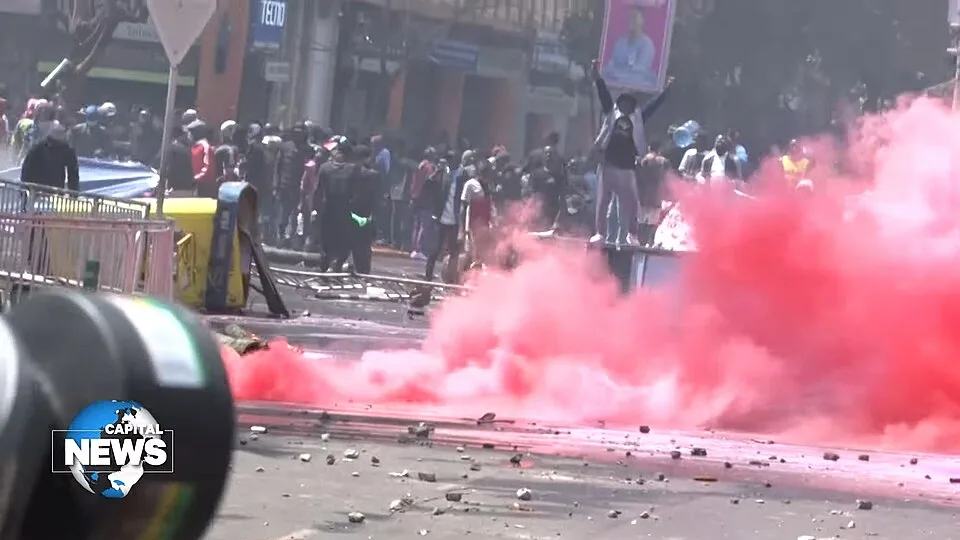
Four dollars. That is the going rate to hire an armed man to attack a protest, break up a civil society meeting, or intimidate a political opponent in Kenya right now. According to an AFP investigation, politicians across the country are quietly building a market for hired muscle so cheap it makes a fast food combo look expensive, and rights groups are warning the whole thing could swallow Kenya's democracy before the 2027 elections even happen.
The Goon Economy Is Open for Business
The AFP investigation found that Kenyan politicians can recruit armed enforcers for as little as 500 Kenyan shillings per day, roughly four US dollars, with rates going up depending on how powerful the patron is. These recruits are not hard to find. Nairobi's sprawling informal settlements are full of young men with no work, no prospects, and no particular reason to say no to four bucks and a sense of purpose, however grim.
One man identified only as Marius told AFP he wanted to be a surgeon. He was seventeen when his family ran out of money for school fees and he started hiring himself out as an enforcer instead. He's twenty-seven now. Another recruit named Daniel studied criminology, got his degree, and then couldn't find a job anywhere in the formal economy. His line to AFP was bleak and perfect: 'They say education is the key, but honestly speaking we never find the padlock open.'
This is what scholars call 'informal repression,' according to Ernest Oduor, Head of Communication at the Kenya Human Rights Commission. The state, or actors close to it, outsource violence to groups with no official connection to anyone, which means no one is ever officially responsible for anything. It is plausible deniability with a machete.
What 'Goonism' Actually Looks Like on the Ground
Demas Kiprono, Executive Director of the International Commission of Jurists Kenya, described the phenomenon bluntly: whenever political competition heats up in Kenya, rights and democratic freedoms start getting trampled in ways that are, in his word, 'abhorrent.' The use of politically sponsored gangs serves two purposes, Oduor told Africanews. It undermines the legitimacy of protest movements, making them look chaotic and violent, while simultaneously allowing whoever hired the gangs to keep their hands officially clean.
AFP reporters did not just hear about this in interviews. They witnessed it. Armed groups were reportedly operating alongside police during anti-government protests last year. CCTV footage from June, according to the AFP reporting Africanews cites, showed officers moving with armed men who stormed a civil society meeting at Nairobi's All Saints Church. An actual church. Rights groups allege that in repeated incidents across political rallies, demonstrations, and civic events, police have simply not intervened when gangs showed up to work.
Police Say Relax, Everyone Else Says Don't
Police spokesperson Michael Muchiri called the collusion allegations 'preposterous.' Any officers who appeared to be acting alongside armed groups were doing so independently, he said, and are under investigation. 'The National Police Service is determined to ensure the goon culture does not gain a foothold in this country,' he told AFP.
The problem with that statement is that multiple human rights organizations, journalists with video footage, and a growing number of Kenyans who have been on the receiving end of these gangs would suggest the foothold already exists and has for a while. Saying you're determined to stop something that is already visibly happening is a bit like a lifeguard announcing their commitment to preventing drowning while someone is actively drowning.
This Is Not New, and the Current President Knows It Well
Kenya has a long and documented history of politically mobilized youth violence. Africanews traces the modern version of it back to the early 1990s and the Youth for KANU '92 movement under former President Daniel arap Moi, which was accused of vote buying and outright political violence. One of the organizers of that campaign was a young William Ruto, who is now Kenya's president.
Ruto was later charged by the International Criminal Court in connection with the catastrophic post-election violence of 2007 to 2008, which killed over a thousand people and displaced hundreds of thousands more. The ICC case was eventually dropped after witnesses recanted or disappeared. The government did not respond to AFP's requests for comment on the current reports of gang activity.
Some former gang members interviewed by AFP say demand for hired enforcers has actually increased since Ruto took office in 2022, particularly during the youth-led protests over corruption and the rising cost of living that shook the country in recent years. Make of that what you will.
The 2027 Election Clock Is Already Ticking
Rights organizations are not being subtle about the stakes here. With election campaigns expected to intensify over the coming months, Kiprono and others are warning that the combination of economic desperation, political rivalry, and organized informal violence is a recipe for something a lot worse than a disrupted protest.
Kiprono's prescription is straightforward: Kenya needs independent policing that is actually governed by the constitution and accountable to communities rather than to whoever is currently in power. 'To deal with this goonism we need an independent, strong police that is governed by the constitution and is democratic,' he told Africanews. That is a reasonable thing to ask for. It is also, in the current Kenyan political environment, an enormous ask.
The Dingo Take
Here is the thing about hiring people to commit political violence for four dollars a day. The price tells you everything. It tells you that the supply of desperate young men is essentially unlimited. It tells you that the economic conditions creating that desperation are not an accident, they are a feature of the same system that then turns around and rents those men out as weapons against the people trying to change that system. Daniel wanted a career in criminology. Instead he became a case study in it.
And look, the ICC connection is not a small detail you bury in paragraph eleven. Kenya's current president has a documented history with politically organized youth violence going back thirty years. The case against him at The Hague collapsed under circumstances that were, at minimum, suspicious. Now his government isn't responding to press inquiries about a new generation of hired enforcers and there is footage of police walking alongside men who just stormed a church meeting. The pattern is not hidden. It is just not being addressed.
Kenya is heading into an election cycle with mass youth unemployment, a political class with a long institutional memory for using violence as a campaign tool, security forces with a credibility problem, and a price point for hiring a thug that is genuinely lower than a movie ticket. The rights groups sounding the alarm are not being alarmist. They are doing arithmetic.



Comments