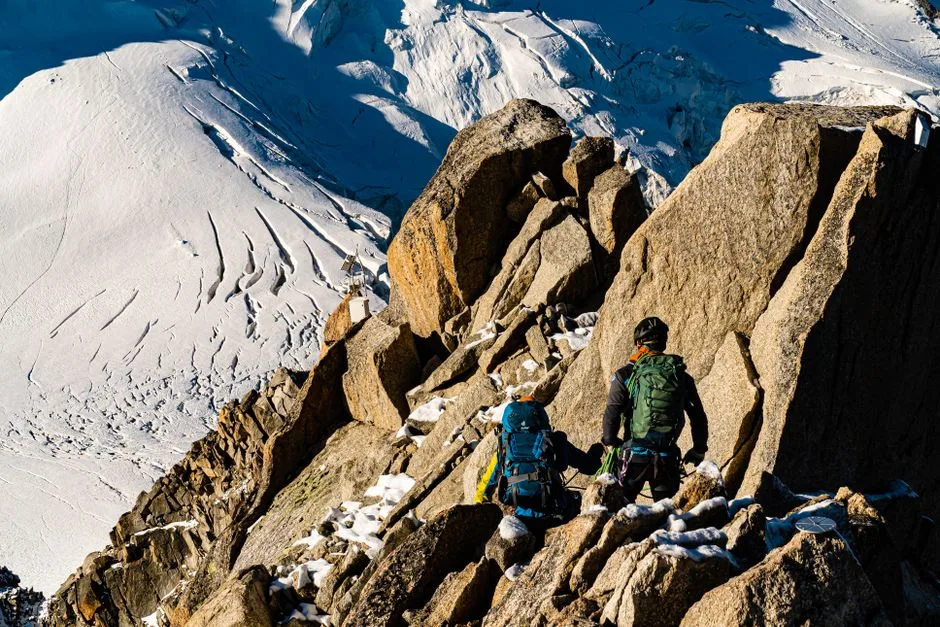
Two Romanian climbers who went missing in the Italian Alps last week were found Monday morning at the bottom of a crevasse roughly 65 feet deep, authorities told AFP. They had last been seen leaving a mountain refuge on July 9. Nobody heard from them again.
Five Days, No Contact, Then a Crevasse
The two climbers, Romanian nationals whose ages have not been disclosed, set out from a refuge in the Gran Paradiso massif on July 9, according to authorities in the Aosta Valley. That region sits in northern Italy, wedged between Switzerland and France, and Gran Paradiso itself peaks at 4,061 meters inside Italy's oldest national park. Scenic. Brutal. Unforgiving.
After days of helicopter searches, rescuers found the bodies Monday morning, CBS News reports, citing regional authorities and Italian news agency ANSA. They had fallen into a crevasse. Sixty-five feet deep. That is not a survivable fall, and nobody appears to have known it happened until this week.
Italy's Mountains Are Killing More People Every Year
Here is the part that should make you sit up straight. Mountain accidents in Italy killed 528 people in 2025, according to the Italian National Alpine and Speleological Rescue Corps, known as CNSAS. That is a 13% increase over the 466 deaths recorded in 2024. The trend line is pointing in exactly the wrong direction.
Earlier this year, CBS News reported that a record 13 backcountry skiers, climbers, and hikers died in the Italian mountains in a single week, with 10 of those deaths caused by avalanches. In November 2025, five German mountaineers died after an avalanche hit them in South Tyrol, among them a man and his teenage daughter. The Alps are not getting safer. If anything, they are getting meaner.
What the Numbers Are Actually Telling Us
A 13% year-over-year jump in mountain fatalities is not a blip. It is a pattern. Climate change is doing genuinely unhinged things to alpine snowpack, glacial stability, and the predictability of weather windows that climbers have historically relied on. Crevasses that were once covered by stable snow bridges are increasingly exposed or unpredictably unstable. Glaciers are retreating, leaving behind loose rock and new hazards that no guidebook has caught up to yet.
None of that is to say these climbers did anything wrong. Crevasse falls can happen to experienced alpinists in conditions that look completely reasonable from the surface. The mountain does not care about your skill level or your preparation. It just does what it does.
Gran Paradiso Is Not a Beginner's Destination
Gran Paradiso has a reputation as one of the more accessible 4,000-meter peaks in the Alps, which is a relative term. "Accessible" in alpine terms still means serious altitude, glaciated terrain, objective hazard, and consequences that leave no room for error. It draws a lot of climbers precisely because of that accessibility reputation, which is not always a good thing.
The mountain sits entirely within Italy's Gran Paradiso National Park, established in 1922. It is genuinely beautiful. It is also, as this week reminds us, capable of swallowing people whole and not giving them back for five days.
The Dingo Take
Two people left a mountain hut on July 9 and were not heard from again. That sentence alone should land with some weight. Whatever brought them to Gran Paradiso, whatever they were hoping for from that climb, it ended at the bottom of a 65-foot crack in the ice. Their names have not been released. Their ages have not been released. They are, for now, just a data point in a death toll that went up 13% last year and shows no sign of reversing.
The broader story here is not really about these two climbers specifically. It is about what is happening to the Alps as a whole. The mountains are changing faster than the systems humans built to manage them, and the death count is the receipts. Search and rescue operations are getting harder. The terrain is less predictable. And people keep coming, because the Alps are extraordinary and humans are wired to seek out extraordinary things even when those things can kill them.
None of this is an argument for keeping people off mountains. It is an argument for taking seriously what climate change is doing to places that millions of people treat as playgrounds. The crevasse that killed two Romanians this week probably looks different than it did ten years ago. The snow bridge that might have covered it might not exist anymore. That is not a tragic accident in isolation. That is a dispatch from a much larger disaster that is unfolding in slow motion, one body at a time.


Comments