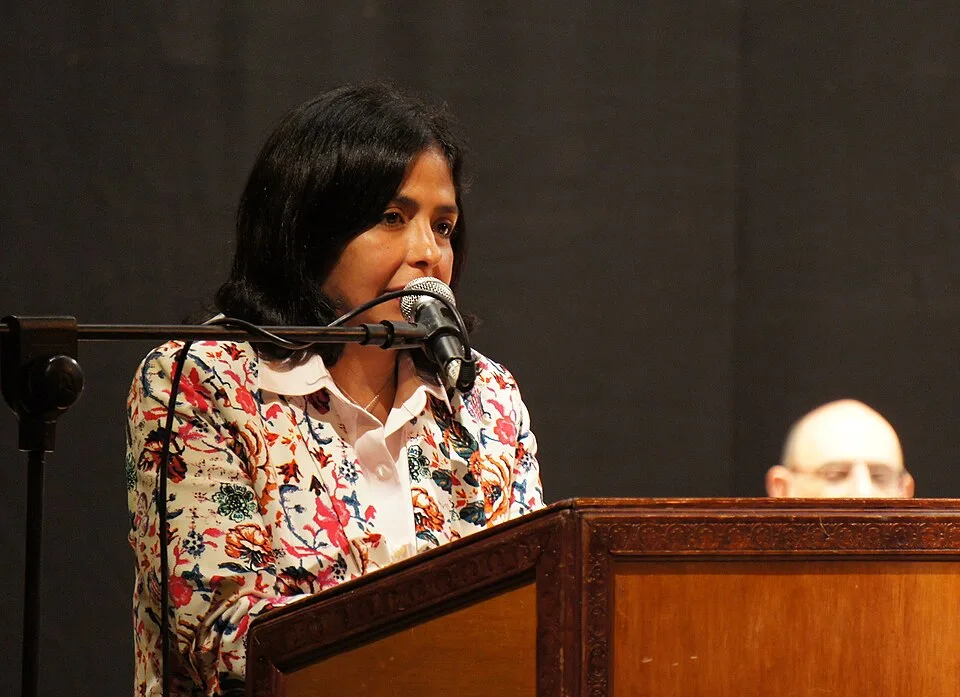
Eighty percent of the buildings in La Guaira, Venezuela just collapsed in a double earthquake. Multiple states suffered significant structural damage. And Venezuelan Acting President Delcy Rodriguez wants you to know that the economy is absolutely ripping right now, up over 9% in the second quarter. Everything is fine. Please stop asking questions.
The Plan With the Incredible Name
Rodriguez convened a meeting of more than 600 representatives from public, private, and foreign productive sectors to launch what the government is calling the "Venezuela Renace" plan, or in the official English translation provided by Venezuelan Presidential Press, the "Venezuela is Borned" Plan. Yes. Borned. That is the name of the national earthquake reconstruction strategy.
TeleSUR English reports the meeting was meant to "coordinate the launch of the strategic reactivation" effort and define "concrete actions to revitalize the country's productive apparatus in the areas affected by the double seismic event." The affected areas, again, include a state where 80% of buildings have collapsed, plus Caracas, Miranda, Vargas, Aragua, and Carabobo. So we are talking about most of the country's most populated corridor.
The plan prioritizes restoring infrastructure in the hardest-hit sectors and, according to TeleSUR, aims to "ensure the operational and logistical continuity of the main industrial branches." Which is a very polished way of saying: the country got hammered and now they have to figure out how to keep things running while rebuilding from rubble.
The Numbers That Are Doing A Lot of Work Right Now
Here is where it gets interesting, or depending on your tolerance for state media economic figures, where it gets complicated. Rodriguez did not stand in front of a disaster zone and project doom. She projected growth. Oil production is at one million barrels per day, tax revenues are up, and real consumption as of July is reportedly 33% higher than the same period last year, according to TeleSUR's reporting sourced directly from Venezuelan Presidential Press.
The economy, the acting president says, grew more than 9% in the second quarter, representing a 10% increase over the same quarter the previous year. If those numbers are accurate, Venezuela is genuinely outperforming most of the Western Hemisphere. If those numbers are what Venezuelan state press says they are, well, that context is worth carrying in your pocket.
To be direct about it: Venezuela does not have an independent statistics agency with international credibility. The government that is reporting 9% growth is the same government that controls the reporting mechanism for 9% growth. That does not mean the number is fabricated. It means you should hold it loosely, the way you would hold any figure generated by an apparatus that has historically stretched economic data to political purposes.
What Actually Happened in These Earthquakes
TeleSUR's reporting is thin on the seismic specifics, focusing almost entirely on the government's response plan rather than the scope of the disaster itself. What it does confirm is staggering: 80% of buildings collapsed in La Guaira state. Significant structural damage across Caracas and at least four other states. A population now living in or near rubble across the most densely populated part of the country.
La Guaira is Venezuela's main port state. It sits on the Caribbean coast just north of Caracas and handles a significant share of the country's imports. Losing 80% of its building stock is not a regional tragedy cordoned off from the rest of the economy. It is a direct hit to the infrastructure the country needs to move goods, people, and money. The government's emphasis on "logistical continuity" starts making more sense when you realize the port that feeds the capital is sitting in a devastated state.
The government also activated what TeleSUR describes as "all state mechanisms to guarantee the continuity of economic activity, the protection of employment, and the progressive restoration of dignified living conditions." A previous TeleSUR report noted that Venezuelans are "removing rubble in a technical and organized manner," which is a sentence that could mean many things depending on what resources the state actually has at its disposal.
The Ministerial Lineup and What It Signals
Rodriguez did not show up to this meeting alone. She brought the Sectoral Vice President for Administration and Digital Government, the Sectoral Vice President for Economy, the Minister of Industries and National Commerce, and the Minister of Ecological Mining Development. That is a cross-ministry formation designed to signal that this is a whole-of-government response, not a PR exercise.
The inclusion of the mining development minister is worth flagging. Venezuela's mining sector, particularly gold and coltan extraction in the Orinoco Mining Arc, has been one of the economy's more active revenue sources in recent years, operating under conditions that international human rights organizations have described as deeply problematic. Whether earthquake recovery efforts will draw further on those resources is not addressed in the reporting, but the minister's seat at the table is a data point.
According to TeleSUR, the acting president "emphasized that the articulation between the public and private sectors is essential to overcome the emergency." That framing, a socialist government leaning hard into private sector partnership during a crisis, is either pragmatic realism or a sign of how severe the situation is. Possibly both.
What 'Venezuela Renace' Actually Has to Do
Strip away the press release language and what the "Venezuela is Borned" Plan is actually being asked to do is enormous. Reconstruct a state where 80% of buildings are gone. Restore industrial capacity across six states. Protect employment. Maintain oil production at one million barrels per day. Guarantee social welfare. Do all of this simultaneously, with an economy that has spent the better part of a decade under US sanctions, hyperinflation, and mass emigration that has sent an estimated seven million Venezuelans out of the country.
TeleSUR notes the reconstruction process will happen "hand in hand with the private sector and national capacities," and that the government is maintaining "a permanent evaluation of the situation." These are the kinds of phrases that mean something or nothing depending entirely on the follow-through. Rodriguez projected, according to the reporting, "the comprehensive recovery of the entity most affected," and committed that the national plan contemplates "a profound transformation for the region."
Profound transformation is one way to describe rebuilding from 80% structural collapse. It is technically accurate.
The Dingo Take
Look, there are two stories running in parallel here and you have to hold both at once. One is a genuine catastrophe. A double earthquake just devastated one of Latin America's most populated urban corridors, leveled La Guaira, and left millions of people in damaged or destroyed housing across six states. That is a humanitarian disaster on a significant scale, and it deserves serious international attention regardless of what you think about the Maduro government or Venezuelan politics.
The other story is that the government's official response, filtered through state media and Venezuelan Presidential Press, is a masterclass in leading with strength you may or may not have. The 9% growth figure, the 33% consumption increase, the one million barrels per day: these are the numbers a government reaches for when it needs to project stability into a vacuum of fear. Whether they reflect reality, a version of reality, or a very determined aspiration is something no independent journalist operating freely in Venezuela can currently tell you with confidence.
What we can say is this: real people lost their homes, their neighborhoods, and in some cases their lives in these earthquakes. The "Venezuela is Borned" Plan, name aside, is the mechanism the government is betting on to help them. Whether it has the resources, the competence, and the freedom from corruption to actually deliver is the question that matters. The economic indicators can wait. The rubble cannot.



Comments