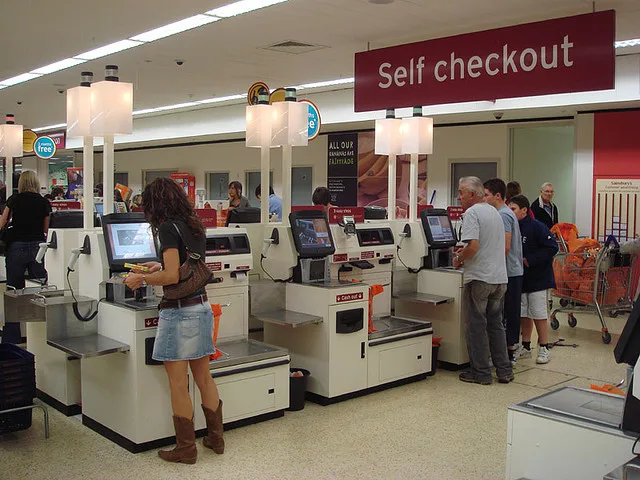
A grocery chain in the Bay Area has decided that the best way to catch shoplifters is to scan the face of every single person who walks through the door. Not just the ones acting suspicious. Everyone. You, your grandmother, the guy in the parking lot just trying to return his cart like a decent human being.
Every Shopper Gets the Surveillance Treatment
Grocery Outlet, headquartered in Emeryville, is rolling out facial recognition software called SAFR at select locations, starting with one store in Pleasant Hill, in Contra Costa County. The New York Post reports that shoppers will be notified the technology is in use, which is a nice touch, in the same way that a prison posting visiting hours is technically a courtesy.
The company is pitching this as a shoplifting countermeasure, and to be fair, California's shoplifting numbers are genuinely ugly. According to the Post, theft has jumped 50% since the pandemic, which is a real problem that real store managers have to deal with every single day. The question is whether the cure is worse than the disease.
The Part Where the Privacy Lawyer Says the Quiet Part Loud
Mario Trujillo, an attorney with the Electronic Frontier Foundation, did not mince words when CBS News came calling. "This is a dragnet that scans everyone. Even if you've done nothing wrong, your face is being scanned," he said. "What you're essentially doing is violating the privacy rights of every customer who walks into your store."
That is a pretty clean summary of the problem. You are not a suspect. You have not stolen anything. You just need eggs. And yet, somewhere between the parking lot and the produce section, your face gets run through a database anyway. The system does not care that you are innocent. It scans you because you showed up.
San Jose State engineering professor Dr. Ahmed Banafa raised a separate alarm for CBS News: that AI facial recognition systems have a documented history of racial bias. "AI is famous for going after, you know, certain races," he said. He added that any responsible deployment needs a human in the loop making the final call, not just an algorithm flagging someone and calling it a match.
What Grocery Outlet and SAFR Say in Their Defense
SAFR President Charisse Jacques told the Post that the system is not connected to law enforcement, does not build a public database of regular customers, and only stores information on people identified as shoplifting suspects, and only for a limited time. Jacques also said SAFR has never shared data with the government or ICE and has never been asked to.
That last part is doing a lot of work. "We have never been asked" is not the same as "we would refuse if asked," and in 2026, with the current administration's track record on immigration enforcement, that is not a distinction most civil liberties attorneys are going to let slide quietly. Promises about data sharing have a way of aging poorly.
Regular Shoppers Are Not Thrilled
CBS News talked to customers outside the store, and the reactions ranged from grudging understanding to flat-out rejection. "I do understand, but invading my privacy with my picture. I don't agree on that," one shopper named Barbara Jackson said. "You gotta find a better way."
Another customer, Steve Burdette, kept it simple: "It could lead to a lot of problems, I think for companies and businesses and people." That is a lot of polite hedging for what is, at its core, a pretty alarming thing to have happen to you while you are buying cereal.
For what it's worth, experienced store manager June Guerrero told CBS News she gets it. "I worked for years as a manager of a store and the theft was just unbelievable. I agree with it." That perspective deserves to be taken seriously. Retail theft is not a victimless crime, and the people most exhausted by it are usually the workers, not the executives making decisions from the corporate office.
The Bigger Picture Behind the Price Tag
Grocery Outlet's facial recognition rollout does not exist in a vacuum. American grocery chains have been aggressively expanding their surveillance and data-collection infrastructure for years, usually sold to the public as a loss-prevention or efficiency measure, and usually landing somewhere between mildly creepy and genuinely alarming.
The Post notes that Walmart has already been moving toward digital shelf labels across all US stores, and shoppers have raised legitimate concerns that those labels could enable dynamic, or surge, pricing, where the cost of your milk adjusts in real time based on demand and inventory conditions. Combine that with facial recognition at the door and you start to get a picture of what the modern American grocery run actually looks like: a fully instrumented commercial transaction where you are the least-informed party in the room.
The Dingo Take
Here is the thing about the shoplifting argument: it is not wrong. California grocery stores are getting hit hard, and the people who feel it most directly are employees who have to manage the chaos and absorb the stress of a system that has failed to adequately address the problem legislatively. That is a real grievance and it deserves a real response.
But "scan every face that walks in the door" is not a targeted solution to shoplifting. It is a surveillance infrastructure built on the premise that everyone is a suspect until proven otherwise, operated by a private company with financial incentives to expand its footprint, in a political moment where the government has shown it will happily repurpose any data it can get its hands on. The SAFR president saying they have never been asked to share data with ICE is not reassuring. It is a countdown.
The Electronic Frontier Foundation flagged this. A San Jose State professor flagged this. Multiple shoppers flagged this. At some point, "we're just trying to stop theft" stops being a sufficient answer to the question of why a grocery store needs a biometric record of your face. California has some of the strongest privacy laws in the country. Someone should probably start enforcing them before the eggs aisle starts feeling like a TSA checkpoint.




Comments