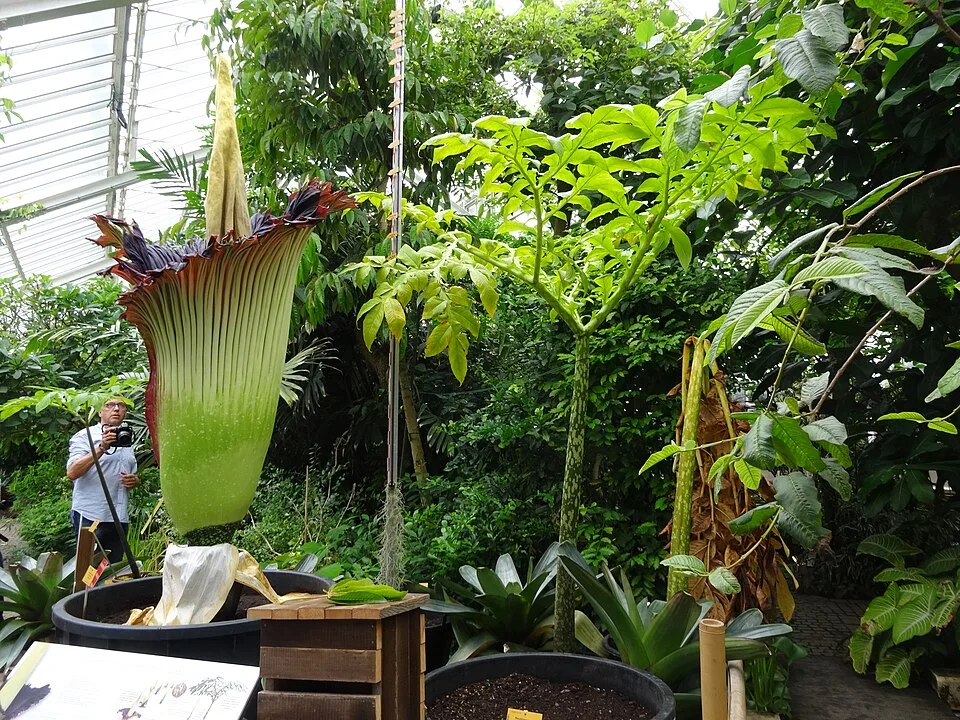
Seven thousand people drove to San Marino, California, stood in line for up to three hours, and paid for the privilege of smelling something that reeks of a decomposing body. This happened on a Monday. And honestly? Good for them. This is the most wholesome news we've had in months.
Two Stinky Giants Bloom at Once
The Huntington library, art museum and botanical gardens got very lucky this weekend. Two of its titan arums, named Odorysseus and Odora, bloomed simultaneously, which is the kind of rare botanical coincidence that scientists will talk about for years. Staff notified the public Sunday afternoon once the plants started unfurling, and by Monday morning, advance tickets had completely sold out.
According to the Guardian, each bloom lasts only about 24 to 48 hours before the towering structure begins to close. So when the Huntington said jump, 7,000 people asked how high and then drove to San Marino, roughly 12 miles from downtown Los Angeles, to watch two enormous plants slowly shut themselves back up after the briefest possible moment of stinking glory.
What Even Is a Corpse Flower
Here's the thing most people don't know: the corpse flower is not actually a single flower. It is a giant flowering structure made up of hundreds of tiny blooms packed together into something that can grow more than 12 feet tall. The Guardian reports it produces a smell specifically designed to mimic rotting flesh, which attracts carrion beetles and flesh flies to do the pollinating. Nature built an entire elaborate deception around death. Respect.
The titan arum is native to western Sumatra in Indonesia, and fewer than 1,000 are believed to remain in the wild, making it an endangered species. The Huntington has been cultivating them for more than 25 years and currently holds more than 43 mature specimens, many descended from a single successful pollination event in 2002. Once that plant was pollinated, it produced hundreds of fruits and hundreds of seeds, which the Huntington propagated and shared with other botanical gardens across the country to help keep the species going.
Three Hours in Line to Smell Death, and People Would Do It Again
Brandon Tam, curator of the Huntington's orchid collection, told the Guardian that visitors were "enchanted" by the experience. His word, not ours, though it tracks. "People who lined up for three hours in our line just to see the corpse flowers for just a few minutes," he said, in a sentence that captures something quietly moving about human beings and their relationship with the natural world.
"People were curious, people were inspired," Tam said. "People started to fall in love, if they haven't already been falling in love, with plants because of this poster child of a plant that has led people to better understand that plants have a life of their own." That is a genuinely beautiful thing to say about a plant that smells like your worst nightmare. The corpse flowers will remain on display at the Huntington through early August, long after the smell has faded and the bloom has collapsed into dormancy.
After the Bloom, Years of Nothing
Once the brief flowering window closes, the titan arum collapses entirely and enters a dormant period that can last years. Years. It builds up all that biological energy, produces an enormous 12-foot stinking spectacle for 48 hours, and then vanishes. That is either a cautionary tale or aspirational lifestyle content, depending on your personality.
The plants that bloomed this weekend were part of a lineage that traces back to that 2002 pollination at the Huntington. Decades of careful cultivation, shared seedlings, and botanical patience so that a Monday crowd in San Marino could experience something they'll describe to their grandchildren. That's how conservation actually works, unglamorous and slow and then suddenly very publicly worth it.
The Dingo Take
In a news cycle currently featuring ongoing democratic backsliding, climate disaster, and the general sensation that civilization is being held together with wet tape, 7,000 people choosing to spend their Monday standing in the hot California sun to smell a flower that mimics a corpse is, genuinely, kind of beautiful. It's a reminder that humans are wired to care about strange and specific and wonderful things, even when the world is giving them every reason not to bother.
There is also something worth sitting with in the conservation angle here. The titan arum is endangered. Fewer than 1,000 exist in the wild. The reason this double blooming was possible is because scientists spent over two decades carefully growing and sharing these plants, doing quiet painstaking work that nobody was watching. And then one weekend, 7,000 people showed up and fell in love with a plant. That is how you save a species. Not with a press release. With patience and spectacle and a smell that stops traffic.
So yeah. Go to the Huntington. Get in line. Smell the corpse flower. The world is on fire and the plants still have a life of their own, and sometimes that's the only thing that makes any sense.




Comments