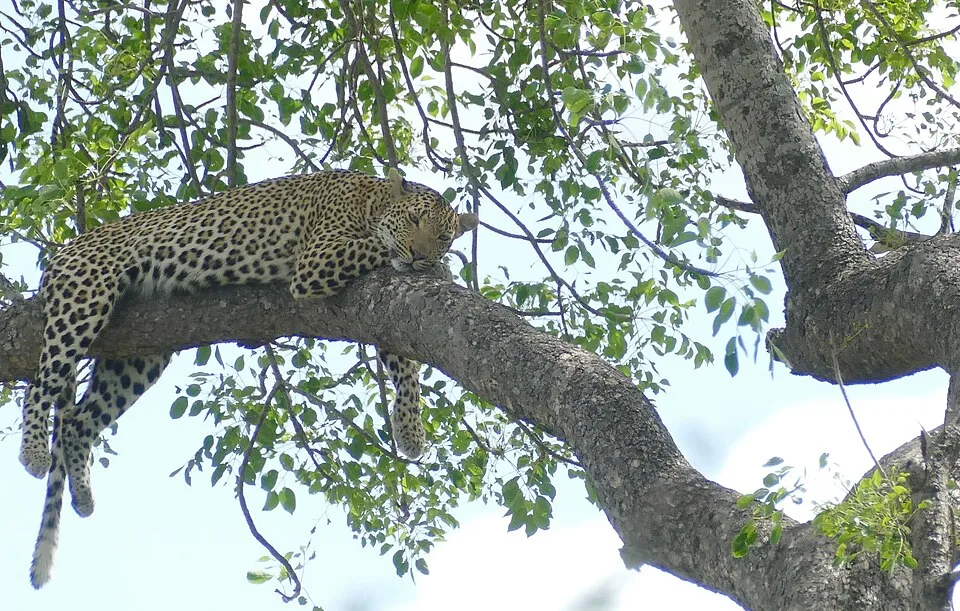
There are 354 West African leopards left on the planet. Armed jihadist groups have moved into their last major stronghold. Poachers are hunting them for their teeth, bones, and skin. And somehow, against every reasonable expectation, they are coming back.
The Number That Puts Everything in Context
Three hundred and fifty-four. That is the estimated total population of West African leopards across the entire region. Not in one park. Not in one country. All of West Africa. To put that in perspective, the average NFL stadium holds about 70,000 people. You could fit every remaining West African leopard in a single school gymnasium with room left over for a bake sale.
These leopards are not just regular African leopards having a rough decade. According to Good Good Good, West African leopards are geographically separated from other African leopard populations and were listed as regionally endangered on the IUCN Red List in 2025, after suffering a 50% population decline over the past two decades. Half. Gone. In twenty years.
The strongholds that remain are scattered and increasingly isolated. Pendjari National Park in Benin is one of the most important. It is also, currently, one of the more dangerous places on earth to do field research.
The Park at the Edge of a War Zone
Pendjari sits inside the W-Arly-Pendjari Complex, a massive transboundary conservation area spanning Benin, Burkina Faso, and Niger. The whole thing covers about 10,425 square miles, roughly the size of Haiti, and it is a UNESCO World Heritage Site. It shelters West African lions, up to 90% of the region's remaining forest elephants, the last known population of Northwest African cheetahs, and a key population of those 354 leopards.
It is also, per Good Good Good, being actively infiltrated by non-state armed groups operating out of the Sahel. Specifically, Jama'at Nusrat al-Islam wal-Muslimin and, to a lesser extent, the Islamic State Sahel Province, have moved down from Mali and Burkina Faso into this wilderness area, according to a report by the Global Initiative Against Transnational Organized Crime. The same remote terrain that makes it good leopard habitat makes it useful for armed groups who would prefer to operate without oversight.
Conservation in active conflict zones is not a new challenge, but it is a brutal one. Researchers expected the combination of security chaos and intensifying armed group activity around 2022 to show up clearly in the leopard data. They were bracing for bad news.
What the Cameras Actually Found
They did not get bad news. They got the opposite.
A team of ecologists, rangers, and researchers began biennial camera trap surveys in Pendjari in 2017, the first long-term leopard study in West Africa. When they analyzed the full dataset from 2017 to 2023, Good Good Good reports, leopard density had increased from 0.62 to 2.08 leopards per 38.6 square miles. That is not a rounding error. That is a more than threefold increase in density over six years, in a park surrounded by armed conflict and poaching pressure.
"Even if it's only a slight increase and the density remains relatively low compared with Southern Africa, it's significant," study lead author Marine Drouilly, a biologist with Panthera, the global wild cat conservation nonprofit, told Good Good Good. "We were very, very happy." The study was published in the journal Global Ecology and Conservation.
The researchers also found moderately high survival rates, suggesting a small but genuinely recovering population. There was one serious concern: the survey failed to detect any cubs. That is a red flag worth watching. A population that is not successfully reproducing has a ceiling on how far its recovery can go.
Who Is Actually Doing This Work
The nonprofit African Parks has managed Pendjari in partnership with the Benin government since 2017, which is exactly when the camera trap surveys began and when the density numbers started climbing. That timing is not a coincidence.
According to Good Good Good, African Parks maintains a field presence of rangers and an anti-poaching unit inside the park, with support from the Benin Armed Forces and aerial surveillance. They are also restoring habitat, rebuilding prey populations, and managing water sources. Crucially, they have invested in relationships with surrounding communities, involving local people in decision-making and supporting economic development in the region. That last part matters more than people usually acknowledge. A community with a stake in a park's survival is a much better early warning system than any camera trap.
The threats they are working against are serious and multiplying. A rapidly growing human population across West Africa is shrinking and fragmenting wildlife habitat. Bushmeat hunting strips the ecosystem of the prey leopards depend on. And a continent-wide surge in poaching targets leopards specifically for their spotted skins, canine teeth, and bones, feeding the illegal wildlife trade in Africa and Southeast Asia. In West Africa, Good Good Good reports, there is also growing local demand for talismans made from small pieces of leopard skin.
Why This Matters Beyond One Park
Drouilly told Good Good Good that the study has lessons for conservation in other conflict zones. That framing is important. The default assumption when armed groups move into a protected area is that wildlife is finished there, that you write it off and redirect resources somewhere more stable. Pendjari is a small but real piece of evidence that the default assumption is wrong.
It is also a reminder of what is actually at stake in the broader Sahel security crisis, a story that mostly gets covered in terms of counterterrorism strategy and regional political instability. The ecological dimension rarely makes the briefing. Three critically endangered species share this complex with the leopards: West African lions, forest elephants, and the last known Northwest African cheetahs. If the WAP Complex collapses as a functional conservation area, those species do not have a backup plan.
The Dingo Take
Here is a story about 354 animals clinging to survival in a UNESCO World Heritage Site that jihadist groups are actively using as operational terrain, managed by a nonprofit that is somehow holding the line with camera traps, community outreach, and sheer stubbornness. The leopard density nearly tripled. In six years. While a war crept in from the north. That is genuinely remarkable, and it deserves to be said plainly before we get to the caveats.
The caveats are real, though. No cubs detected in six years of surveys is not a footnote, it is a warning. A population of adults with improving survival rates but no observable recruitment is a population with an expiration date. The security situation in the WAP Complex is not improving in any meaningful way. And 354 animals spread across an entire region is not a recovery, it is a holding action. A hopeful one, right now, but the margin for error is basically zero.
What the Pendjari data actually proves is that conservation works when someone shows up and does it, even in places where showing up is genuinely dangerous. African Parks showed up. The Benin government showed up. The rangers showed up, repeatedly, in a park with armed groups in it. The leopards responded. That is the story. It would be nice if it did not take this much heroism to keep three hundred and fifty-four animals alive, but here we are.




Comments