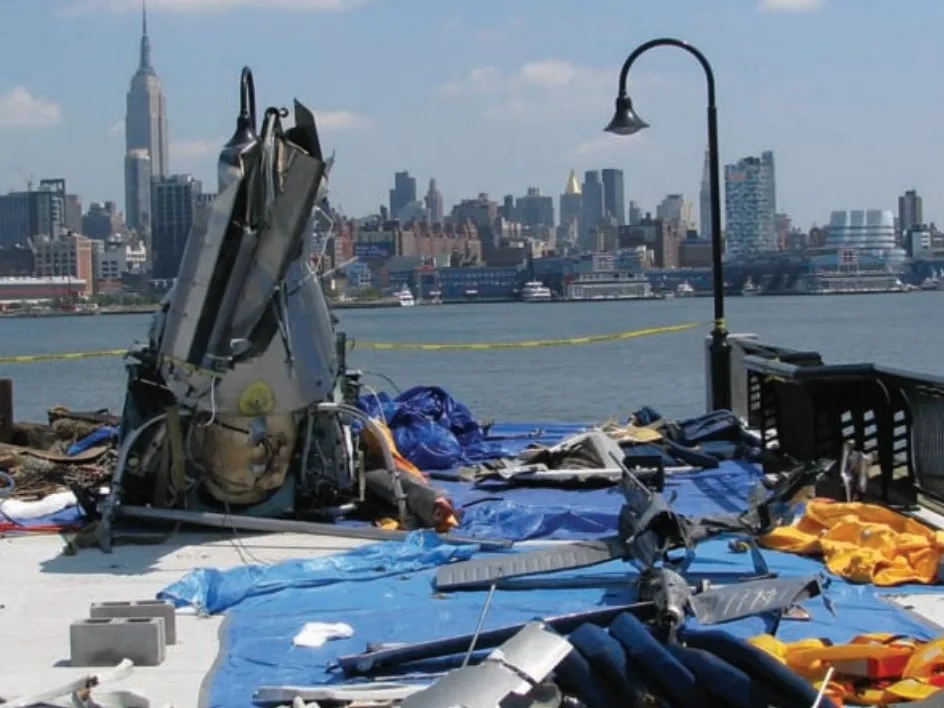
A bird strike almost certainly tore a sightseeing helicopter apart over the Hudson River last April, killing a Spanish family of five and their pilot, the National Transportation Safety Board concluded Thursday. The helicopter had a system specifically designed to ward off bird strikes. The toggle switch for that system was missing.
What Actually Happened Up There
The Bell 206L-4 helicopter took off from lower Manhattan just before 3 p.m. on April 10, 2025, according to CBS News. It was a tourist flight. Seventeen minutes in, after a pass by the Statue of Liberty and up the Hudson, it was on its way back down the river when it broke apart midair and fell into the water.
Surveillance video captured the moment the aircraft split into three distinct pieces: the fuselage, the main rotor system with both blades and the transmission, and the tail boom. Not a controlled emergency landing. Not a hard touchdown. The helicopter came apart in the sky over New Jersey.
Multiple witnesses heard loud bangs and pops before that happened. One witness told NTSB investigators she watched a large flock of geese take flight just before the impact. Her words were exactly what you'd expect: "The geese were big and there were many of them. When the helicopter went bang, I immediately thought it was a bird strike."
The Science Makes It Pretty Definitive
The NTSB did not leave this to eyewitness accounts alone. According to CBS News, investigators found bird remains in the wreckage and in the surrounding area. A specialist from the Smithsonian Institution's feather identification lab conducted sampling of the wreckage. The NTSB's own lab then confirmed those findings independently.
Pieces of the helicopter's main rotor blade and a severed bird wing turned up on the ground and on rooftops roughly 2,000 feet away from where the wreck was recovered. A severed bird wing. That is not ambiguous evidence. That is a CSI scene for ornithologists.
The working conclusion: a bird strike hit the rotor system with enough force to cause catastrophic structural failure. Six people were dead before that helicopter hit the water.
The Missing Switch That Could Have Mattered
Here is where this story stops being a tragedy and starts being a question. The helicopter was equipped with a system designed to flash lights and deter bird strikes. Standard aviation safety logic: make the aircraft more visible to birds, reduce the chance of a collision.
According to the NTSB report cited by CBS News, the toggle switch for that system was missing from the overhead panel above the pilot's seat. Not broken. Not switched off. Missing. The chief pilot for New York Helicopter Charter told investigators that using the system was voluntary anyway and wasn't required during daylight hours.
Voluntary. During a daytime flight over a river in a major metropolitan area that is home to an enormous and well-documented urban goose population. Let that sit with you for a second.
The Tour Company's Response Is Something Else
New York Helicopter Charter Inc. shut down following the crash. That much was expected. What was perhaps less expected was the posture of the company's owner, Michael Roth, who spoke to CBS News New York after the NTSB report dropped.
"They should not only give me a license back, they also compensate me to get back in the business," Roth said. "And I want the city of New York to restore my license at the downtown heliport, which they wrongfully took."
Six people are dead, including three children from Spain whose family paid to go on a sightseeing tour. The FAA says the company's license remains suspended and that it is working closely with the NTSB on the investigation. Roth's position is that he is the victim in this situation and the city owes him money. That is a choice.
A Family That Came to See the City
It is easy to get buried in the mechanical and regulatory details of a crash like this and lose track of who actually died. A family of five from Spain, including three children, boarded a helicopter in lower Manhattan to see New York City from the air. That is the kind of trip families plan for months. You can picture the photos they were taking by the Statue of Liberty.
None of them came home. The pilot did not come home either. Seventeen minutes into a tour flight on a Thursday afternoon in April, and six people were gone because a flock of geese flew into a rotor system on an aircraft that may or may not have had a functioning bird deterrent, on a route that required no such deterrent to be used in the first place.
The FAA is still reviewing. The NTSB has issued its findings. Nobody has been charged with anything. The company's owner wants his license back.
The Dingo Take
The NTSB report gives us the probable cause. What it does not give us is any satisfying answer to why a helicopter conducting commercial tourist flights over one of the most goose-dense waterways in North America was operating with a voluntary bird-deterrence system and, apparently, a missing switch for that system. "Voluntary" is doing a lot of work in this story. So is "wasn't required during the day." Required by whom? Set by whom? Reviewed by whom after six people died?
This is how regulatory gaps kill people. Not with a dramatic villain twirling a mustache, but with a toggle switch nobody noticed was gone and a safety feature nobody was required to use. The FAA has had years of documented concerns about urban helicopter tourism operations. The Hudson River corridor sees constant commercial flight traffic. The Canada goose population in the New York metro area is not a secret or a surprise. It is a known, mapped, studied hazard. And yet here we are.
Michael Roth wants compensation. He wants his license back. He wants an apology from the city of New York. Three children from Spain are dead. Their parents are dead. Their pilot is dead. Whatever conversation we eventually have about accountability for this crash, it should probably start somewhere other than Roth's grievances about his business license.




Comments