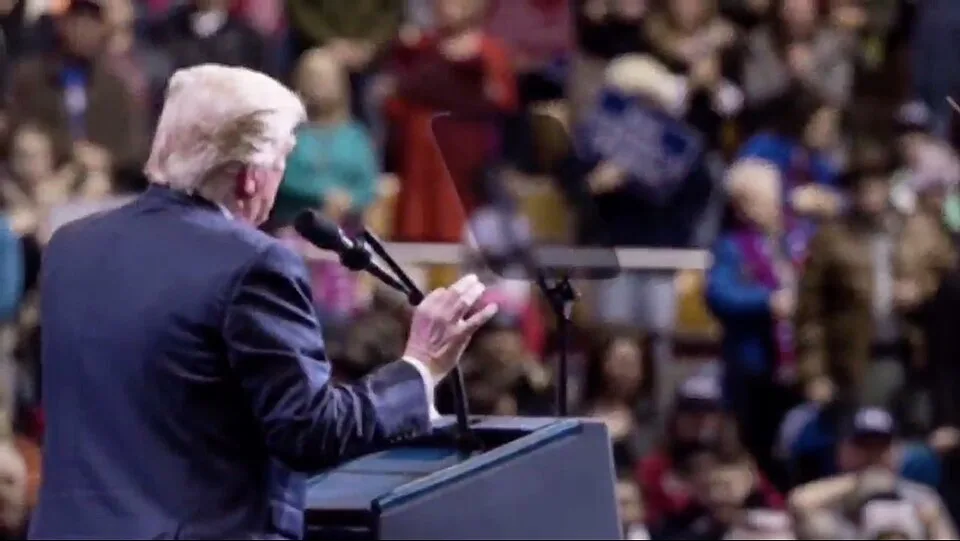
The man who scrolls Donald Trump's words across a screen before Trump says them allegedly turned that job into a nearly $100,000 prediction market windfall. Gabriel Perez, Trump's teleprompter operator since 2016, is now in settlement talks with the Commodity Futures Trading Commission after Kalshi's own surveillance systems caught him betting on whether the president would say specific words during his public speeches. This is the first time anyone inside the White House has been investigated for allegedly using their access to cash in on prediction markets.
What He Actually Did
Kalshi runs what are called 'mention markets,' where traders bet on whether a speaker will or will not say a particular word or phrase during a public event. Ahead of Trump's address to the nation on Thursday, NPR notes that Kalshi traders had already wagered more than $800,000 on whether the president would say words like 'Hormuz,' 'rigged election,' or 'fake news.' The odds on these markets swing wildly in real time as Trump riffs, digresses, and goes wherever his particular brain takes him on any given night.
Perez allegedly had a significant advantage over every other bettor: he had already read the speech. As the teleprompter operator, Perez would have had access to the president's prepared remarks before they were delivered, which is exactly the kind of non-public government information that a White House memo sent in March specifically warned staff not to use for betting. According to NPR, that memo stated it is a 'criminal offense' for anyone inside the White House to buy or sell on prediction market sites, and that misusing government information 'is a very serious offence and will not be tolerated.' Apparently someone did not read the memo. Or did, and bet on it anyway.
How He Got Caught
Kalshi caught him. That's the part that should make every would-be insider trader a little nervous. Axios reports that the company's surveillance systems detected unusual betting patterns on mention markets involving Trump that didn't match typical trader behavior. When Kalshi investigated the accounts behind those trades, they discovered a federal employee. They then referred the matter to the CFTC.
'Our surveillance team promptly flagged and referred these trades to the CFTC after an exchange investigation,' Robert DeNault, who heads enforcement at Kalshi, told NPR. 'We have been assisting regulators on this matter and provided evidence we collected, as we do in any referral.' Kalshi has since frozen roughly $90,000 of Perez's profits and banned him from the platform. He did not respond to a request for comment. ABC News first reported the investigation.
This Is Not an Isolated Incident
The Perez case is the most brazen White House example, but it is sitting inside a much larger pattern of people with access to non-public information deciding that prediction markets are their personal ATM. In April, NPR reports, federal prosecutors charged a U.S. Army special forces soldier with making $400,000 on Polymarket ahead of the capture of Venezuelan leader Nicolas Maduro. That case involved classified military intelligence about an active operation.
The following month, the Department of Justice charged a Google software engineer with using confidential company information to make $1.2 million on Polymarket by correctly anticipating Google search trends. And then there is former Republican congressman George Santos, who investigators say pumped up a Kalshi market by publicly claiming he would attend Trump's 2026 State of the Union address, then cashed out on a 'no' trade when he skipped it. George Santos allegedly committed prediction market fraud. In the current timeline, this does not even crack the top five most shocking George Santos stories.
The prediction market industry has grown explosively in recent months, and that growth has apparently attracted people who believe that knowing things other people don't know entitles them to money. What is wild is that they're not wrong, exactly. That's just insider trading. It has been illegal for decades. The medium being new does not change what the act is.
What Perez Actually Faces
Perez is currently in settlement talks with the CFTC, which handles commodity futures regulation and has jurisdiction over prediction market platforms like Kalshi. It is not yet clear whether the Department of Justice is separately examining the case, according to NPR. That distinction matters enormously, because a CFTC settlement typically means fines and disgorgement of profits, while DOJ involvement means potential criminal prosecution.
Under existing law, using non-public information to win on Kalshi could be prosecuted as wire fraud, commodities fraud, and money laundering. These are not minor charges. The $90,000 frozen by Kalshi would be the least of his problems if federal prosecutors decide to pick this up. The State of the Union was among the speeches Perez allegedly traded on, according to Axios, which means he potentially bet on the single most-watched presidential address of the year using advance access to its contents. That is an aggressive choice.
The Prediction Market Problem Nobody Fixed
The White House sent that memo in March. That is a tacit admission that by March, the administration already knew this was a problem serious enough to require a written warning to staff. The memo, reviewed by NPR, explicitly told aides that misusing government information on prediction market sites is a criminal offense that 'will not be tolerated.' Perez had been working for Trump since 2016. He received that memo. He apparently kept betting anyway, or had already placed trades that predated the memo.
The broader regulatory framework here is still catching up to reality. Kalshi and its competitors have expanded from election betting into an enormous range of markets covering global policy, corporate decisions, and yes, what exact words the president of the United States will say at a given moment. Every person in Washington with access to any non-public information is now potentially sitting on a tradeable asset. The Army soldier, the Google engineer, the teleprompter guy: these are early cases. There will be more.
The Dingo Take
Let's just sit with this for a moment. The man whose entire job is to make sure Donald Trump can read scrolling text without squinting allegedly used advance access to that text to make nearly a hundred grand on internet betting markets. He had one of the most specific, niche advantages in the history of financial crime. Most insider traders at least have to attend board meetings or read classified cables. This guy just had to show up to work.
The thing that actually deserves scrutiny here is the systemic failure, not just the individual one. The White House sent a memo in March explicitly warning staff that this was illegal and would not be tolerated. That memo existed because people were already doing it, or because the administration reasonably anticipated people would try. And then, allegedly, someone who had been working for Trump for a decade kept doing it anyway. The surveillance systems at a private prediction market company caught what the White House's own internal warnings apparently did not stop.
The prediction market industry will keep arguing that robust surveillance and CFTC oversight make their platforms safe from manipulation. The Perez case is, depending on your generosity, either proof that those systems work or proof that the temptation to abuse inside access is so overwhelming that no memo will stop it. What it is definitely not is the last of these cases. There are a lot of people in Washington who know things. There is now a market for everything they know. Do the math.


Comments