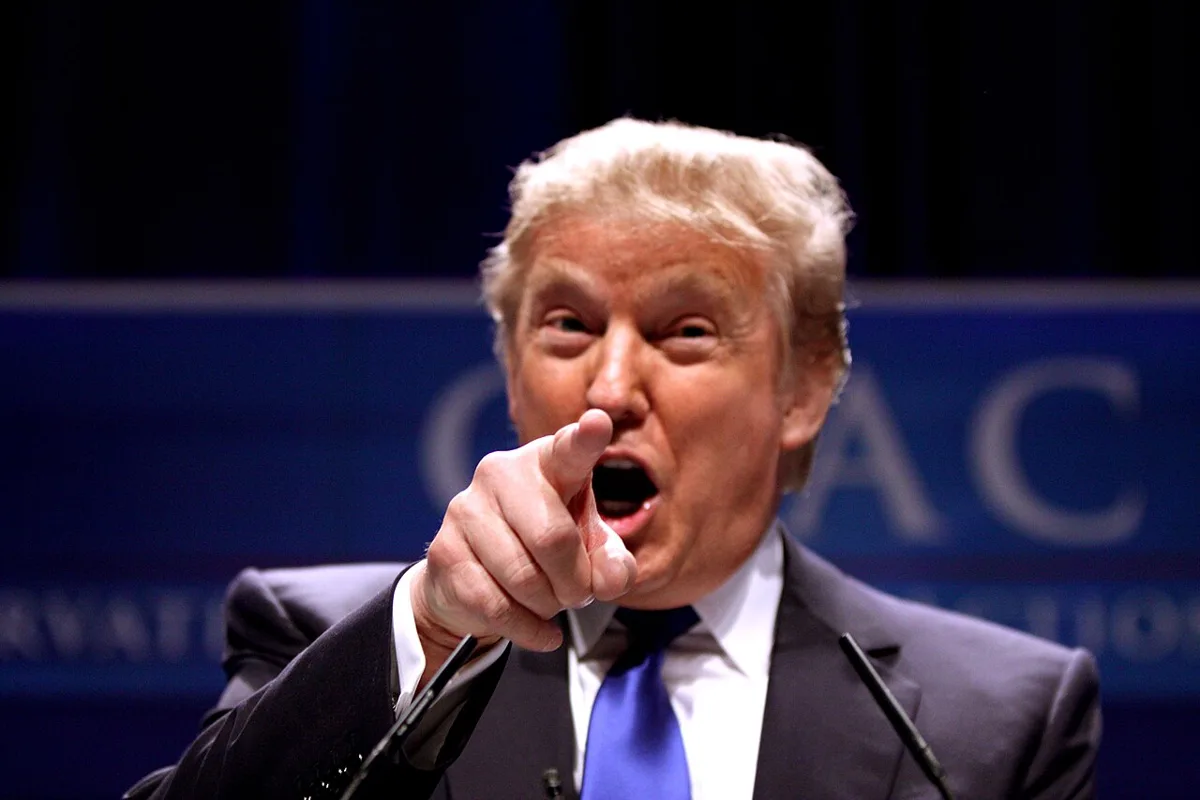
Donald Trump threatened Thursday to revoke the broadcast licenses of ABC and NBC because they declined to drop their regular programming and air his speech live. Think about that sentence for a second. The President of the United States is threatening to destroy two major television networks because they chose not to broadcast him.
What Actually Happened
According to Axios, Trump made the threat after both ABC and NBC decided not to preempt their scheduled programming to carry his address on election integrity live. That's it. That's the whole crime. They didn't pull the plug mid-broadcast. They didn't run a hit piece. They just... didn't rearrange their entire programming schedule around his speech.
"In a rare move, NBC and ABC fake news have both said that they would not cover this speech. They knew what it was about," Trump said, per Axios. Then came the implied threat, framed as a statement of principle: "Fraud like this should mea" -- and yes, the quote got cut off there, which might be the funniest detail in the whole story.
Networks make programming decisions every single day. That is how television works. The White House does not get to dictate what airs at 8pm on a Thursday. Or at least, it didn't used to.
The FCC Is Already Doing His Dirty Work
Here's where this stops being funny. Axios reports that the Federal Communications Commission has already launched formal probes into broadcasters, alleging their practices violate public interest standards. These are not idle threats rattling around in a Truth Social post. There is an actual federal agency already building cases that could have, as Axios puts it, "serious business consequences" for these networks.
The FCC grants and renews broadcast licenses. Every major over-the-air television network in America depends on those licenses to legally operate. Threatening to revoke them is not a toothless complaint from a guy who's mad at the television. It is a direct threat to the economic survival of news organizations, delivered by the most powerful person in the country.
When a government uses the threat of regulatory destruction to pressure the press into favorable coverage, there is a word for that. Political science textbooks have a whole chapter on it. We're living in the chapter.
This Is Not the First Time
Axios notes that Trump "threatened again" to revoke these licenses on Thursday. Again. He has done this before, and he will do it again, and each time the sheer repetition risks making it feel normal. It is not normal.
Since returning to office, the pattern has been remarkably consistent. Trump says something outrageous about the press. His FCC follows up with formal regulatory action that inches the threat closer to reality. Rinse, repeat, slowly boil the frog. The licenses haven't been pulled yet. But the mechanism for pulling them is being stress-tested with increasing frequency and increasing institutional muscle behind it.
What "Election Integrity" Actually Means Here
The speech Trump was delivering was on "election integrity," which in 2026 is not a neutral phrase. It is the rhetorical vehicle Trump has used since 2020 to relitigate lost elections, push voting restrictions, and keep his base in a permanent state of grievance about a system he claims is rigged against him every time results go wrong.
So let's be precise: Trump threatened to use the federal government to punish broadcasters for declining to air, live and uninterrupted, a speech about how elections are fraudulent. The networks that cover elections. The networks that will cover the next one. The networks he needs to have a complicated relationship with the concept of "fraud" in order to benefit from whatever comes next.
You don't have to squint very hard to see what's being built here.
What Broadcast License Revocation Actually Looks Like
For anyone unfamiliar with how this works: the FCC doesn't typically yank a network license overnight. The process involves formal proceedings, hearings, legal challenges, and years of litigation. In theory, that's a feature, not a bug. The regulatory structure was deliberately designed so that no single administration could simply destroy a broadcaster because its coverage was unflattering.
But "in theory" is doing a lot of work in the current political environment. The FCC under Trump appointees has already shown a willingness to open investigations that, even if they never result in license revocation, cost networks enormous sums in legal fees, generate uncertainty for investors, and create a chilling effect on editorial decisions. You don't have to actually pull the license to get the result you want. You just have to make people afraid you might.
The Dingo Take
Let's be direct: what Trump described Thursday is a protection racket. Air my speech, or face consequences from a federal agency that controls your ability to operate. That is the transaction being proposed. The fact that it's being wrapped in the language of "fraud" and "public interest" doesn't obscure what it is. It makes it worse, because it suggests he actually believes the framing, or worse, knows exactly what he's doing and assumes nobody will say it plainly.
The First Amendment does not protect broadcasters from losing licenses the same way it protects print or online media, which is a quirk of communications law that Trump's team understands very well. The FCC has real leverage here. The fact that they are openly deploying that leverage as a response to editorial decisions, rather than genuine public interest violations, is the story. That is the part that should have every journalist in America paying very close attention.
ABC and NBC didn't air a speech. That's what started this. In a functioning democracy, the government's response to that would be nothing, because a free press makes its own editorial calls. Instead we got federal license threats and ongoing FCC investigations. If you're looking for a canary in the coal mine, it just stopped singing.



Comments