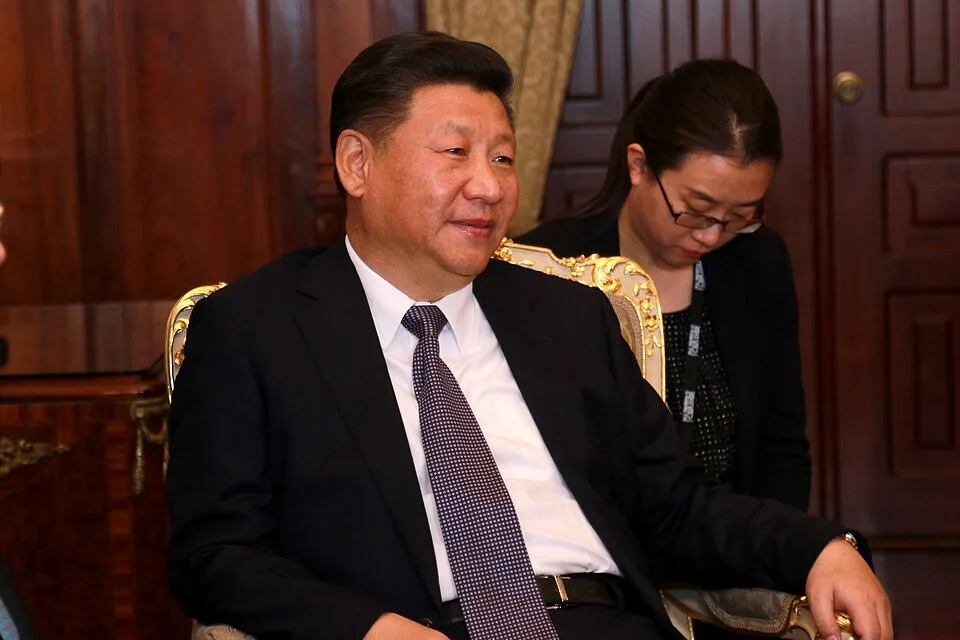
While Washington was busy congratulating itself on blocking China from advanced chips, Xi Jinping walked into Shanghai on Friday, gathered leaders from across the developing world, and announced China will train 5,000 people from other nations in AI over the next five years. Twenty-nine countries, including Russia and Pakistan, signed an agreement the day before to form an entirely new intergovernmental AI organization headquartered in Shanghai. You love to see a plan come together.
The Speech Washington Should Be Worried About
Xi's remarks at China's annual World Artificial Intelligence Conference were not subtle. "The development of artificial intelligence should not be a solo performance by any single country but rather a symphony of global cooperation," he said, according to the Associated Press. It's the kind of line that sounds like a fortune cookie until you notice the 1,100 companies and heads of state from Kazakhstan, Cambodia, Thailand, and the UN Secretary-General sitting in the audience nodding along.
Xi also took the gloves off on American export controls, calling out the "overstretching" of national security concerns and arguing that no country should place its own security above that of others. This is a complaint China has repeated for years. The difference is that this time, Xi said it with receipts in his hand and a freshly signed multilateral agreement on the table.
Twenty-Nine Countries Just Picked a Side
Here's what actually happened the day before Xi's speech, per the Associated Press: 29 nations, including Russia, Pakistan, and Kazakhstan, signed an agreement to create the World Artificial Intelligence Cooperation Organization, a new intergovernmental body headquartered in Shanghai. China's state media is framing it as a global governance body for AI. Whatever you call it, it is a direct institutional rival to every US-led tech framework that exists.
This is not a press release. This is a geopolitical move. Beijing just built an AI equivalent of a parallel international order, and it recruited nearly 30 countries to join on day one. The Trump administration's response to this will presumably be another executive order about TikTok.
The Developing World Is the Actual Prize
Xi announced that China will expand AI cooperation with ASEAN, the African Union, the Arab League, the Community of Latin American and Caribbean States, BRICS, and the Shanghai Cooperation Organization. He also pledged to give 30 countries access to a Chinese-built AI meteorological system for early weather warnings. That is a concrete, useful, immediate benefit being offered to nations that the United States has mostly engaged with through lectures about democracy and conditions attached to aid.
China's open-source AI models, most famously DeepSeek, have already been gaining traction across the developing world as cheaper, accessible alternatives to American closed-source systems, as NPR reports. The US tech industry's instinct to lock everything behind a paywall and a terms-of-service agreement is doing a lot of geopolitical heavy lifting for Beijing right now, and not in a good way.
Huawei Shows Up With Hardware
While Xi was making speeches, Huawei was on the conference floor showing off its Atlas 950 SuperPoD AI computing system, according to the Associated Press. This matters because the entire premise of American chip export controls was that cutting China off from advanced semiconductors would kneecap its AI development. Huawei building its own high-powered AI hardware suggests that strategy has had a more complicated outcome than advertised.
Some technology analysts now believe China has moved from catching up with the US to actively innovating, NPR notes. China's five-year plan through 2030 has made AI a national priority. At some point, a sanctions regime stops being a ceiling and starts being a motivation.
What the US Actually Built With Its Export Controls
The US restrictions were supposed to slow China down. And maybe they did, for a while. But the Associated Press reporting out of this conference tells a story of a country that responded to being locked out by building its own door and then inviting half the world over for dinner.
The global south is not waiting around for Silicon Valley to decide whether to offer them favorable API pricing. China is offering training slots, meteorological systems, open-source models, and now an entire international organization. The American pitch, meanwhile, is essentially "trust us, we have better chips, also please don't use Huawei." That is a tough sell in Nairobi or Dhaka or Bogota.
The Dingo Take
Let's be honest about what happened in Shanghai this week. The United States spent years designing an export control architecture intended to keep China from becoming an AI superpower. China responded by becoming more self-sufficient, going open-source where it could, and pivoting to court every nation the US has been too distracted or too arrogant to properly engage. Xi did not walk into that conference as a supplicant. He walked in as a host, with 29 signed agreements and a five-year commitment to AI training programs in the developing world. That is not the behavior of a country that is losing.
The bipartisan consensus in Washington is that being tough on China's tech access is smart strategy. Maybe it is. But tough strategy without a parallel affirmative strategy for winning hearts and minds across the global south is just half a plan. You can't export control your way to global AI leadership if the rest of the world is signing up for the other team's governance organization because at least someone bothered to ask them.
China just held a conference with the UN Secretary-General, three heads of state, 29 treaty signatories, and over 1,100 companies in attendance, and launched what amounts to a rival international AI order. The US didn't even send someone to watch. That should terrify people. It probably won't.


Comments