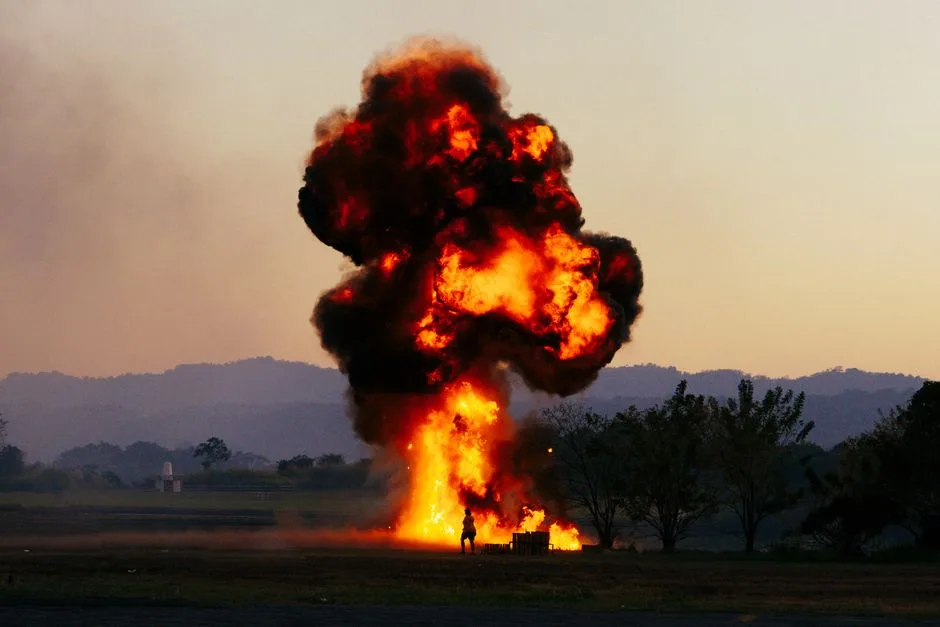
The United States bombed Iran for the seventh night in a row on Friday. Not a typo. Seven consecutive nights of American airstrikes against a sovereign nation, with the president going on Fox News to promise it gets worse next week. This is not a drill, and it is barely making the front page.
What Happened Friday Night
US Central Command released a statement confirming its forces struck "surveillance sites, military logistics infrastructure, underground weapons storage, and maritime capabilities" across Iran on Friday. Fighter aircraft, aerial drones, warships, and what CENTCOM described only as "other assets" were all in play. The strikes wrapped up at 9:30 p.m. ET, neat as a shift change.
CENTCOM released video of the operation showing cruise missiles launching off a Navy warship, jets lifting into the dark, and at least three targets taking direct hits from precision munitions. Among those targets, according to the New York Post: what appears to be a communications tower and a highway road bridge. So we're hitting bridges now. File that one away.
Iranian state media reported explosions across central and southern Iran, including the cities of Ahvaz, Lar, Yazd, and Sirik. Iran answered by firing missiles and launching drones at multiple countries in the region. Kuwait intercepted Iranian projectiles. Jordan intercepted Iranian projectiles. Air raid sirens went off in Bahrain. A multi-country military incident, and it's night seven.
Trump's Fox News Ultimatum Was Not Subtle
Earlier this week, President Trump went on Fox News and laid out exactly what comes next if Iran doesn't make a deal. "We're going to hit them very hard tonight. We're going to hit them very hard tomorrow night. We're going to hit them very hard the night after, and then next week it gets really bad for them because next week comes the power plants," Trump said Tuesday. "Next week comes the bridges. We're going to knock out all their power plants. We're going to knock out all their bridges unless they get to the table and negotiate."
That is an American president announcing, on cable television, a planned escalation against a foreign nation's civilian infrastructure. Power plants. Bridges. He named them. He gave a timeline. There was no diplomatic back-channel ambiguity here. The man told a TV audience what he intends to bomb and roughly when.
This followed Trump's declaration that a ceasefire reached with Iran roughly a month ago is, in his assessment, effectively dead. Which raises an obvious question: what exactly was in that ceasefire, and how did we get from there to nightly bombing runs in under thirty days?
The Naval Blockade Nobody Is Talking About Enough
Alongside the airstrikes, the US is running a naval blockade against Iranian ports, specifically aimed at choking off Bandar Abbas and loosening Tehran's grip on the Strait of Hormuz. CENTCOM's statement confirmed it is "fully enforcing a naval blockade against Iranian ports." The Post reports Thursday's strikes were explicitly designed to cut off Bandar Abbas as part of that pressure campaign.
The Strait of Hormuz is not some obscure waterway. Roughly 20 percent of the world's oil supply moves through it. A shooting conflict there, combined with a US naval blockade and nightly strikes on Iranian infrastructure, is the kind of thing that makes energy markets, shipping insurers, and people who understand geopolitics very quiet and very pale. We are deep inside that scenario right now.
More than 50,000 American service members are currently operating across the Middle East, according to CENTCOM. That number deserves to sit with you for a moment.
Thursday Made This Worse
Friday's strikes did not come out of nowhere. The New York Post reports that Thursday alone saw two separate waves of US military attacks on Iran. One of the most visually striking moments of this entire conflict so far came Thursday, when American strikes dramatically toppled a large white surveillance tower in Chabahar, Iran's southernmost city. Chabahar sits on a critical trade corridor for landlocked Afghanistan, which adds another layer of regional consequence to what just became a pile of rubble.
Each night's strikes build on the last. The targets have expanded from what were initially described as nuclear-adjacent or military facilities to now include logistics infrastructure, maritime capabilities, communications, and road bridges. The scope is growing. The tempo is not slowing.
How Kuwait and Jordan Got Dragged Into This
Iran is not just absorbing these strikes. Its response on Friday included firing missiles and launching drones at multiple countries in the region, countries that are not the United States and are not the ones doing the bombing. Kuwait's army said it intercepted Iranian missiles and drones. Jordan's military confirmed it shot down incoming Iranian missiles. Bahrain triggered air raid sirens.
Think about that chain of events. The US bombs Iran. Iran shoots missiles at Kuwait, Jordan, and Bahrain. Those countries scramble their air defenses. And all of this is happening on night seven of what Trump is calling a negotiating strategy. The neighborhood is on fire and we're the ones who brought the matches.
None of these countries asked to be part of this. Kuwait and Jordan and Bahrain are not parties to whatever dispute the Trump administration has with Tehran's nuclear program or its role in regional proxy conflicts. They are just close enough to catch the shrapnel, literally.
The Dingo Take
Let's be honest about what is happening here, because the breathless pace of the news cycle is doing a lot of work to normalize it. The United States is conducting nightly bombing raids against a country of 90 million people. The president announced on Fox News that power plants are next. A naval blockade is strangling Iranian ports. Neighboring countries are intercepting Iranian missiles every time we hit another target. This is a war. Call it a pressure campaign if you want, but when you are on night seven of consecutive airstrikes with 50,000 troops in the theater and drones in the air every night, you are at war.
The ceasefire that apparently died in under a month deserves a lot more scrutiny than it is getting. What were the terms? Who enforced it? What broke it? The public answer right now is essentially "Trump says it's dead, so now we bomb every night until they negotiate." That is not a strategy with an endgame anyone has explained publicly. What does a deal look like? What does Iran have to do to stop the strikes? What happens if they don't? These are not trick questions. They are the only questions that matter.
And here is the part that should terrify you: Iran is already shooting back at third countries. Kuwait. Jordan. Bahrain. Any one of those intercepts could fail. Any one of those missiles could hit something it shouldn't. The margin for error in a nightly shooting conflict across the Middle East is not wide. Somewhere in the seventh consecutive night of this, the adults are supposed to be in the room. Look around the room. Take stock of who's there.





Comments