Iran's president announced Monday that his country is in a 'full-scale war' with the United States, which is roughly the sentence you never want to read before your morning coffee. The US has been bombing military command centers, missile sites, and air defense networks across Iran, while Tehran has been striking US Gulf allies, lighting tankers on fire in the Strait of Hormuz, and generally making the global energy market have a complete breakdown. Oil just crossed $90 a barrel. The Houthis are blockading Saudi ports. A ceasefire proposal is apparently somewhere in a diplomat's inbox. So, you know. Things are going great.
What the US Has Been Hitting, and What Iran Has Been Hitting Back
The Guardian reports that Iranian media confirmed strikes around Tabriz, which is believed to house underground missile bases, and Bushehr, the location of Iran's only operational civilian nuclear power plant. That last one is the kind of target that tends to make international law professors update their will. The US military, for its part, said it struck 'military command centers, air defence and coastal surveillance sites, maritime capabilities, missile and drone launch sites and communications networks.' So, basically, they tried to knock out everything Iran uses to fight.
Iran responded by hitting Bahrain, which hosts the US Navy's Fifth Fleet, and Kuwait. Bahrain said air traffic systems took damage but flights were not disrupted. Iran also struck tankers transiting the Strait of Hormuz, a waterway that, before this war started, carried roughly one fifth of the world's oil and gas supply. The IRGC claimed to have blown up two oil tankers attempting to use the southern corridor that the US had been encouraging ships to use as a workaround. There was no independent confirmation of that claim, but a ship did catch fire near the Omani coastline Monday morning, with the crew abandoning vessel before a tugboat recovered it.
Trump Said 'We Hit Them Very Hard Again Tonight' While Returning from the World Cup Final
Donald Trump, landing back in Washington after attending the World Cup final, offered the public this measured foreign policy assessment: 'We hit them very hard again tonight.' He added that the strikes were done 'in honour of the, probably three, it's probably three great patriots,' referring to US service members killed in recent days. The fact that the president was not entirely sure of the death count of his own service members, live, on camera, is the kind of detail that lands differently when there is an active shooting war happening.
According to The Guardian, three US service members have now died in recent days. Two were killed Friday when Iran struck a Jordanian airbase, with a third reported missing in action. A third death occurred Saturday in northern Iraq during a controlled detonation of unexploded ordnance found on a downed Iranian drone. Seventeen US service members have been killed since the war began. Iran's health ministry said 50 Iranians had been killed and more than 500 injured in the current round of fighting alone.
The 60-Day Peace Deal Is Not Having a Great Month
Here is some essential context that makes the current situation even more maddening. The Guardian reports that a memorandum of understanding, struck last month to halt attacks and reopen the Strait of Hormuz, is currently more than halfway through a 60-day implementation period specifically designed to create space for diplomacy. It is not going well. The MoU is alive in the technical sense that nobody has formally scrapped it yet, but both sides are actively bombing each other, so the spirit of the thing is in rough shape.
Despite the fighting, an Iranian official told Reuters that mediators had presented Tehran with a proposal for a 10-day ceasefire intended to find ways to revive the original deal. Iran's foreign ministry spokesperson Esmail Baghaei confirmed that 'the diplomatic apparatus has been active in recent days and ideas have been conveyed to us by certain mediators.' Qatar and Pakistan are reportedly still talking to both sides. Marco Rubio said Monday that the US remains open to negotiations, adding that 'it has to be real,' which is a sentence that does a lot of work without saying very much.
The Houthis Decided This Was a Good Time to Blockade Saudi Ports
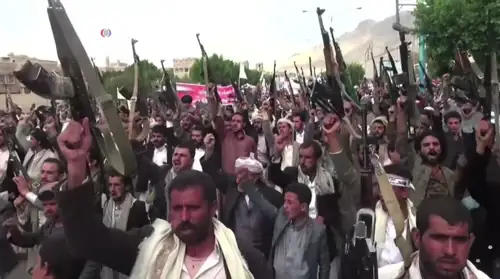
Because this region apparently operates on the principle that no situation is so bad that someone cannot make it significantly worse, Yemen's Houthi movement announced Monday that it was blockading Saudi ports. The Houthis framed it as retaliation for Saudi airstrikes on Sana'a airport last week and said they would answer 'a blockade with a blockade.' The timing could not be more damaging to global energy markets.
Saudi Arabia had been routing oil exports through the Red Sea specifically to work around Iran's closure of the Strait of Hormuz. The Guardian reports that this was an active workaround keeping millions of barrels of oil flowing to global markets. A Houthi blockade of those same ports closes that valve too. Oil has already passed $90 a barrel, its highest point in a month. If both the strait and the Saudi Red Sea route are effectively closed, the global energy crisis that is already biting will get considerably more painful.
Israel Is Watching and Has Thoughts
Israel has stayed out of the direct US-Iran exchange so far, but Israeli Defense Minister Israel Katz made clear Sunday that patience has a ceiling. 'If Iran fires missiles at Israel, we will attack them with full force,' Katz said. Iran struck sites in Jordan on Sunday, and Israel warned that further escalation risks spillover across its borders, which would light up a regional conflict that has been carefully contained even as US-Iran tensions exploded.
The Guardian also reports that the US is expected to send dozens of additional aerial refueling planes to Israel as part of a broader reinforcement of its regional force posture. That is not the kind of military logistics move you make when you think the situation is about to calm down. Trump has also threatened, separately, to target Iranian power stations and bridges to pressure Tehran into reopening the strait, a threat that US Energy Secretary Chris Wright has defended.
The Dingo Take
Let's be honest about what we are watching. A sitting US president is conducting an expanding air war against Iran while referring to the death toll of his own troops in approximate terms on a tarmac, fresh off a soccer match. The Strait of Hormuz, through which one fifth of global energy supply moves, has 'slowed to a trickle' according to The Guardian. Oil is at $90 a barrel. The Houthis are blockading Saudi ports. Israel is threatening to go kinetic if one missile crosses its border. And somewhere in Islamabad, an Iranian interior minister is getting on a plane, because apparently that is the diplomatic situation we are relying on right now.
The ceasefire proposal is real. The mediators are real. The talks are apparently still happening in some form, which is something. But the gap between 'diplomacy is continuing' and 'the president of Iran just announced full-scale war on state media' is not a gap that normally gets bridged by a 10-day cooling-off period. The MoU that was supposed to be the breathing room for all of this is itself on life support while both sides bomb each other through the implementation period.
What happens when the 60-day clock runs out and there is no revived deal, no ceasefire, and the only functioning energy chokepoint in the region is on fire? Nobody in Washington seems to have a clean answer to that question. Trump is hitting things 'very hard.' Rubio is waiting for the right guys to win internal Iranian power struggles. The rest of the world is watching oil prices and quietly losing its mind. This is not a plan. This is a dare.



Comments