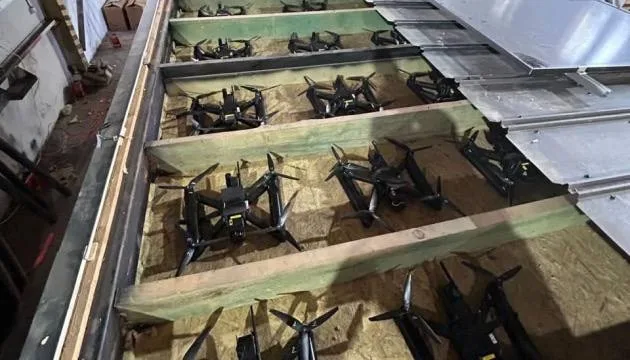
Ukraine fired more than 400 drones at Moscow overnight Sunday into Monday, because apparently this is just what July looks like now. The attack lit up an industrial park 18 miles south of the Russian capital and sparked a fire at an oil depot even closer in, while back in Kyiv, Zelensky was simultaneously trying to hold his government together with what appears to be duct tape and sheer willpower.
400 Drones. One Night. You Do the Math.
Moscow Mayor Sergei Sobyanin confirmed that over 400 Ukrainian drones were sent toward the Russian capital from late Sunday through early Monday morning. Most were downed before reaching the city, he said, but 85 were intercepted in Moscow's immediate vicinity. Ten people were wounded, according to Andrei Vorobyov, the head of the surrounding Moscow region, and several residential buildings and civilian infrastructure facilities took damage.
The New York Post reports that a fire broke out at the Yuzhnye Vrata industrial park about 30 kilometers south of Moscow, and the Astra news outlet reported a second fire at an oil depot in Podolsk, roughly 20 kilometers out, though Russian officials did not confirm that one. Zelensky, for his part, said Ukrainian forces hit logistics facilities and an oil depot in the Moscow region, more than 400 kilometers from Ukraine's border. He also claimed Ukrainian forces struck two ships belonging to Russia's shadow fleet and four dry cargo vessels in the Black Sea.
Independent verification of the specific targets was not possible, as is standard in a war where both sides have strong incentives to shape the narrative. What is not in dispute: Ukraine sent 400 drones at the Russian capital in a single night. Let that number sit with you for a moment.
Russia's Ballistic Missile Problem Is Actually Ukraine's Ballistic Missile Problem
While Ukraine was lighting up the Moscow suburbs, Russia was doing what Russia has been doing with increasing aggression: hammering Ukrainian cities with ballistic missiles. A Russian bombardment on Sunday killed at least six people and wounded dozens, according to Ukrainian officials. A strike on Pavlohrad in the Dnipropetrovsk region injured 13 more, including a 13-year-old girl who was hospitalized.
The Institute for the Study of War, a Washington-based think tank, dropped a grim assessment Sunday night: Russia has launched more ballistic missiles against Ukraine so far in July than it reportedly produces in an entire month. That means Moscow is burning through stockpiles to keep up this pace. It also means, as the ISW put it, that Russia is prioritizing ballistic missiles because they work. They fly faster than the speed of sound. They can reach Kyiv in minutes. Air defenses have almost no time to react, and civilians have almost no time to reach shelter.
Ukraine has been pleading with its partners for sophisticated interceptors capable of stopping ballistic missiles, which are a fundamentally harder problem than drones or cruise missiles. Russia, meanwhile, has clearly noticed the gap in Ukraine's defenses and is exploiting it as aggressively as possible. Russia also fired 94 long-range strike drones overnight, of which Ukraine's air force said it jammed or intercepted 81. The remaining drones and a missile caused damage at nine locations.
The Drone War Ukraine Is Actually Winning
Here is the one corner of this catastrophe where Ukraine has a genuine edge. The New York Post notes that Ukraine's long-range drone technology has evolved rapidly throughout the war, and Russia's enormous land mass makes it essentially impossible to fully protect. Kyiv has zeroed in on Russian oil infrastructure as a priority target, causing fuel shortages and generating the kind of domestic embarrassment that Vladimir Putin normally does not tolerate.
In May, Russia's Defense Ministry claimed its air defenses downed 1,054 Ukrainian drones in a single 24-hour period. That number tells you something important: Ukraine has the capacity to launch drones at a volume that saturates Russian air defenses, at least partially, even when the overall intercept rate is high. It is asymmetric warfare working roughly as intended. The problem is that drones, for all their effectiveness against infrastructure, cannot stop a ballistic missile from hitting a Kyiv apartment building at Mach 5.
Zelensky Has a War Outside and a Fire Inside
If conducting a 400-drone offensive while absorbing a ballistic missile campaign was not enough, Zelensky is also managing a domestic political crisis that erupted after last week's government reshuffle. He fired 35-year-old Mykhailo Fedorov as defense minister, a move widely seen as sacrificing a modernizing innovator to appease the military's old guard. Fedorov's removal triggered days of street protests in Ukraine.
The fault line is generational and strategic. Fedorov represented the faction pushing to fight this war with cutting-edge technology and fresh thinking. Keeping 60-year-old Soviet-trained General Oleksandr Syrskyi as armed forces chief signals, at least to the protesters, a preference for the old ways. Zelensky said Monday he would hold key talks to try to defuse the situation. He needs Ukrainians to believe that this reshuffling does not mean the innovative, technology-driven approach to the war is being sidelined, and right now a lot of Ukrainians are not buying it.
This is not a minor internal squabble. Ukraine's drone program, the thing that let them send 400 machines at Moscow last night, is a product of exactly the kind of tech-forward thinking that Fedorov represented. The optics of dumping him while keeping a Soviet-era general are, to put it mildly, not great.
What Peace? Where?
The New York Post frames the current situation with the kind of bleak accuracy that requires no embellishment: this relentless cycle of tit-for-tat strikes makes a settlement to end Moscow's more than four-year-old invasion appear a distant possibility. That is the diplomatic way of saying there is no end in sight.
Russia is burning through its ballistic missile stockpiles to maintain an escalating tempo. Ukraine is launching 400-drone blitzes at the Russian capital. Both sides are hitting civilian infrastructure. The casualties keep coming. A 13-year-old girl is in a hospital in Dnipropetrovsk. Ten people are wounded in the Moscow suburbs. And somewhere in all of this, the world is supposed to believe that peace negotiations are a near-term realistic outcome.
The Dingo Take
Let's be clear about what Monday's news actually tells us. Ukraine sending 400 drones at Moscow in a single night is not a sign of a losing war. It is a sign of a war that has metastasized into something that neither side can end cleanly and both sides are committed to continuing at staggering human and material cost. Russia is firing more ballistic missiles in a month than it produces in a month. Ukraine is launching drone swarms at the Russian capital. This is not a war winding down. This is a war accelerating.
The Zelensky domestic crisis is worth watching closely, because it cuts right to the heart of how Ukraine intends to fight. If the protest movement over Fedorov's firing reflects a real internal struggle between technological innovation and Soviet-style military orthodoxy, that has direct implications for Ukraine's most effective weapon, which is its asymmetric drone and technology capacity. You do not win a war against a larger, nuclear-armed adversary by reverting to conventional thinking. The protesters seem to understand that. Whether Zelensky does remains the open question.
And for anyone still nursing the fantasy that a Trump-brokered peace deal is going to materialize and wrap this up neatly: look at the scoreboard. 400 drones. Ballistic missiles hitting Kyiv faster than Russia can manufacture them. Street protests in Kyiv. Oil fires outside Moscow. Four years in, and the two sides are hitting each other harder, not winding down. Whatever comes next, it is not going to look like a handshake photo op.




Comments