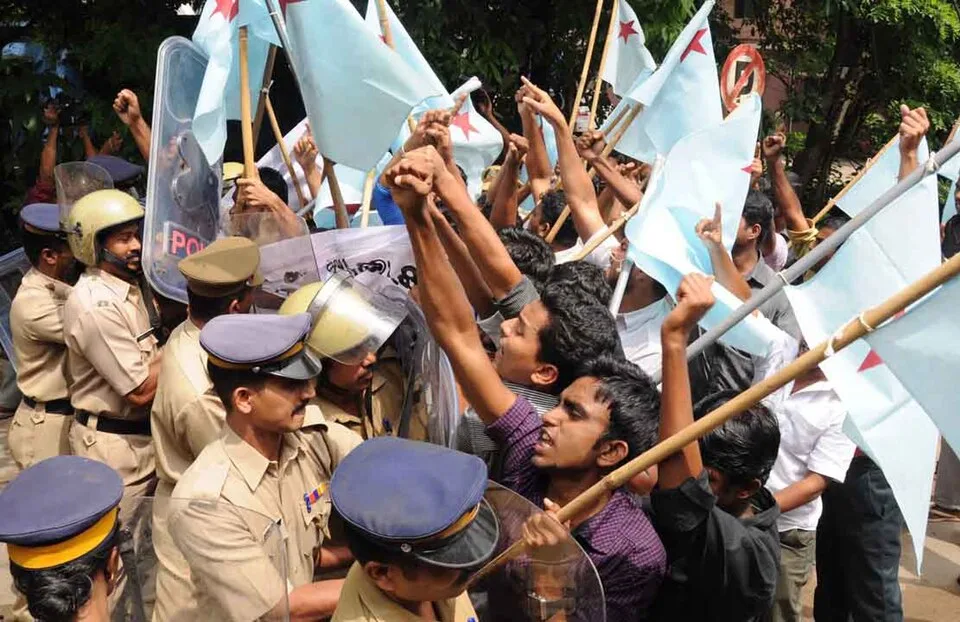
Indian police beat students with batons, fired tear gas at thousands of young protesters, forcibly hospitalized a hunger-striking activist, and injured 60 demonstrators. The government's plan to stop the Cockroach movement? It did not work. The protesters came back the next morning and set up camp.
What the Hell Is the Cockroach Movement?
Two months ago, the Cockroach Janta Party did not exist. Now it is shutting down central New Delhi and making Prime Minister Narendra Modi's government look like it is afraid of its own students. The movement was founded by Abhijeet Dipke and started, as NPR reports, as a satirical protest before rapidly evolving into a nationwide, youth-led uprising focused on exam leaks, unemployment, and government accountability.
The name is the point. Cockroaches survive everything. You stomp on them, you gas them, they keep moving. Whoever came up with that branding deserves a raise, because after Monday's crackdown, the metaphor has basically written itself.
The protests have drawn students, working professionals, and families, all united around demands that include the resignation of Education Minister Dharmendra Pradhan, sweeping examination reforms, and compensation for families of students who died by suicide following alleged exam irregularities. These are not abstract political grievances. These are people whose futures got stolen and who want someone to answer for it.
Monday's Crackdown, on Video, for the Whole Country to See
Thousands of Cockroach movement supporters tried to march toward Parliament on Monday. Police responded with tear gas and batons. According to the Associated Press via NPR, Delhi Police reported nearly 180 people injured in the confrontation, including 118 security personnel and 60 protesters.
Video of officers beating protesters and dragging them away spread across social media immediately. The footage showed young people crying, pleading with officers not to hit them, and in other cases simply standing their ground and taking the blows. If the government's goal was to scare people into going home, it badly misjudged what public footage of cops beating students does to public sympathy.
Activist Sonam Wangchuk, who had been on a hunger strike for three weeks and had become one of the movement's most visible symbols, was forcibly taken to a hospital by police during the crackdown. His removal from the protest site, rather than breaking the movement's momentum, seems to have poured gasoline on it.
The Government Tried to Talk. It Went Badly.
After nearly a month of ignoring the protests entirely, the government blinked. A senior minister held talks with movement representatives on Monday, marking the first real engagement from Modi's administration. It did not go well.
Founder Dipke accused authorities of negotiating in bad faith, telling reporters that police launched a baton charge after protesters had actually been invited in for dialogue. Movement leaders were clear: they want action, not assurances. Specifically, they want Pradhan's resignation. They are not interested in being managed.
Rights group Amnesty International weighed in Monday night, stating that the police action demonstrated, in their words, 'how peaceful dissent is being suppressed in India,' and pointing out that the right to peaceful assembly is recognized under the Indian constitution. That last part matters. The government is not just beating protesters. It is beating protesters in violation of rights its own founding document guarantees.
Tuesday Morning: Everyone's Still There
Hundreds of protesters camped overnight at Jantar Mantar, a designated protest site in New Delhi, under heavy police presence. They were not subtle about their intentions. 'We are going to continue our protest,' Dipke told reporters Tuesday.
Sona Bisht, a 20-year-old student who was part of Monday's confrontation, told NPR's AP reporters exactly what the crackdown accomplished. 'If the government thinks that doing this with Gen Z, they can stop us, then that won't happen,' she said. 'We are here talking about education, talking about securing our future. And till the time our demands are not met, we will not move from here.'
New people are joining. Rabina Kashyap, 26, showed up Tuesday as a first-time participant. She told reporters she had no personal stake in the original protest. 'I have nothing to do with this protest,' she said. 'But this is India, this is my country, and these are my people. So I will stand by them.' That is the part authoritarian-leaning governments never seem to learn: heavy-handed crackdowns do not shrink movements. They grow them.
Opposition Smells Blood
Congress party leader Rahul Gandhi did not miss the moment. On Tuesday, Gandhi and dozens of Congress lawmakers staged a sit-in protest outside Modi's own residence, with several lawmakers fastening zip ties around their wrists in a gesture of solidarity. Gandhi posted on X that they were there to 'demand answers from him for the brutalities against young students yesterday.'
This is significant. The Cockroach movement is explicitly youth-led and non-partisan, but when the government beats students on camera, the opposition does not need to manufacture outrage. The NPR report frames Monday's events as a rare public challenge to Modi's government in its third term, reviving criticism about its handling of dissent. That framing is generous. Beating students who are protesting exam fraud is not a handling-of-dissent problem. It is a governing-through-fear problem.
The Dingo Take
Let's be honest about what is happening here. India's government allegedly allowed widespread corruption in its national examination system, potentially robbing millions of students of fair access to universities and careers. Students died by suicide. Families were destroyed. When young people took to the streets to demand accountability, the government spent a month pretending the protests did not exist, then sent police with batons when ignoring them stopped working. This is not a complicated story. It is a government that failed its young people and is now hitting them for noticing.
The Cockroach movement's durability is not surprising if you have been paying attention to what is happening globally with Gen Z organizing. These are people who grew up watching institutions fail them in real time, who document everything on their phones, and who have nothing left to lose in a job market that already squeezed them out. Tear gas does not break that. Footage of tear gas being used against students asking for fair exams just recruits the next wave of protesters, as Tuesday's new arrivals demonstrated with embarrassing precision for the Modi administration.
Modi's government has a choice here, and it is not a complicated one. It can actually address the examination failures, let Pradhan absorb the political cost, and give the movement something real to point to as a win. Or it can keep sending police to Jantar Mantar, keep generating footage of officers beating crying students, and keep watching the protests grow. One of those paths ends this. The other one ends worse. Based on recent behavior, the government appears to be betting on the second option. The cockroaches are still there.




Comments