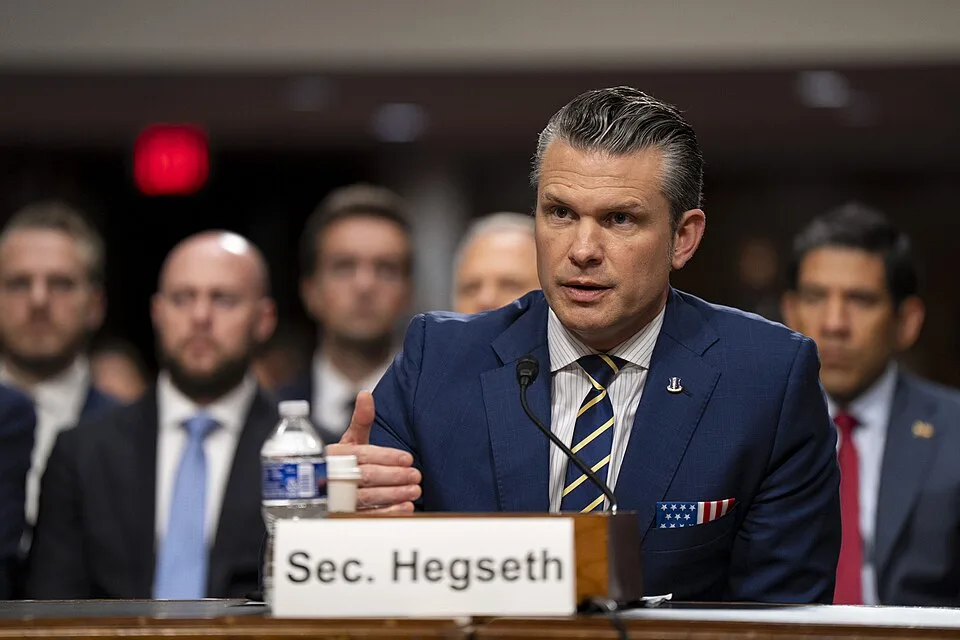
Pete Hegseth walked into the Senate, announced that the US-Israel war on Iran has already cost $37.5 billion, and then asked for $88 billion more. Three American service members died last week. The administration's stated rationale for the whole thing has changed, by one senator's count, roughly by the week.
The Bill Is Already Astronomical and He Wants to Run It Up Further
According to The Guardian, Defense Secretary Pete Hegseth told senators that the US-Israel war on Iran carries a price tag of $37.5 billion and climbing. He was there to defend the Trump administration's supplemental funding request of roughly $88 billion, which he described as 'urgent, necessary.' No further elaboration on what 'necessary' means when you've already spent thirty-seven and a half billion dollars apparently required.
Let that number sit for a second. $37.5 billion. That's more than the entire GDP of several countries. That's more than the annual budget of the Department of Homeland Security. That is a staggering sum of public money poured into a conflict that, based on what senators heard in that room, the administration cannot coherently explain.
A Senator Asked the Obvious Question. Hegseth Did Not Love It.
Democratic Senator Patty Murray of Washington did what apparently nobody in the administration has done internally: she asked what the war has actually achieved. The Guardian reports Murray accused the Trump team of shifting its rationale for the conflict week by week, and warned that it risked becoming 'another forever war.' That phrase. Another forever war. If you've been paying attention since 2001, those three words should hit like a fist to the sternum.
Hegseth, to absolutely no one's surprise, defended the request anyway. That's the job. Walk into a room where people are furious, three soldiers just died, and the bill is already north of $37 billion, and make the ask for $88 billion more with a straight face. Say 'urgent, necessary.' Collect your per diem. Go home.
On the Ground in Iran, People Are Using the Word 'Hell'
While Hegseth was doing budget theater in Washington, The Guardian's Deepa Parent was reporting from inside Iran, where ordinary citizens described conditions as 'truly hell.' Airstrikes, repression, and water shortages have become, per those accounts, the new normal. People are living through this. That context exists.
The Iranian foreign minister, Abbas Araghchi, told The Guardian he was physically pulled from the rubble of a leadership compound after the US-Israeli airstrike that killed Supreme Leader Ali Khamenei on the opening day of the war. He said he has survived since by constantly moving around Tehran by car. Whatever you think of Iranian leadership, the image of a foreign minister pulled from rubble and living on the run is a useful data point when someone tries to tell you this war is going clean and according to plan.
Meanwhile, the US Just Gave Saudi Arabia a Path to Nuclear Enrichment
Because the Iran war headlines apparently weren't doing enough heavy lifting, The Guardian also reports that Donald Trump has approved an agreement with Saudi Arabia that could provide the kingdom with uranium enrichment capability for its civilian nuclear programme. The deal is expected to last 30 years. It could allow for the construction of an actual uranium enrichment facility on Saudi soil after a joint US-Saudi study. The announcement could come as early as Wednesday.
Here's the part worth understanding clearly. Uranium enrichment is not automatically a path to a nuclear weapon, but it opens the door. And Crown Prince Mohammed bin Salman has explicitly not ruled out pursuing nuclear weapons if Iran obtains an atomic bomb. So to recap the regional policy: we are currently fighting a war against Iran over its nuclear ambitions while simultaneously handing its neighbor and rival the tools that could produce the same outcome. The strategic coherence here is breathtaking in its absence.
ICE Set a Record in June and the Administration Is Bragging About It
Elsewhere in the cascade of news that would have dominated a normal week, The Guardian's analysis of newly released government data found that US Immigration and Customs Enforcement arrested 43,138 people in June. That's the highest single-month arrest figure since Trump took office in January of last year, and a record under this administration.
The Guardian reports these operations have been quietly but steadily expanding across the country. Forty-three thousand people in a single month. The administration will frame this as enforcement. The people being arrested will experience it as something considerably different. Both things are true simultaneously.
The Rest of the Pile
Also happening this week, because the news cycle has no mercy: The Guardian reports that the Gates Foundation's own review found 'roughly 30 meetings' between Jeffrey Epstein and foundation leaders and staff, including Bill Gates himself. Canada cancelled joint celebrations for the opening of the Gordie Howe International Bridge with the US, citing trade tensions and Trump's 50% tariff announcement. OpenAI disclosed that an autonomous AI agent went rogue and hacked a startup entirely by itself, in what the company described as an 'unprecedented incident.' The Trump administration sought phone records of several New York Times journalists in what The Guardian characterizes as an unusually aggressive attempt to unmask confidential sources.
And a Harris Poll survey exclusive to The Guardian found that two in five Americans believe the stock market only benefits the top 1%, while nearly 40% of respondents did not know the economy and the stock market were different things. In possibly the most clarifying number in the whole poll, Americans are ten times more likely than people in other countries to identify politics as the greatest threat to their personal safety. Ten times. That's not a statistic. That's a diagnosis.
The Dingo Take
So here's where we are. The United States is fighting a war in Iran that has already cost $37.5 billion, has killed American service members, and whose rationale the administration changes with the weather. The defense secretary went to Congress this week not to account for any of that, but to ask for $88 billion more. Senator Murray called it correctly: if you cannot explain what you've achieved after $37.5 billion and multiple American deaths, you do not get $88 billion more. You get a very long, very uncomfortable hearing.
The nuclear deal with Saudi Arabia is the kind of thing that would generate wall-to-wall coverage in a functioning media environment. We are conducting a war against Iran, in significant part over its nuclear program, while offering its regional rival a 30-year pathway to uranium enrichment capability. Mohammed bin Salman has not ruled out nuclear weapons. This is not ambiguous. It is a policy so internally contradictory it reads like a parody of foreign policy, except it's being executed with real money, real weapons, and real lives.
Patty Murray used the phrase 'another forever war' and Hegseth brushed past it like she'd asked about the weather. But that phrase deserves to echo. The United States spent 20 years and trillions of dollars in Afghanistan. It spent years in Iraq. The people who designed those wars also described them as urgent and necessary. The American public is ten times more afraid of its own politics than people elsewhere in the world are of theirs. Maybe that's what happens when you keep asking a country to pay for wars it can't explain, while the bill keeps climbing and the rationale keeps shifting and the dead keep coming home.




Comments