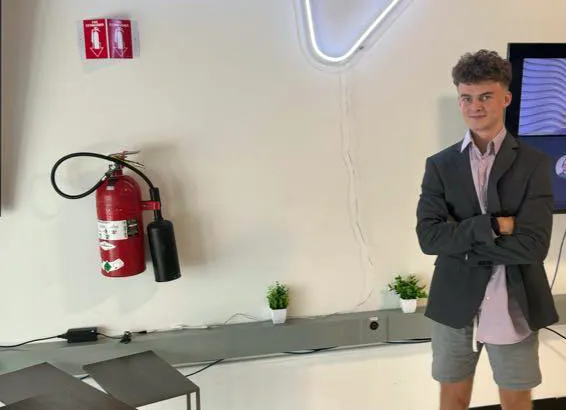
Edward Coristine, the 20-year-old former DOGE engineer who goes by "Big Balls," is now the lead engineer on America.gov, the Trump administration's new AI-powered portal for your passport, your Medicare enrollment, and whatever else the government can cram behind a chatbot. Trump personally singled him out at the launch and thanked him for his work. This is where the story of America's "efficiency" crusade has landed.
From Neuralink Intern to Federal Digital Front Door
Let's start with the résumé, because the résumé is the story. Coristine did several months at Neuralink, Elon Musk's brain-chip company, then joined DOGE at 19. Now, per a sit-down with Fox News Digital at the White House, he's helping the National Design Studio build the revamped America.gov, which launched September 29 as an AI-powered single entry point for information pulled from thousands of government websites.
Trump called him out by name at the launch event, identified him as the project's lead engineer, and thanked him. A kid who was in high school not long ago is now the face of how Americans will interact with their own government.
Look, nobody is saying young people can't build things. Plenty of great software has come from people who couldn't legally rent a car. But the gap between "talented kid" and "person you hand the keys to the federal front door" is a gap worth staring at.
The Pitch: 29,000 Websites Is Too Many
Here's the thing. Coristine's core complaint is not wrong. "I think that the fact that there's 29,000 government websites is pretty insane," he said, and he has a point. Anyone who has tried to enroll in Medicare and ended up bouncing between Medicare.gov and the Social Security site knows the pain.
His vision is to make the government work like a company with one website where everything is easy to find. America.gov is supposed to deliver tailored services and answer questions with responses sourced from federal information.
That is a legitimately good idea. Simplifying federal digital services is the kind of boring, useful work that actually helps people. It's also the kind of work that existing federal digital teams were doing before DOGE showed up with a chainsaw and a meme budget.
Passports, Selfies, and a Whole Lot of Trust
The headline feature is passports. Coristine says first-time applications will go fully online for the first time ever, ending the current routine of trudging to the post office and getting your photo taken at a CVS or Walgreens. Under the plan, you snap your own passport photo at home, preview how it will look on the document, and finish without leaving America.gov.
On paper, fine. Nobody loves the post office line. But a passport is an identity document, and the people who forge identity documents are creative, motivated, and extremely online. A system that takes self-submitted photos and routes a first-time application through an AI-driven portal has to be airtight.
The reporting contains zero detail about security, fraud prevention, or what verification looks like when no human at a counter is looking at your face. That's not a small omission. That's the whole ballgame.
Government as a Hospitality Business
Then there's the philosophy. Coristine described Trump as "a great host for his entire career," noting the president comes from the hospitality business. "Any great host knows they have to make things easy, they have to make it all feel clean," he said. Trump, he added, is focused on "removing the potholes from the digital government."
This is a fascinating way to describe a government. Hotels have guests. Governments have citizens, who have rights, who are not there to be comped a nice experience. The relationship is different. A hotel can ask you to leave. A government that treats the people it serves as customers to be pleased tends to forget about the ones who can't pay.
And "feel clean" is doing a lot of work in that sentence. Making something feel clean and making something be clean are different jobs.
Yes, the Nickname Came From His Dad
Because we are a serious publication, we must report that Coristine says he got the "Big Balls" nickname from his father and eventually made it his LinkedIn URL. "It was actually, like, fairly underground, but I was discovered," he said. "It's been very funny ever since."
So that's settled. The man leading engineering on the federal government's new AI-powered front door has a LinkedIn address his dad picked, and he finds the whole thing hilarious.
We get it. We run a website called The Dingo Daily. We are not the nickname police. But there is a time when a joke handle is charming and a time when it is attached to a portal that will hold your Social Security number, and those times are not the same time.
What DOGE Actually Left Behind
The unspoken question hanging over this interview is what DOGE did to earn this redemption arc. Coristine says his time there showed him how frustrating federal services are for Americans. Fair enough. But the operation he came up through was sold as a slash-and-burn mission, and it generated plenty of controversy about who got access to what inside federal systems.
Now the same orbit is building the consolidated gateway to those systems, with AI answering your questions. If you trusted the DOGE era, this is the sequel you've been waiting for. If you didn't, you are being asked to extend credit.
The piece we're drawing on is a friendly White House sit-down, so tough questions about data handling and oversight were never going to come up. They should have.
The Dingo Take
Competence is not a vibe, and we're about to find out which one this is.
There is a real, unglamorous good idea buried in America.gov: one place, fewer dead links, passports without the CVS photo booth. If it works, millions of people will save hours and nobody will care who built it. We'd be the first to admit that.
But the standard here isn't whether it looks slick at a launch event. It's whether it protects your identity, tells you the truth, and holds up when something goes wrong. A 20-year-old with a joke nickname and a president's thanks has not yet shown us any of that. Show us the security audit, show us the oversight, and show us who answers when the chatbot gets it wrong. Until then, the potholes are the least of our worries.



Comments