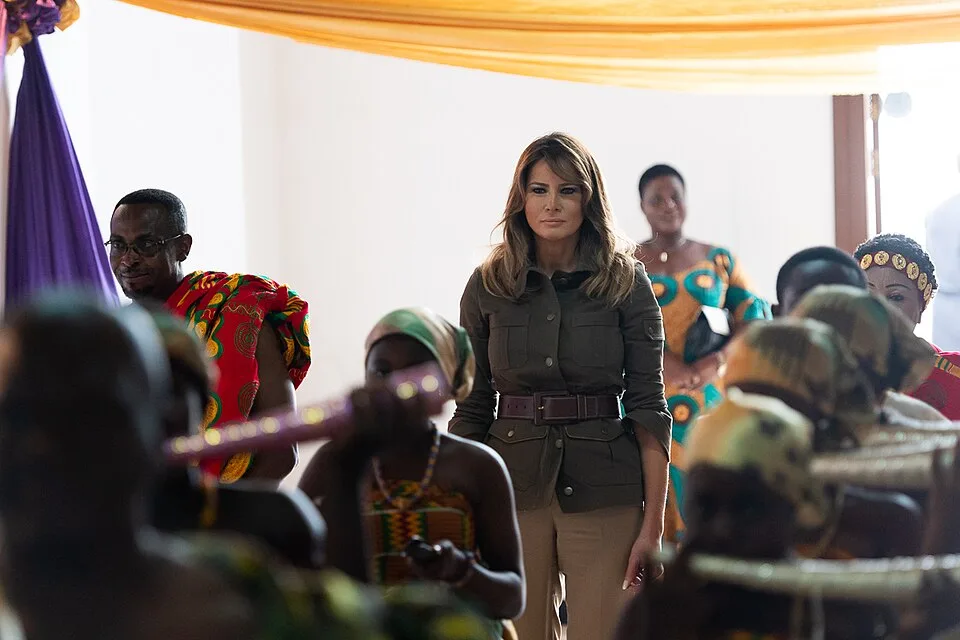
Michael Wolff accused Melania Trump of being tied to Jeffrey Epstein, then turned her demand for a retraction into a six-figure fundraising campaign, then got his lawsuit thrown out by a federal judge who described it as 'contorted almost beyond recognition.' Now Melania wants him to pay for all of it. The man may have miscalculated.
Let's Back Up and Explain What Wolff Actually Did Here
The New York Post reports that Melania Trump filed a motion Tuesday in the Southern District of New York seeking sanctions against Fire and Fury author Michael Wolff, demanding he cover court costs and attorneys' fees she racked up fighting his lawsuit.
Here is the sequence of events, because it really does need to be laid out. Wolff made statements alleging the first lady had some kind of association with convicted sex trafficker Jeffrey Epstein. Melania's lawyer, Alejandro Brito, sent Wolff a letter last year demanding a retraction. Brito also warned Wolff that if he didn't comply, Melania would sue him for $1 billion.
Instead of retracting or waiting to be sued, Wolff went to a New York court himself last October and filed a preemptive lawsuit against Melania. The legal theory, as The Post describes it, was essentially asking a federal judge to declare in advance that if Melania ever sued him, he should win. Then, according to Melania's legal team, he promoted the whole thing across his own media platforms and used it to raise more than $836,000.
The Judge Was Not Impressed
Manhattan Judge Mary Kay Vyskocil tossed Wolff's lawsuit in May. Her ruling did not pull punches. 'Plaintiff asks for a declaration that, if the First Lady sues him, he deserves to win,' Vyskocil wrote. 'That is not how the federal courts work.'
She described the lawsuit as 'contorted almost beyond recognition.' That is a federal judge, in a written ruling, using the word 'contorted.' That is not the kind of language judges reach for when they think you came close to having a point.
Melania's 26-page sanctions motion, per The Post, accused Wolff of transforming 'a serious, looming defamation suit against Plaintiff based on his wrongdoing into a fundraising drive and a political spectacle.' The filing argues that sanctions are warranted on their own merits, completely separate from whether Wolff's original Epstein statements were actually defamatory. The motion points to what it calls 'unsupported and mischaracterized federal submissions,' improper use of those filings, and what it describes as 'textbook bad-faith forum-shopping.'
The Epstein Angle Has a Nasty Twist
Melania has denied any connection to Epstein, the sex trafficker who died in a Manhattan jail cell in 2019 while awaiting trial on child sex trafficking charges. That part of the story is not new.
What is new, and what makes Wolff's specific choice to smear Melania with an Epstein connection so awkward, is this: according to The New York Post, a trove of Justice Department documents released earlier this year revealed that Wolff himself exchanged more than 1,000 messages with Epstein and described the deceased pedophile as his 'good friend.' So the man who decided to publicly link Melania Trump to Jeffrey Epstein had, by his own apparent account, a warm personal friendship with Jeffrey Epstein. The phrase 'glass houses' seems almost too gentle here.
Where This Goes Next
Melania's legal team has been clear that the sanctions push does not replace the original $1 billion defamation threat. That sword is still hanging. The sanctions motion is a separate matter targeting what Brito's team calls the abusive way Wolff used the federal court system while simultaneously running a fundraising operation off the drama.
Lawyers for both sides did not respond to requests for comment from The Post before publication. Wolff has raised more than $836,000 from supporters who presumably believed his lawsuit had merit. A federal judge has now said, on the record and in writing, that it did not. What happens to that money, and what Wolff's next legal move looks like, remains to be seen.
The Dingo Take
Look, there is something almost admirably bold about being a journalist who accuses someone of Epstein ties while sitting on 1,000 friendly messages to Epstein himself. That takes a specific kind of confidence. The kind that tends to age very poorly in a courtroom.
Wolff's strategy here was not subtle. Get a threatening letter from Melania Trump's lawyer, file a preemptive federal lawsuit, blast it across every platform you have, collect nearly a million dollars in donations from people who will never read the actual filing, and hope the chaos drowns out the underlying question of whether your original statements were true. A federal judge read that playbook, called it 'contorted almost beyond recognition,' and threw the whole thing out. Now the sanctions motion is asking the court to make Wolff pay for the legal bills he generated with a case that should never have been filed.
None of this makes Melania Trump's $1 billion defamation threat less absurd as a number. Billion-dollar defamation suits against journalists are a tool of intimidation as much as anything else, and we should say that plainly. But Wolff handed her legal team a gift by filing a federal lawsuit that a judge shredded in writing. Whatever sympathy a press freedom argument might have earned him, he burned a lot of it by turning federal litigation into a crowdfunding campaign. Both things can be true at once. And in this story, both very much are.



Comments