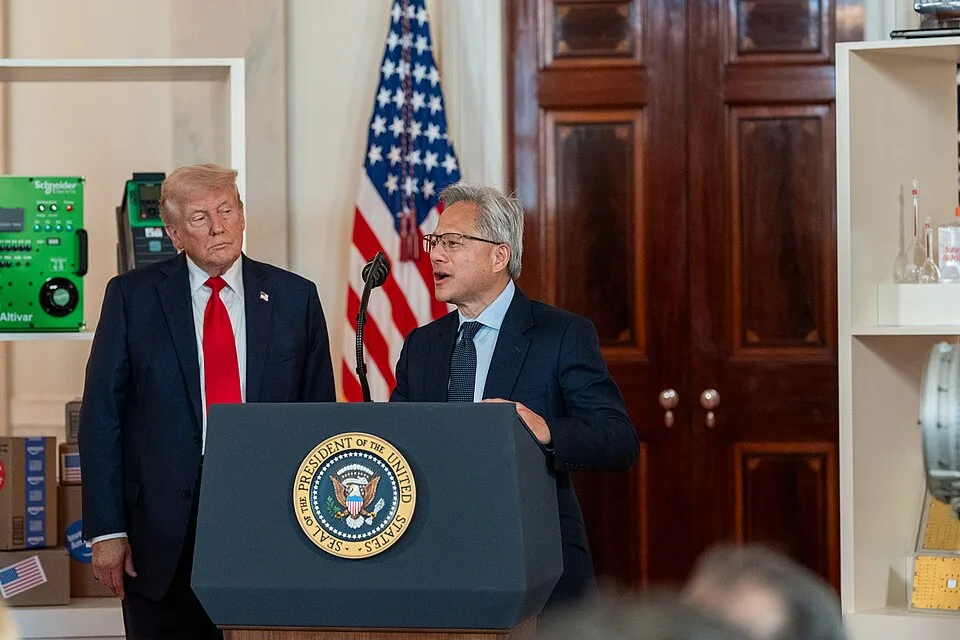
The CEO of the company that has made more money from the AI boom than practically anyone alive on earth would like you to know that fears about AI are overblown and you should stop worrying. Jensen Huang told Axios this week that 'science fiction' fears are driving bad policy in Washington, and that overreacting to AI risks could slow adoption and hurt America's competitive edge. The man sells shovels in a gold rush, and he is here to tell you the gold is definitely real and the mine is definitely safe.
What Huang Actually Said
In an interview with Axios' Mike Allen for their 'Behind the Curtain' video series, Huang railed against what he called AI doomerism, according to Axios. The argument, as best as it can be summarized: Washington policymakers are letting fears rooted in Hollywood movies and speculative worst-case scenarios shape decisions about one of the most consequential technologies in human history, and that's bad for America.
He's not wrong that some AI panic is silly. The people who think a chatbot is about to become Skynet and nuke Ohio are probably not worth centering your entire regulatory framework around. But Huang's argument conveniently lands right where you'd expect it to land for a man whose company's stock price is essentially a bet on maximum AI adoption as fast as possible.
The Conflict of Interest Sitting Right There in the Room
Let's be precise about this. Nvidia makes the chips that power AI systems. The more AI gets built, trained, and deployed, the more GPUs get sold. The more GPUs get sold, the more money Jensen Huang makes. His net worth is somewhere north of $100 billion. When he says AI regulation could 'weaken America's competitive edge,' he is also describing something that would weaken Nvidia's profit margins.
None of this means he's wrong. It just means he is not a neutral observer offering dispassionate policy advice. He is an extremely interested party making an extremely convenient argument. Washington has a bad habit of treating tech executives as wise men dispensing wisdom from the mountaintop rather than as corporate executives doing what corporate executives do, which is advocate for conditions that make their companies more money.
The Actual Policy Fight Happening in Washington
The AI policy debate in Washington right now is not one argument, it's two happening simultaneously, according to Axios. The first is about how to manage increasingly advanced AI systems as they become more capable. The second is whether to restrict powerful open-source AI models coming out of China, given allegations of IP theft and genuine national security concerns.
These are genuinely hard problems with no clean answers. The China question especially is a real tension: open-source AI models are useful, and restricting them has costs, but some of the most capable open-source models circulating right now are coming from Chinese labs operating under the thumb of the Chinese Communist Party. Figuring out where to draw those lines requires serious, careful thinking. What it does not require is a GPU salesman telling everyone to relax.
The Doomerism Problem Is Real, But So Is the Dismissiveness
Here's the thing about AI discourse that makes all of this so exhausting. Both extremes are genuinely unhelpful. The pure doomers who think AI is an extinction-level threat next Tuesday are not serious. But the pure accelerationists who treat any attempt at caution as luddite hysteria are also not serious. Huang is firmly in the second camp, which is not exactly a bold position when you are the person cashing the biggest checks in the room.
The researchers raising concerns about AI systems are not, by and large, people who watched too many Terminator movies. Many of them built these systems. Some of the loudest alarm-raisers used to work at the very labs building the most powerful AI in the world. Dismissing all of that as science fiction is itself a kind of motivated reasoning, just wearing a blazer and holding a keynote clicker.
Trump's Washington and the AI Regulatory Vacuum
The Trump administration has not exactly been a beacon of coherent tech policy. The administration rolled back Biden-era AI executive orders early on, and the approach since has been a chaotic mix of deregulatory instinct, nationalist chest-thumping about beating China, and whatever Elon Musk says in a given week. Into that vacuum, Huang is making his pitch.
And look, the Trump crowd is receptive to this message. They hate regulation on principle. They love 'winning' against China. They are not predisposed to slow down and ask hard questions about second-order effects. A tech billionaire telling them that the nerds worrying about AI safety are basically just scared of robots fits neatly into how this administration sees the world.
The Dingo Take
Jensen Huang is a brilliant engineer who built a company that turned out to be positioned perfectly for one of the biggest technological shifts in decades. He is also a man with a direct and enormous financial stake in one specific policy outcome, and he is in Washington making the case for that outcome while being treated as a sage. These two things can both be true.
The frustrating part is that the actual policy questions here deserve better than this. How do you handle increasingly capable AI systems? How do you think about Chinese open-source models without either ignoring real risks or kneecapping American researchers? These are hard, consequential questions that a serious government would be wrestling with carefully. What Washington is doing instead is listening to whoever has the biggest check and the loudest voice.
Huang wants policymakers to stop being scared of science fiction. Fair enough. But the flip side of that is that policymakers should also stop taking their cues from the guy whose business model depends entirely on everyone buying as many chips as possible and asking as few questions as the market will allow. That's not science fiction either. That's just how capitalism works.
Comments