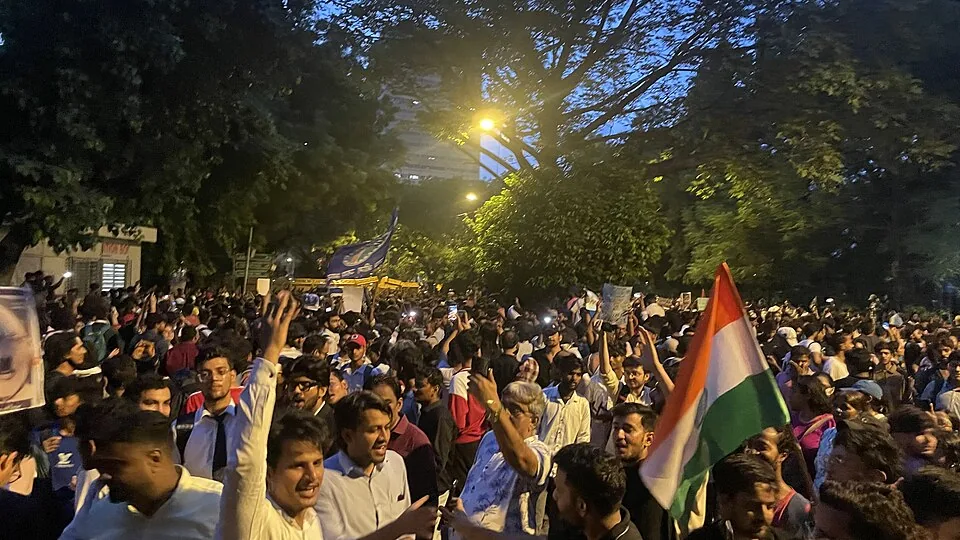
A movement called the Cockroach People's Party, named after a sitting Supreme Court chief justice compared unemployed young people to cockroaches, has become one of India's largest waves of public dissent in years. Activist Sonam Wangchuk just ended a 26-day hunger strike. The protesters, for their part, are just getting started.
Twenty-Six Days Without Food, and the Government Still Didn't Blink First
Sonam Wangchuk, a prominent Indian activist who you may know as the real-life inspiration behind the film '3 Idiots,' ended his hunger strike on Friday after 26 days, NPR reports. He was eventually transferred to a hospital by police while still fasting, which is the kind of optic a government usually tries very hard to avoid.
In a post on X, Wangchuk said he ended the fast in the presence of two federal ministers, following what he described as a 'long negotiation on various conditions and in view of possible violence in the country.' He didn't say what the conditions were. The government, presumably, would like you to believe this counts as a win for them. The protesters disagree loudly.
Wangchuk's fast had become the symbolic heart of the Cockroach movement, which began more than a month ago demanding accountability over leaked entrance exam papers. His body was the exclamation point on a sentence India's young people have been trying to finish for years.
The Name Alone Should Tell You How Angry These Kids Are
Let's linger on the name for a second, because it matters. The Cockroach Janta Party was born from a remark by India's Supreme Court chief justice, who compared unemployed young people to cockroaches. Rather than quietly accepting that particular insult from the highest court in the land, Gen Z did what Gen Z does: they turned it into a brand. A movement. A flag they marched under into tear gas clouds.
The group's founder, Abhijeet Dipke, said after Wangchuk ended his fast, 'We won't let Sonam sir's sacrifice go in vain.' The protests, according to NPR, have drawn not just students but professionals, families, and activists to demonstrations in New Delhi and cities across the country. This is not a fringe thing. This is a generation that has run out of patience.
The movement started over exam leaks in some of India's most competitive entrance exams, the kind that determine life trajectories for millions of students. But it has since pulled in bigger grievances: unemployment, economic stagnation, and a government that treats accountability like a suggestion.
Modi Finally Showed Up, Said Some Words, Solved Nothing
Prime Minister Narendra Modi addressed the protests publicly for the first time on Thursday, a full month after they erupted. He announced fast-track courts to handle exam leak cases and said his government would introduce legislation in Parliament to crack down on paper leaks. The protesters heard this and kept marching.
That is the correct response. 'We will create courts to deal with this crime' is not the same as 'here is accountability for the specific people who did this specific crime and here is what we are doing for the students whose futures were derailed.' Protesters told NPR's source outlets that Modi's announcements failed entirely to address their core demands: systemic reform, government accountability, and compensation for families of students who died by suicide after the leaks. The government announced process. The protesters want consequences.
This is a familiar playbook. Faced with mass public anger, announce a committee, a court, a bill. Let the news cycle do the rest. It usually works. This time, it doesn't seem to be working.
Tear Gas Outside Parliament and a Movement That Won't Disperse
Earlier this week, thousands of protesters marched on Parliament. Police responded with tear gas and batons. Protest organizers then called for nationwide demonstrations in solidarity with the students who were beaten. According to NPR, those demonstrations went ahead on Friday.
That sequence matters. Government uses force. Movement grows. This is not the behavior of a protest that's losing momentum. This is the behavior of one that has crossed the threshold where normal deterrents stop working, where people are angrier about what happened than they are afraid of what might happen next.
Protest organizers have stated clearly that demonstrations will continue until Education Minister Dharmendra Pradhan resigns. That is the demand on the table. Not a commission. Not a court. A resignation.
The Dingo Take
Here's what's actually happening in India right now. A generation that was promised opportunity, sat for grueling entrance exams that determine their entire economic futures, and then watched those exams get corrupted by leaks while officials shrugged, has decided that enough is enough. They named themselves after an insult hurled at them by a Supreme Court justice. They watched an activist starve for 26 days. They got beaten outside Parliament. And they are still there.
Modi's fast-track courts announcement is the political equivalent of a landlord installing a smoke detector after the building burned down. It addresses the category of the problem without touching any of the actual accountability that the protesters are demanding. You can almost feel the contempt baked into that response, the assumption that young people will accept the performance of action as a substitute for action itself. This generation is making clear, loudly and in large numbers, that they will not.
The Cockroach movement probably won't get everything it wants. Movements rarely do. But the fact that it has pulled hundreds of thousands of people into the streets, sustained itself for over a month, survived police crackdowns, and forced a prime minister who usually ignores domestic dissent to address it publicly is not nothing. Call it what it is: a generation telling its government that the social contract is broken and they noticed. Whether anyone in power actually listens is a different question, and based on the evidence so far, you should not hold your breath.




Comments