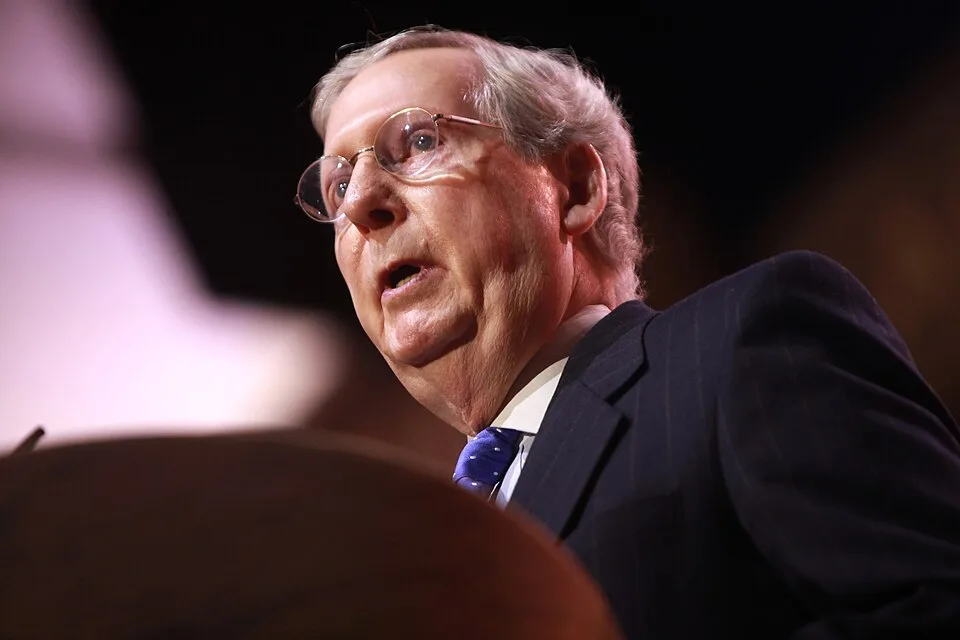
Mitch McConnell is currently in a rehabilitation center recovering from a serious fall, which means he is technically alive, which means his hometown newspaper just published what is essentially his obituary while he can still read it. The Louisville Courier Journal columnist Joseph Gerth decided to get the record straight now, before McConnell dies and the rules of decorum kick in. It is, genuinely, one of the most brutal pieces of political writing you will read this year.
Why Now? Because Dead Guys Get a Free Pass
Gerth was direct about his timing. He told readers he was inspired by the backlash that followed criticism of the late Sen. Lindsey Graham, who died suddenly on July 11 at 71. According to the Mirror US, which covered Gerth's column, Graham's critics got hammered in the press for speaking ill of a man who could no longer respond. Gerth apparently looked at that situation, looked at the 82-year-old McConnell sitting in a rehab facility, and thought: not this time.
So he wrote the pre-obituary. A full accounting of McConnell's legacy, achievements and all, delivered while the man is still breathing and therefore still fair game. It is the political journalism equivalent of handing someone their performance review and then walking out of the room very slowly.
The Nixon Comparison That Will Ruin McConnell's Entire Morning
Gerth did not ease into it. He wrote that McConnell is "every bit the detestable figure that Nixon was." Then he made it worse. "But unlike Nixon," Gerth continued, "McConnell never paid for his sins that have damaged our nation's trust in government, destroyed the country's ability to have meaningful dialogue, and cemented our nation's politics as an arena in which winning is the only thing that matters."
Read that again. The argument is not just that McConnell is as bad as Nixon. The argument is that he is worse, because Nixon at least faced consequences. Nixon got caught, Nixon resigned, Nixon became a punchline who died in disgrace. McConnell, according to Gerth's framing, did comparable damage to American democracy and then just kept getting re-elected to the Senate. The man served as Senate Majority Leader for years. He goes to galas. People name things after him in Kentucky.
That is a genuinely damning framing, and Gerth earns it with specifics.
The Supreme Court: Where McConnell's Legacy Gets Cemented and Cursed
Gerth acknowledges the achievements. He credits McConnell with securing real investment for Kentucky, rebuilding the state Republican Party, and occasionally defending free speech even when it cost him politically. The column is not a hit piece dressed up as analysis. It does the work.
But then it gets to the Supreme Court, and the column shifts gears entirely. The Mirror US reports that Gerth identified two things McConnell will ultimately be remembered for: his manipulation of the Supreme Court confirmation process, and his decision to stick with Trump despite believing the man is, in Gerth's words, "stupid" and someone who "led an attempt to overthrow the United States' government on Jan. 6, 2021."
On the court specifically, Gerth drew a line straight from McConnell's past to his present. McConnell broke with his own party in 1964 to support the Voting Rights Act. Decades later, the court he built by blocking Merrick Garland's nomination in 2016 and ramming through Amy Coney Barrett's in 2020 struck down the last remaining significant provision of that same Voting Rights Act. The court McConnell engineered also overturned sixty years of civil rights case law and a century of law limiting presidential power. He voted for one thing. He built the court that undid it.
The January 6th Soft-Shoe Routine
McConnell's relationship with Trump is its own special category of political cowardice, and Gerth does not let it slide. According to the Mirror US, Gerth describes McConnell as someone motivated above all by the desire to "protect and increase" his own political power. That diagnosis explains everything that followed.
McConnell stood on the Senate floor after January 6th and gave a speech that was, by his standards, almost shockingly pointed. He blamed Trump directly. He said Trump was practically and morally responsible for the attack on the Capitol. It was the kind of thing you say when you're about to vote to convict someone in an impeachment trial. Then he did not vote to convict. He said the Senate lacked jurisdiction because Trump had already left office, a legal argument so convenient it practically filed its own paperwork. McConnell had the speech and the cover and the moment, and he blinked.
The Man in the Rehab Center
McConnell has been largely out of public view since June 14th, when he suffered a severe fall at his Washington, D.C., home. For weeks, according to the Mirror US, rumors circulated that he was dead or on life support. His office released a statement and a new photo on July 12th confirming he had been moved from hospital care to a rehabilitation center. He has not returned to the Senate.
So that is the context here. Gerth is writing about a man who is 82 years old, recovering from a fall serious enough to require weeks of hospital care, and who has been the subject of death rumors for over a month. The column is not cruel about that. It does not mock his health or suggest he has somehow gotten what he deserves. It simply makes the case that if we are going to have an honest conversation about what Mitch McConnell did to this country, now is the time to have it.
The Dingo Take
Here is what makes the Gerth column land so hard: it is not wrong. The Supreme Court argument alone would be enough. McConnell held open a Supreme Court seat for eleven months by simply refusing to hold a hearing, citing a principle he invented on a Tuesday and abandoned four years later when it suited him. The result was a six-to-three supermajority that has spent the last several years dismantling the legal architecture of the twentieth century. Roe. The Voting Rights Act. The Chevron doctrine. Presidential immunity. He built that court. He owns that court. That is the legacy.
The Nixon comparison is provocative, and Gerth knows it. But the underlying point is serious. Nixon's crimes were largely about self-preservation and personal paranoia. McConnell's long game was structural. He did not break into anybody's office. He just systematically rewrote the rules of how power works in Washington, with a patience and a cynicism that makes Watergate look like a smash-and-grab. The damage from Watergate was real but recoverable. Fifty years of Supreme Court precedent, once overturned, does not come back easily.
Gerth is right that the window for honest reckoning closes when someone dies. We watched it happen with Graham, we watched it happen with a dozen others. The American political tradition of speaking no ill of the dead is charming and completely insane when applied to people who spent decades in positions of extraordinary power. Mitch McConnell shaped this country more than most presidents. He should be evaluated accordingly, in real time, while the record is fresh and while he is still here to read it.




Comments