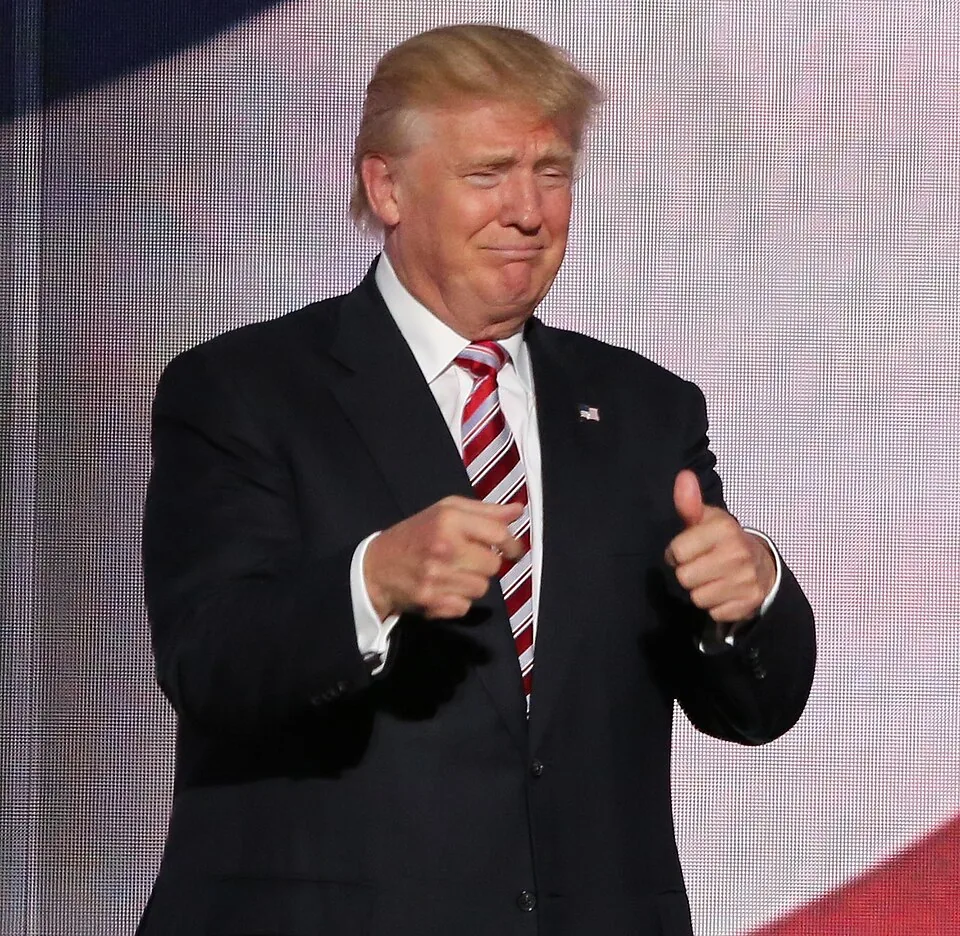
Donald Trump stood in front of a arena full of people in sparkly MAGA hats on Wednesday night and promised every adult American $5,000 if Republicans win Congress in November. There are roughly 270 million American adults. That's $1.3 trillion. He did not mention where the money would come from.
The Convention That Wasn't Really a Convention
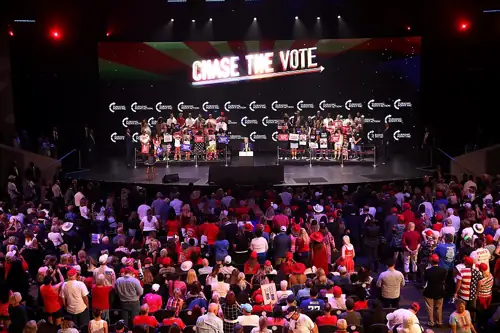
The Republican Party held what the BBC is calling its first-ever midterms convention in Dallas this week, a two-day event that looked like a presidential convention but functionally was not one. No party business was conducted. No platform was debated. It was, in the most technical sense, a very expensive pep rally.
The distinction matters because it tells you something about where the GOP is right now. The party does not need to conduct business. It does not need to deliberate or decide anything. It just needs Trump to stand at a podium and fire people up, and it needs people to go vote in November. That's the whole strategy. Senator Susan Collins and other Republicans running in competitive races didn't even bother showing up, which, given that those are exactly the races the party needs to win, should give someone pause.
It apparently gave no one pause.
"Pretend I'm On the Ballot." Sure, Why Not.
Trump opened by warning the crowd that the sitting president typically loses the midterms, which is true, and then offered his solution: "I'm asking you to pretend that I'm on the ballot."
Set aside for a moment that the leader of the free world just asked a roomful of adults to engage in a group act of political make-believe. What he was actually admitting, out loud, on the record, is that without his name on the ballot, his party struggles to generate the turnout it needs to win. The BBC reports that convention-goers were already debating his 2028 successor, with JD Vance and Marco Rubio getting the most mentions. Trump, for his part, showed zero interest in any of that. He is still the show, and the show is not over.
The structural problem this creates for Republicans is real and not going away. Trump cannot run again. Whoever follows him will not be him. And the party has spent the better part of a decade systematically clearing out anyone who might have built an independent political identity capable of filling that void.
Gas Is Expensive and the War Is Still On, But Trust the Process
Before flying to Dallas, Trump told reporters that Americans should expect to wait "a little bit longer than the midterms" before seeing any relief from high fuel prices. He then reiterated that message in his speech, arguing the economic pain from the ongoing war in Iran was a necessary cost to stop Tehran from getting nuclear weapons.
That is a genuinely difficult argument to make to voters who are watching prices climb. Polls have consistently shown cost of living as a top concern for Americans, and a Financial Times and Focaldata poll released just before the convention put Trump's approval rating at 33 percent among registered voters, a new low. Thirty-three percent. Running a midterm strategy around "stay the course" when a third of the country approves of you is a choice.
Many Republican candidates in competitive races were almost certainly hoping Trump would show up with something more targeted on inflation and a clearer off-ramp from the Iran conflict. Instead, they got the $5,000 thing.
The $1.3 Trillion Promise With No Details Attached
Here is what Trump actually said: if Republicans win both chambers of Congress in November, he will pay every adult American citizen $5,000. The only condition is that the money must be spent in the United States.
He offered no explanation of how this would be funded, how the government would verify where the money was spent, or whether this was a one-time payment, a tax credit, a check in the mail, or something else entirely. Democrats called it an empty promise. Legal experts questioned whether it was even constitutional. The BBC did the math: 270 million American adults times $5,000 equals $1.3 trillion. The crowd went absolutely wild.
To be clear about the scale here: $1.3 trillion is roughly what the United States spends on Social Security in a year. It is more than the entire defense budget. Trump did not gesture at any of this. He floated the number, the crowd roared, and that appeared to be the entire transaction.
What This Convention Was Actually For
Strip away the glitter and the vendor tables and the speeches, and what happened in Dallas was a turnout operation wrapped in pageantry. The Republican Party is genuinely worried about November. History is against them. The war in Iran is dragging. Trump's approval numbers are in the basement. The candidates they need to win in swing districts were too nervous to attend the party's own convention.
So they built a tent and filled it with the most loyal slice of the base they have, and they gave those people a show. The $5,000 promise will generate headlines. It will get shared. It will make a certain type of voter feel like something exciting is happening. Whether it does anything for the Republicans in suburban Philadelphia or suburban Atlanta who actually decide these elections is a different question entirely.
The Dingo Take
Trump just promised $1.3 trillion he does not have, to people who did not ask how he'd pay for it, at a convention where the candidates who actually need to win in November were too scared to show their faces. And the crowd loved every second of it. You are supposed to look at this and think it represents a political party with a governing vision. It does not. It represents a man who is very good at filling a room.
The 33 percent approval rating is the number that should be dominating coverage of this week. Not as a reason to celebrate, but as context. The president of the United States has the approval of one in three registered voters while asking the country to absorb economic pain from a war and wait for gas prices to come down after the election. "Pretend I'm on the ballot" is not a midterm strategy. It is a hostage negotiation where the hostage is the Republican congressional majority.
The $5,000 promise is going to work on some people, and that's the part that should genuinely bother you. Not because Trump is uniquely evil for making promises he can't keep, politicians do that constantly, but because the promise requires zero engagement with reality to generate applause. No funding mechanism, no legal framework, no math. Just a number and a cheer. That's the game, and it has been working for a decade. Whether it still works in November without his name on the ballot is the one question nobody in that arena seemed particularly interested in answering.


Comments