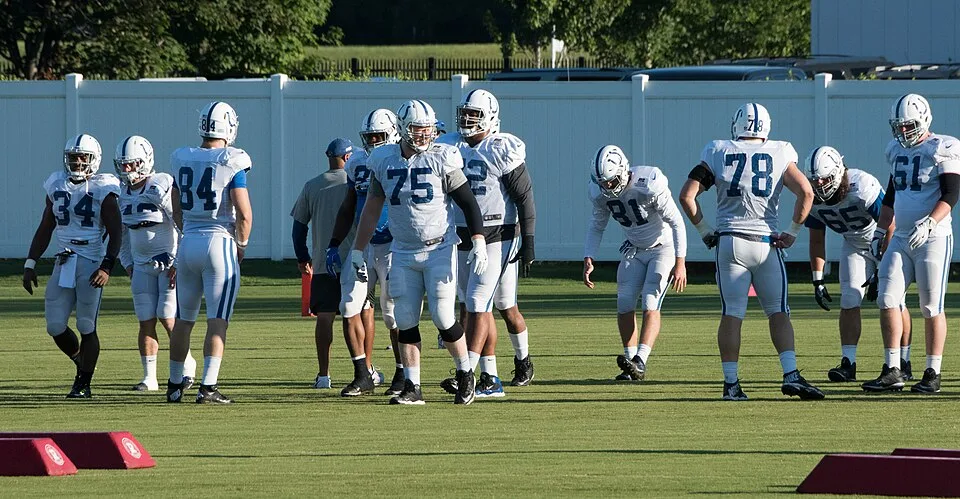
A man who doctors described as 'acutely psychotic with traumatic brain injury' was deported by ICE in June, and the agency would like you to know it's very proud of itself. Daniel Adongo, 37, the first Kenyan-born player in NFL history, was quietly removed from the United States on June 20 after a career that left him, by multiple medical accounts, with a shattered brain. ICE's response? They called him 'dangerous' and declared the community safer.
Who Daniel Adongo Actually Is
Adongo was not a household name, but his story is remarkable. A rugby player from Kenya, he was signed by the Indianapolis Colts in 2013 and became the first Kenyan citizen to ever play in the NFL. That is a genuinely extraordinary thing. The kind of story that gets made into a movie.
His NFL career ended in 2015. According to NBC News, he overstayed his visa in 2016, the year after he stopped playing. What followed was a years-long spiral that his lawyers and doctors attributed to the physical wreckage left behind by years of professional contact sports.
The Indianapolis Star reported that court records show Adongo had repeated run-ins with the law after his playing days ended. He was at times found incompetent to stand trial. A doctor who examined him at St. Joseph Regional Medical Center described him in a 2020 report as 'acutely psychotic with traumatic brain injury.' A mental health social worker who treated him for years suspected he had Chronic Traumatic Encephalopathy, the degenerative brain disease linked to repeated head trauma.
What CTE Actually Does to a Person
CTE is not a legal defense that lawyers invented to spring athletes from accountability. It is a documented, studied, horrifying disease that destroys the brains of people who spend their lives getting hit in the head for our entertainment. The NFL itself, after years of denial, officially acknowledged the link between football and CTE in 2016.
Here is the catch that makes this whole story even darker: CTE cannot be diagnosed in a living person. Only an autopsy can confirm it. So Adongo's doctors and social workers were working from symptoms alone, watching a man unravel and doing their best to name what they were seeing. According to NBC News, a 2024 survey found that about one-third of former NFL players suspect they have the disease.
We fed men into this machine for decades. We cheered. We bought jerseys. And when those men came out the other side broken, unable to hold it together, acting erratically in ways that got them arrested, we apparently reserve the right to deport them for the inconvenience.
The Charges That Actually Stuck
ICE's statement called Adongo a 'dangerous individual.' So let's be precise about what he was actually convicted of, because precision matters here. According to NBC News, Adongo was convicted of criminal mischief with damage, a misdemeanor, in 2020. He was sentenced to 364 days in jail but served six months with credit for time served.
That's it. That is the conviction. ICE also cited felony intimidation, battery, and disorderly conduct charges. Those were all dismissed. Every single one. Dismissed charges are not convictions. Charges that do not result in conviction are, legally speaking, not crimes. This is not a complicated concept.
The agency invoked the Laken Riley Act to justify his detention, a law that requires ICE to detain undocumented immigrants who are arrested on suspicion of certain crimes, not convicted of them. Critics have pointed out, accurately, that this effectively strips due process from people who have not been found guilty of anything. ICE did not specify in its statement which of Adongo's charges triggered the act.
ICE's Victory Lap
ICE Chicago Assistant Field Office Director Douglas Thompson issued a statement that deserves to be read slowly. 'This dangerous individual was clearly a threat to the community, which is now safer since he's been removed,' Thompson said, per NBC News. 'Those who violate immigration law are held equally accountable, including former professional athletes.'
The 'equally accountable' line is doing a lot of work there. What Thompson appears to mean is: we deported a man with a documented brain injury, a history of being found incompetent to stand trial, and one misdemeanor conviction, and we'd like credit for consistency.
The Department of Homeland Security did not respond to NBC News's questions about Adongo's mental health and possible brain injury. Of course they didn't. There is no good answer to those questions, so the strategy is to not engage with them at all and hope the news cycle moves on.
Where This Leaves Adongo
Adongo was removed to Kenya on June 20. NBC News was unable to reach him or confirm who his current legal representatives are. His previous attorneys did not respond to requests for comment. We do not know where he is, how he is doing, or what access he has to the mental health treatment he was receiving in the United States.
An immigration judge ordered his removal back in late March. The legal process here ground along and produced this result, and now a man who may have a degenerative brain disease caused by an American sport, watched by American fans, profited over by American billionaires, is gone. The community, we are told, is safer.
Adongo came to this country for an opportunity. He became a piece of sports history. The sport may have destroyed his brain. And the country that cheered for him deported him for a misdemeanor while he was, by medical accounts, not fully in control of his own mind.
The Dingo Take
There is a version of this story where the immigration enforcement is defensible. Visa overstay, arrests, a legal process that played out over years, a removal order from a judge. You can construct the argument. People do it every day.
But you have to be willing to hold the whole picture at the same time. A man found incompetent to stand trial. Doctors using words like 'acutely psychotic' and 'traumatic brain injury.' A disease that NFL players get from playing a game this country cannot get enough of, a disease the league covered up for years, a disease you cannot even confirm until the person is dead. One misdemeanor conviction. Dismissed felonies waved around in a press release as if charges and convictions are the same thing. ICE calling him 'dangerous' with the confidence of people who know nobody is going to push back hard enough.
The Laken Riley Act has made it easier to detain and remove people who were arrested but never convicted of anything. That is the stated, deliberate policy. Daniel Adongo is what that policy looks like in practice. He is not an abstraction or a talking point. He is a specific person, the first Kenyan to play in the NFL, probably brain-damaged from doing it, deported to a country he left decades ago, and ICE is out here taking a victory lap. Remember that the next time someone tells you this is just about the rule of law.



Comments