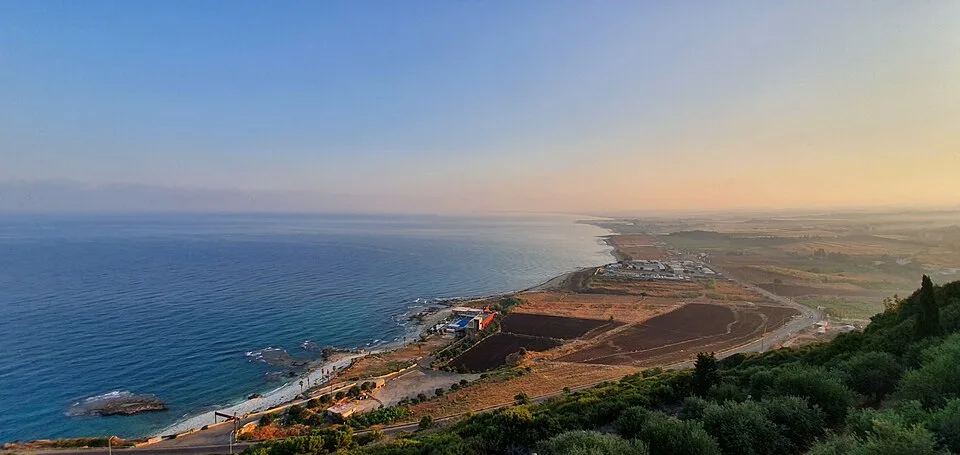
The residents of Yaroun, a village in southern Lebanon that Israel has largely reduced to rubble, cannot go home. They cannot send anyone to check on their homes. So they are doing the only thing left: pooling their money to buy satellite photos of their own neighborhoods, at $112 a pop, just to find out if anything is still standing. This is where we are in 2026.
180 Out of 200 Houses Gone
Yaroun sits 2,600 feet above sea level in southern Lebanon, a village of old stone houses, olive groves, citrus trees, and an oak forest that had stood for centuries. Or rather, it did. According to NPR, Yaroun's mayor, Hafez Ghacham, says Israeli forces have destroyed 180 of the roughly 200 houses in the village since fighting resumed in March of this year.
The Israeli military did not respond to NPR's requests for comment on the destruction. Which tracks, because what exactly do you say to that?
The landmarks are gone too. The Greek Catholic Saint George church, hit in an airstrike, is down to two outer walls. Three mosques, a Shiite religious center, a convent, and a Catholic school that educated both Christians and Muslims for fifty years have all been demolished. Village official Riad al-Ridha told NPR: 'They have erased it.'
The Satellite Photo Hustle Nobody Should Have to Run
Mazen Farah showed NPR satellite images on his phone of Yaroun's Christian quarter. Fuzzy but clear enough. Clear enough to show that his father's two-story stone house, built over 25 years of working in the Gulf, is gone.
Because Israel has barred the displaced from returning, even to visit, and because residents of neighboring villages fear Israeli retaliation for taking photos or video, people like Farah have resorted to crowdfunding commercial satellite imagery. Each image costs at least $112. They pool the money, submit the request, and wait. Often, NPR reports, the satellite provider comes back and says it can't supply images for those specific locations, then refunds the money. They try again.
And here's a detail that deserves its own paragraph: in April, some satellite companies declined to provide imagery of Lebanon and other countries at the request of the U.S. government. So the people trying to find out whether their homes still exist are being blocked by their occupier on the ground and, sometimes, by their satellite provider at the direction of Washington. The circle is complete.
How This Round of Fighting Started
The current escalation did not come from nowhere. NPR reports that in March, as the U.S. and Israel attacked Iran, the conflict widened again, pulling southern Lebanon back into the fire. Israel launched airstrikes on more than 100 villages, displacing hundreds of thousands of people. After an April 17 ceasefire, Israeli bulldozers moved in and continued demolishing buildings. Israel says it is targeting Hezbollah infrastructure. It rarely provides details or evidence to support those claims.
Israeli Defense Minister Israel Katz said in March that his country intended to depopulate all Lebanese villages near the border in order to permanently remove threats to northern Israel and establish what Israel calls a buffer zone. That is not an accusation. That is a quote from a sitting defense minister. He said the quiet part out loud, in public, at volume.
Geryes Saloum, a municipal employee who built a three-bedroom home in Yaroun a decade ago, told NPR he waits every day for a new satellite photo. 'When Mazen's house was destroyed three days ago I didn't sleep,' he said. He also pointed out that after the November 2024 ceasefire, the U.N. and aid organizations spent millions restoring water and electrical systems to these villages. 'We thought it was over, that there wouldn't be more wars,' he said.
The Convent That Israel Insists It Did Not Destroy
In early May, Israel demolished a convent in Yaroun. Israel then repeatedly denied that it had demolished the convent, even as satellite images and video showed the demolished convent. Israel provided images of a different building and argued, apparently with a straight face, that this was the convent they had not destroyed.
This is worth sitting with. The evidence exists. The building is gone. Israel's response was to point at a different building. NPR confirmed the destruction through satellite imagery. The Israeli military did not respond to NPR's requests for comment on the village's destruction overall. The demolition happened. The denial happened. Both are on the record.
Yaroun is part of the broader Galilee region, land where Jesus is believed to have preached and performed miracles, a place that has been continuously inhabited for millennia. The oak forest that stood for centuries is gone. What took generations to build is being unmade in a matter of months, and the people who lived there can only watch from satellite images on their phones.
The Dingo Take
Let's be precise about what NPR's reporting describes. A foreign military has expelled an entire civilian population from their homes, demolished 90 percent of the village, bulldozed churches, mosques, schools, and a convent, and is preventing the displaced from even visiting to see what's left. The displaced are literally crowdfunding satellite photos just to grieve properly. And when a satellite company catches images that document the destruction, the U.S. government can ask those companies to stop providing them. That is the situation. Read that sentence again if you need to.
The argument Israel makes, that all of this is about Hezbollah infrastructure, collapsed the moment Defense Minister Katz went on record saying the goal is to depopulate the border villages entirely. That is a policy of forced displacement. International law has a name for that, and it is not 'buffer zone strategy.' Calling it infrastructure targeting while your defense minister announces a depopulation agenda is not a contradiction Israel seems particularly troubled by.
People who built homes stone by stone, who raised kids in those homes, who are now living in displacement and paying $112 at a time just to confirm the worst, deserve to have the thing that is happening to them called what it is. The Dingo Daily is not going to call it a 'security operation.' Neither should you.




Comments