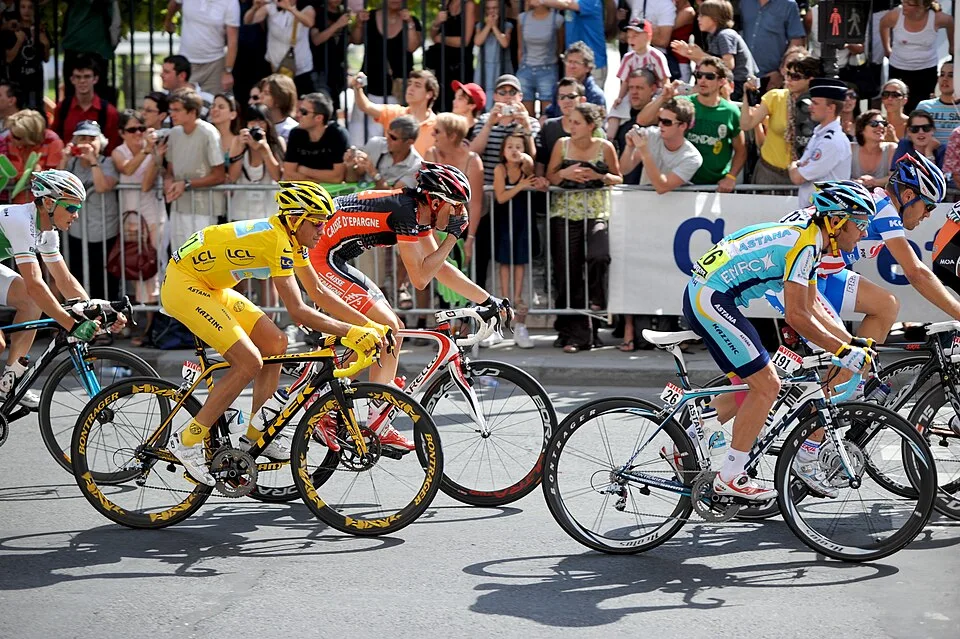
A fan fell into the road at the Tour de France's most iconic climb on Saturday, a team car screeched to a halt to avoid crushing his skull, and Colombian cyclist Einer Rubio had absolutely no time to react. He spent an hour getting his face put back together in a medical truck, got loaded into an ambulance to a hospital in Grenoble, and his Tour was over. Days from the finish line.
How It Actually Went Down
The New York Post reports that the crash happened in the final kilometers of Alpe d'Huez, during one of the most chaotic crowd scenes the race has seen in years. A spectator fell directly under a UAE team car. The driver, team manager Joxean Fernandez Matxin, hit the brakes hard enough to stop inches short of the man's head.
Rubio, riding behind the car at race pace, had no chance. He slammed straight into the back of the vehicle. Multiple facial injuries. An hour in the medical truck. Then the ambulance ride down the mountain to Grenoble.
Matxin wrote about the incident on Instagram afterward. 'A spectator unexpectedly burst onto the scene and fell right under our vehicle,' he said. 'My only reaction was to brake right away to avoid running over him. It all happened in a few tenths of a second.' He said he did not even know the extent of Rubio's injuries until he reached the finish line, at which point he called Movistar to apologize.
This Was Not an Isolated Incident
The Post also reports that a separate rider nearly crashed into a woman who was sprinting up the middle of the road with her back to the race, arms raised, cheering, completely unaware that professional cyclists were hurtling toward her at high speed. She got lucky. Rubio did not.
Even race leader Tadej Pogacar, who won the stage, had to physically usher fans out of his path while climbing. The man who is winning the Tour de France had to play crowd control during the most important moment of his day.
This is what the sport has allowed to happen on its most famous mountain. Fans who are drunk, or just genuinely oblivious to physics, pressing so close to the road that a guy nearly got his head run over by a team vehicle. The margin between 'wild fan experience' and 'someone dies on international television' is measured in inches and tenths of seconds.
The Calls for Change Are Getting Louder
Journalist Robyn Davidson wrote on X that 'something needs to change. Barriers, limiting numbers, even alcohol at this rate.' She added that observers could sense something was going to happen on Alpe d'Huez before the stage even started.
Cycling content creator Mihai Simon called the people responsible 'stupid,' which is blunt but hard to argue with given the footage. Presenter Joseph Ruiz said the Tour 'nearly experienced a dark moment,' which is doing a lot of work as an understatement when a man's head came within inches of being crushed under a vehicle.
The disorder is not a new problem on Alpe d'Huez. The climb has a reputation for the rowdiest crowds in cycling, which has historically been treated as part of the charm. The charm is wearing thin when professional athletes are getting carried off in ambulances.
Where Rubio's Race Ends
Einer Rubio was racing for Movistar. He is now out of the Tour entirely, DNF, done, finished, days before the race reaches Paris. According to the Post, he was bandaged at the scene before being transported to hospital in Grenoble. The extent of his injuries beyond 'multiple facial' has not been fully detailed publicly.
The driver who caused the chain reaction is not a villain here. Matxin made the only call a human being could make in that situation and almost certainly saved the fan's life. The question of who bears responsibility points further back than any individual decision made in a fraction of a second on a crowded mountain road.
Rubio's team called Matxin after the stage. Matxin had already called them. Everyone is sorry. Einer Rubio is still in a hospital in Grenoble.
The Dingo Take
Here is the thing about Alpe d'Huez. The crowd density, the noise, the chaos, the fans pressing onto the road so tightly that there is barely a lane left for the riders, all of that has been treated for decades as what makes it special. A spectacle. The wildest party in professional sports. And for a long time, you could make that argument because serious injuries were rare enough that the sport could keep pretending the setup was fine.
It is not fine. A man's head nearly got crushed under a vehicle. A professional cyclist is in a hospital with a destroyed face and a Tour de France that is over. Another rider nearly hit a woman who was running away from him at full sprint without knowing he was there. These are not freak accidents that could not have been anticipated. These are the predictable outcomes of cramming drunk, excited, untrained crowds onto a narrow mountain road with no meaningful physical barriers between them and athletes moving at lethal speed.
The Tour de France is one of the most-watched sporting events on earth. It has the resources, the influence, and frankly the obligation to do better than this. Barriers exist. Crowd limits exist. Alcohol policies exist. The tools are not mysterious. What has been missing is the willingness to use them before someone dies on live television, at which point everyone will be very sad and very sorry and very busy explaining why no one could have seen it coming.



Comments