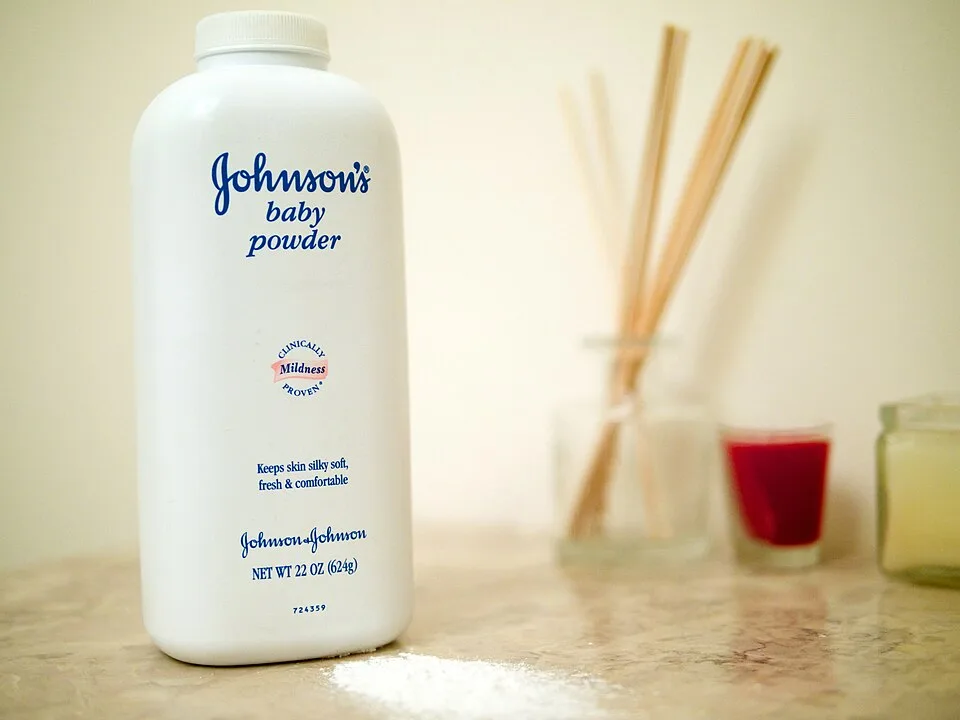
Johnson & Johnson has agreed to pay up to $5.5 billion to settle roughly 76,000 lawsuits claiming its baby powder gave people ovarian cancer. The company would like you to know, very sincerely, that its baby powder absolutely did not give anyone ovarian cancer. They're just paying five and a half billion dollars to clear the air.
The Settlement That Definitely Isn't An Admission Of Anything
According to BBC News, J&J announced Monday that it would offer up to $5.5 billion to resolve the vast majority of remaining talc-related claims against the company. The proposed deal would cover about 76,000 cases. That is not a typo. Seventy-six thousand individual lawsuits, most of them from people with ovarian cancer or their survivors, all pointing at the same white powder in the same iconic yellow bottle.
Erik Haas, J&J's vice president of litigation, described the allegations as "meritless" in the same breath as announcing the company would pay billions of dollars to make them go away. That is a sentence that should be read slowly, twice, out loud. Haas added that the settlement "allows the company to put this matter behind it." Five and a half billion dollars is a steep price to pay for something that apparently never happened.
How We Got Here: A Seventeen-Year Slow Burn
The BBC reports that lawsuits against J&J over its talc-based baby powder started as early as 2009. The core claim across tens of thousands of cases is that J&J's talc products were contaminated with asbestos, a known carcinogen, and that the company knew this and kept selling the stuff anyway. Talc is mined from the earth in seams that run close to asbestos deposits, which is a geological fact J&J has had to contend with in courtroom after courtroom for nearly two decades.
J&J's legal strategy over those years has been aggressive and expensive. The company tried twice to use a controversial bankruptcy maneuver to cap its liability, spinning off a shell subsidiary called LTL Management and immediately putting it into Chapter 11. Both attempts were thrown out by federal courts. When you can't go bankrupt your way out of a problem, apparently you write a very large check instead.
The company stopped selling talc-based baby powder in the US back in 2020, and by 2022 it had pulled the product globally, citing what it called a "worldwide portfolio assessment" and a decision to move to an all-cornstarch formula. The BBC notes that J&J's former consumer health spinoff, Kenvue, which owns Band-Aid and Listerine among other brands, holds liability for Johnson's baby powder outside North America. So this mess has tentacles.
The Fine Print That Makes This Deal Not Quite Done
Before anyone sees a dime, the BBC reports that legal firms representing at least 95% of the ovarian cancer claims in state and federal courts have to agree to the settlement terms. That is a high bar. J&J says it will offer up to $3 billion in the first payment next year, with no additional money due before 2028. So even if the threshold is met, the plaintiffs who have been fighting this company since the Obama administration are looking at a multi-year payout schedule.
Haas said J&J is "confident" it would have "ultimately prevailed with further litigation," pointing to a court victory earlier this month in which a federal judge questioned individual plaintiffs' ability to prove talc directly caused their cancer. Which is a fair legal point to make. It is also the kind of point you make right before offering $5.5 billion to stop having to make it in court indefinitely.
What J&J's Own Numbers Tell You
The company's position, stated clearly in the BBC's reporting, is this: "Studies show talc is safe, does not contain asbestos and does not cause cancer." J&J has won the majority of individual cases that have actually gone to trial. Their legal record is genuinely mixed, not a straight loss column.
But here is the context that matters. J&J's total talc-related legal exposure, if all 76,000 cases went to trial and the plaintiffs started winning at scale, could dwarf $5.5 billion. Settling is almost always a rational corporate calculation, not a confession. The problem is that when the number of people suing you over one product crosses five digits, the phrase "our product is safe" starts to sound less like a scientific statement and more like a legal posture. At some point the sheer volume of the claims becomes its own kind of testimony.
The Dingo Take
Let's be honest about what this settlement is and isn't. It is not proof that J&J's baby powder killed 76,000 people. Corporate settlements happen for all kinds of reasons, and "we'd rather pay than keep litigating for another decade" is a legitimate one. The American tort system is messy, and big companies sometimes settle meritless claims just to stop the bleeding. J&J is entitled to make that argument.
But it is also worth sitting with this: the product is gone. J&J quietly discontinued talc-based baby powder worldwide in 2022. The formula has been changed to cornstarch. The company spent years and untold legal fees trying to bury these claims in bankruptcy court before that gambit failed. And now they are writing what amounts to a $5.5 billion check to people they insist were never harmed. You can call that a rational business decision. You can also call it seventeen years of a healthcare giant grinding down sick people and their families in court while moving the product off shelves in the background.
The people who filed these suits are not abstractions. They are mostly women, many of them now dead, who used a product marketed to them as safe and gentle and literally meant for babies. Whether or not every single case is scientifically airtight, they deserve better than a VP of litigation going on the record to call their claims "meritless" on the same day the company hands over billions to settle them. Pick a lane.



Comments