
Americans are paying more for diesel than at any point in recorded history, and the guy responsible is now pitching a Venezuela oil deal as the fix. Diesel averaged $5.85 a gallon this week, according to the American Automobile Association, up from $3.71 a year ago and past the previous record set when Russia rolled tanks into Ukraine. That's not a blip. That's a war tax.
How We Got Here: The Strait of Hormuz Is Basically Closed
When the US and Israel went to war with Iran at the end of February, Iran did the one thing anyone paying attention knew it would do: it choked off the Strait of Hormuz. That narrow strip of water south of Iran moves roughly one-fifth of the world's oil supply. When it effectively closes, oil prices spike, and when oil prices spike, you feel it every time you fill up.
The BBC reports that fuel prices have tracked almost perfectly with wholesale oil costs since the conflict began. This is not mysterious. This is cause and effect playing out in real time at every truck stop and gas station in the country. The previous record came after Russia's invasion of Ukraine, and we're now past that. Let that sink in.
In Washington state, drivers are paying $6.81 a gallon for diesel. A year ago, it was $5.03. Western states get hit harder due to tax structures and how far the fuel has to travel from US oil producers, per AAA data. But this isn't a regional story. At $5.85 a national average, it is everyone's problem.
Gasoline Isn't Pretty Either
Diesel gets the headline because that's what moves freight, which means diesel prices eventually become the price of everything. But regular gasoline isn't doing great either. The BBC reports the average gallon of gas has hit $4.15, up from $3.20 a year ago.
That's a 30% increase in twelve months. Your grocery bill, your Amazon delivery, your local restaurant's food costs: all of it runs on diesel. All of it is going up. The pump price is just the most visible number in a much larger math problem that American households are currently losing.
Trump's Big Solution: Venezuela, Actually
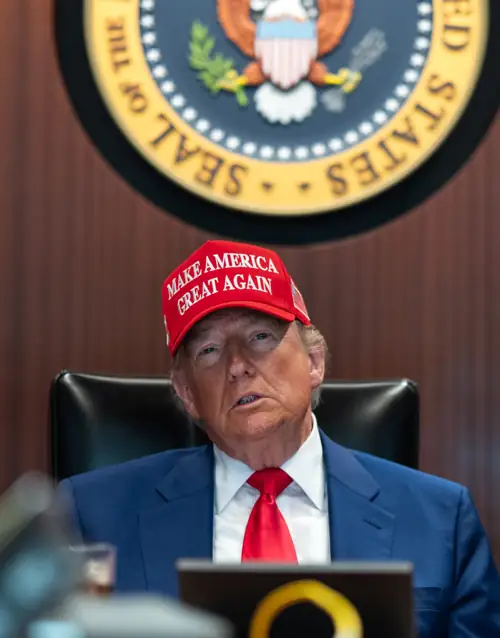
Faced with record prices and cratering poll numbers, Donald Trump announced a deal with Venezuela over the weekend that he's calling historic. The agreement, described by Interim Venezuelan President Delcy Rodríguez, calls for development of 17 strategic oil fields holding a proven potential of 65 billion barrels, plus what Rodríguez described as more than $100 billion in investment and $209 billion in taxes flowing to Venezuela.
A US official told CBS News that the US government would retain 55% control of a joint venture with a private operator in Venezuela. Trump, for his part, pledged to use the deal to "substantially lower Gas Prices for all Americans." The capital letters on Gas Prices are his.
One detail worth keeping in mind: the US invaded Venezuela in January. So the country Trump just signed an oil development deal with is a country the US invaded eight months ago. The deal is either a masterstroke of resource extraction following military conquest, or a chaotic mess that happened to produce a press release. Possibly both.
Analysts Are Not Convinced
The BBC reports that some analysts have reacted with outright skepticism, specifically questioning whether the Venezuela deal would actually overcome the long-running obstacles that have kept serious investment out of Venezuelan oil for years. Those obstacles include aging infrastructure, opaque governance, sanctions legacy, and a business environment that has historically been hostile to foreign capital even when the political situation was stable.
Venezuela has the largest proven oil reserves on the planet and has been dramatically underproducing them for decades. There are reasons for that. A press conference and a signed agreement do not make those reasons disappear. Getting 65 billion barrels out of the ground takes years of infrastructure investment and operational build-out, not a Saturday announcement.
None of that helps the trucker filling up next week.
The Political Price Is Already Coming Due
Americans are not happy. Recent Reuters/Ipsos polling, cited by the BBC, puts Trump's approval rating at 33%. Only 31% of Americans say they approve of the Iran conflict itself. With midterm elections coming in November, those are genuinely bad numbers for a party trying to hold onto congressional majorities.
High fuel prices have a long and consistent history of punishing whoever is in power when they hit. Trump spent years hammering Obama and Biden over gas prices in tweets that are now the stuff of greatest-hits compilations. He's now on the receiving end of that exact dynamic, and the Venezuela deal, whether it ultimately works or not, is clearly at least partly a political response to those poll numbers.
The gap between announcing a deal and having cheaper fuel at the pump is measured in years. The midterms are in November.
The Dingo Take
You are supposed to believe that a country the United States invaded in January just enthusiastically signed a mutually beneficial oil development partnership with us eight months later. You are supposed to believe that 65 billion barrels of Venezuelan crude, which will require years of drilling, pipeline construction, and operational buildout, is going to fix the diesel price before Thanksgiving. And you are supposed to believe a president sitting at 33% approval has this under control.
The Iran war is costing Americans real money, every day, in a form that is impossible to ignore. Five dollars and eighty-five cents a gallon for diesel is not an abstraction. It is the reason your groceries are more expensive, your heating oil bill is more expensive, and the small business owner who runs deliveries is quietly raising prices across the board. This is what resource wars cost when they don't go cleanly and quickly, and nothing about this one has gone cleanly or quickly.
Trump promised to lower energy prices. He is presiding over record-high energy prices caused by a war his administration is prosecuting. The Venezuela deal might be a genuine long-term play, or it might be a press release designed to move a news cycle before midterms. Either way, the guy filling up his truck at $6.81 a gallon in Washington state is not going to feel it either way before he votes.




Comments