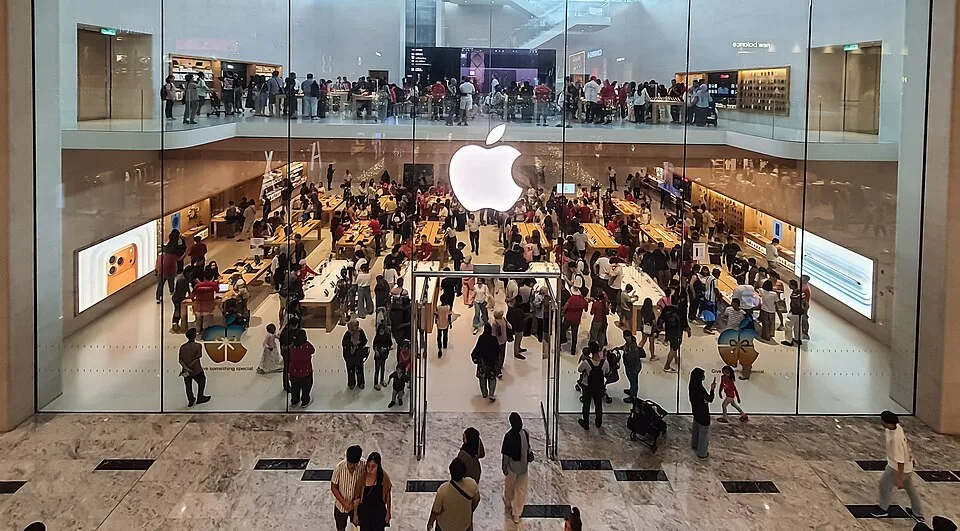
Nvidia spent months as the crown jewel of the global economy, the living symbol of AI mania, worth more than any company on earth. Then Monday happened. One news story, one five percent drop, and Apple quietly walked over and picked up the crown while Nvidia was still checking its phone.
What Actually Happened Monday
The Wall Street Journal reported that Nvidia is in talks to funnel roughly $250 billion into a massive data-centre project for OpenAI. That number is so large it sounds made up, and apparently investors thought so too, because Nvidia shares dropped 5% almost immediately. The BBC has contacted both Nvidia and OpenAI for comment, and neither has confirmed the deal.
That single day of losses was enough to hand Apple the title of world's most valuable listed company. Apple, which has spent the better part of 2025 and 2026 doing comparatively boring Apple things, rose about 25% this year and was sitting right there, waiting. When Nvidia stumbled, Apple stepped over the body. The iPhone maker is now, once again, number one.
This is the part where you remind yourself that Apple's valuation surge is itself not entirely disconnected from AI hype. Nobody is clean here. The whole market is one big house of cards and everyone is arguing about whose cards are the nicest.
South Korea Had an Absolutely Catastrophic Tuesday Morning
If you want to see what panic selling looks like in real time, look at what happened in Seoul. South Korea's benchmark Kospi index dropped so fast on Tuesday morning that trading had to be paused for twenty minutes under an emergency mechanism called a circuit breaker, which exists specifically to stop markets from eating themselves alive. The BBC reports the index still closed 10.8% lower after trading resumed.
Samsung Electronics and SK Hynix, two of the most important chip manufacturers on earth, both fell by more than 13% in a single session. SK Hynix is particularly bruising to watch right now. The company made a record-breaking Nasdaq debut on July 9th at $149 per share. By Monday, its US-listed shares had already fallen to well below that offer price, according to the BBC. Three weeks. That's how long the optimism lasted.
The Kospi has now triggered its circuit breaker multiple times this year alone. The index had more than doubled between January and mid-June, an absolutely insane run driven heavily by retail investors piling into tech stocks. It has since lost around a third of that value. Korean retail investors who bought in near the peak are having a very bad summer.
Japan Also Got Dragged Into It
South Korea did not suffer alone. Japan's Nikkei 225 closed almost 4% lower on Tuesday, as reported by the BBC. The Nikkei is similarly stacked with tech companies, so when AI stocks catch a cold, Tokyo sneezes too.
This is the interconnected joy of global markets in the AI era. A rumored deal between two American companies gets reported in a New York newspaper, and within 24 hours stock markets across Asia are triggering emergency halts. The butterfly effect, except the butterfly is a $250 billion data-centre rumor and the hurricane is an entire continent's retirement savings.
There Is a China Wrinkle in All of This
While American and Asian chip stocks were getting obliterated, something interesting was happening in Shanghai. ChangXin Memory Technologies, China's biggest memory chip maker, made its debut on the Shanghai stock exchange Monday and soared nearly 470%, per the BBC. Nearly 470 percent. On day one.
CXMT makes DRAM chips, the same kind that power AI data centres, phones, and computers. The company said it plans to use IPO proceeds to boost production and fund more research and development. In other words, China is building exactly the kind of domestic chip capacity that American and South Korean companies are terrified of.
Jun Bei Liu, founder of investment firm Ten Cap, told the BBC that investor concerns are centered on two things right now: the sheer volume of money being poured into AI development globally, and rising competition from China. Those two anxieties are not unrelated. The more credible Chinese chip manufacturers become, the shakier the premium valuations on Western AI plays start to look.
Is This the Crash or Just the Wobble?
Liu told the BBC that investors are likely just "taking some profit off the table" and will probably reinvest in these stocks after the US holiday season. That is the optimistic read, and it may well be correct. Markets go up, markets go down, AI is genuinely transformative technology and the money will come back.
But it is worth sitting with the other possibility for a moment. Nvidia's valuation, before Monday, was built on the premise that AI infrastructure spending would grow indefinitely and that Nvidia would capture most of it. The $250 billion OpenAI deal rumor, if anything, is evidence that spending is still accelerating. And yet the market punished Nvidia for it. Investors looked at a quarter-trillion dollar bet on AI and said, actually, that makes us nervous.
At some point the question stops being whether AI is real and starts being whether these specific valuations are real. Those are two very different questions, and right now the market seems to be working through the distinction in real time, loudly, in front of everyone.
The Dingo Take
Here is the thing about the AI stock boom: it was never really about AI. It was about the story of AI. Nvidia became the most valuable company on earth not because anyone had fully figured out what large language models are actually worth, but because the narrative was irresistible. Infinite growth. Transformative technology. Get in now or regret it forever. That story made Nvidia worth more than the GDP of most countries.
Monday was the day a single Wall Street Journal article reminded everyone that a $250 billion bet is still, technically, a bet. The math on infinite AI spending has always required you to not look too closely at the denominator. Now people are looking. South Korean retail investors who doubled down on the Kospi at its June peak are discovering that "the future of technology" is a rough thing to have as your retirement plan.
The CXMT story is the one that should keep American executives up at night, though. While Nvidia was losing its crown and Seoul was triggering circuit breakers, a Chinese chip company debuted in Shanghai and popped 470% in a single day. China is not waiting around for export controls and diplomatic scolding to fix themselves. They are building. The AI race is real. The valuations attached to winning it might be a different matter entirely.





Comments