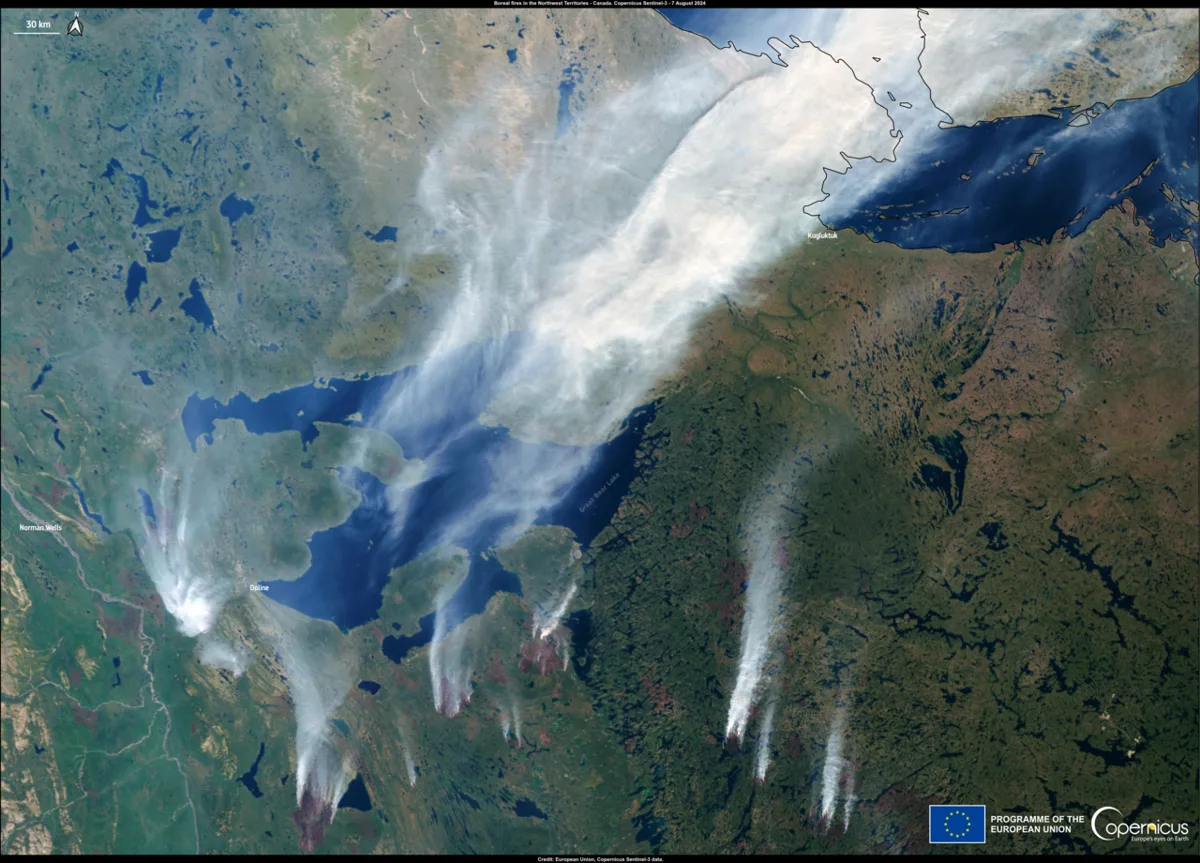
A wildfire burning in southwestern France got so enormous and so hot that it generated its own electrified thundercloud, complete with lightning, violent winds, and brand-new fires. That is not a metaphor. That is what is happening right now in Europe, where two firefighters are dead, a third of a million people have been driven from their homes, and the blaze in France's Gironde region has spread to roughly four times the size of Paris.
A Fire That Makes Its Own Weather
Let's start with the thing that should be on the front page of every newspaper on earth. At some point during the Gironde wildfire, CBS News reports, the blaze generated a pyrocumulonimbus cloud. That is a fire thunderstorm. A column of superheated smoke so massive and so energized that it became its own storm system, producing lightning, violent wind gusts, and igniting new fires beyond the original front.
It was the first pyrocumulonimbus ever recorded in France. Scientists have documented them in Australia, Canada, and the American West. Europe is now in that company. Burn enough of a continent and eventually the fire stops waiting for bad weather and just makes some.
The Gironde region's blaze has consumed pine forests and scrubland that spent the summer baking under successive heat waves. Météo-France described Wednesday as the hottest and driest day of the week, with elevated wildfire danger across every single region of France. Drought now covers all of mainland France and Corsica, with soil moisture approaching the record lows recorded in August 2022. The land is not kindling. It is a fuse.
How This Started: A Brush Cutter Near a Power Line
Here is the maddening part about how this all began. According to CBS News, investigators believe the Gironde inferno was sparked by contractors doing routine brush-clearing work near a high-voltage line for power-grid operator Enedis. The work appeared to comply with regulations. Nobody did anything dramatically wrong. A machine cut some brush next to a wire on a day when the ground was bone dry and the air was hot enough to cook with, and now four times the landmass of Paris is ash.
Bordeaux prosecutor Renaud Gaudeul confirmed the suspected cause. There is a grim lesson buried in there about what climate change actually does to risk. Rules written for a wetter, cooler world do not account for conditions where a compliant, routine operation can trigger the largest peacetime evacuation France has seen since World War II. That is not hyperbole. French authorities used those exact words.
More than 2,200 firefighters and over 20 aircraft are still deployed in Gironde alone, backed by crews from across France and partner nations across Europe. Fire commander Matthieu Jomain told reporters they were striking "quickly and hard at any new smoke emissions." When your fire generates its own lightning, fast response is about all you have left.
330,000 People Gone, and Counting
At the peak of the crisis, roughly 330,000 people were evacuated across France and Spain combined. In Gironde alone, more than 250,000 received evacuation orders over a single weekend. CBS News reports that authorities described it as potentially the largest peacetime evacuation in France since the Second World War. Read that sentence again slowly.
The movements were simultaneously massive and chaotic. Gironde prefect Sophie Brocas authorized 60,000 evacuees to return to three Bordeaux suburbs untouched by flames, even as 4,000 more people on the Atlantic coast were ordered out of tourist sites the same day. Thousands going home with relief while thousands more grabbed emergency bags and left. That tension captures exactly how volatile the situation remains.
In Spain, some ground was recovered. About 20,000 people in the Madrid region had evacuation orders lifted, and stay-at-home restrictions ended for another 14,000 near Ávila. But 10,000 people remain under evacuation orders in Castellón, where fires were still active as of the reporting. Progress is real. It is also fragile.
Two Firefighters Dead in Crete
While France commanded most of the headlines, two firefighters died Wednesday battling a wildfire in the Rethymno region of Crete. Greece's fire department confirmed the deaths and said the pair died "in the line of duty to protect the lives and property of citizens and the natural environment." The circumstances of their deaths were not immediately clear.
About 125 firefighters were battling the Crete blaze at the time, supported by four helicopters and four water-dropping aircraft. The deaths are a reminder that behind every satellite image of orange-glowing hillsides, there are people physically standing between the fire and everything it wants to consume.
Europe's wildfire emergency now stretches from the Atlantic coast of France and Spain to the eastern Mediterranean. High temperatures, drought, and powerful winds are degrading containment efforts across the entire region simultaneously. This is not a series of separate emergencies that happen to be occurring at the same time. This is one emergency with a very large footprint.
Civilians Filling the Gaps
With official resources stretched across an enormous front, ordinary people have stepped in. At Souge, volunteers worked the edges of dirt firebreaks while a local digger driver plowed through still-burning soil trying to hold a line before the expected west wind arrived. In Lacanau, residents pumped water from a lake into tanks bound for firefighters' cisterns, CBS News reports.
"If one day the fire starts in our neck of the woods, I know very well that all the people here would do the same for us," said Flavien Dubuch, 33, who drove to the fire zone from Saint-Émilion with his father. That quote will not trend on social media. It should.
Meanwhile, Gironde's wine-tourism industry is watching the peak summer season collapse in real time. Edouard le Grix de la Salle, who runs Château du Grand Verdus, told the Associated Press that official warnings to avoid the region were gutting the trade. "How did they not think about protecting that sector?" he asked. A fair question. Also a question that somewhat misses the scale of what is happening, but you can understand why a man watching his livelihood burn would ask it.
The Dingo Take
A wildfire that generates its own thunderstorm is not a natural disaster in any sense we used to understand that phrase. It is a data point. It is the climate system sending a memo written in smoke and lightning, and the memo says: the rules you built civilization around no longer apply.
Europe has spent the summer watching heat records fall, rivers dry up, and harvests fail. The Gironde fire is the most dramatic single image of that collapse, but it is not an outlier. It is the direction. Soils approaching record dryness. Drought covering an entire country. A brush cutter operating inside the law igniting a catastrophe the size of a major city. The risk has been recalibrated upward, and the regulations, the infrastructure, and the political will to respond have not kept pace.
Two people are dead in Crete. A third of a million people lost weeks of their lives to forced evacuation. France's largest peacetime displacement since World War II happened because someone legally trimmed some plants near a wire on a hot day. If that does not register as a crisis requiring a response proportional to its actual scale, then the next fire will make the same argument, just louder.



Comments